
Two worthies were overheard mulling recent political developments
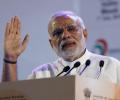
Modi denies the charges and was exonerated in an Indian Supreme Court inquiry in 2012.

A day after an Ahmedabad court accepted the Special Investigation Team's closure report giving clean chit to Narendra Modi in the Gulberg Society massacre case, the Bharatiya Janata Party on Friday demanded an apology from the Congress for carrying out a "vilification campaign" against him after the Gujarat riots.

The Sikkim government is planning to convert an artificial lake, formed by a massive landslide in the state's northern part in August last year, into a tourist spot.

The television channel is in hot water for not having made a public announcement in 2009 of a 'change of control' of the company.
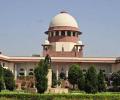
The apex court is hearing its two-decade-old 'Hindutva' judgement for an authoritative pronouncement on electoral law categorising misuse of religion for electoral gains as "corrupt practice".

The writers, artistes, thinkers and academics had gathered for a "resistance" meet (Pratirodh) against what they described as "attack on reason, democracy and composite culture".
Religion or caste is a key part of India's political discourse, the Supreme Court observed on Wednesday and asked whether seeking of votes on that basis would amount to "corrupt practice" under the election law.

We're behaving like frogs in warm water. We swim around untroubled, cooled by our faith in Indian liberal democracy. We are blind to the bubbles popping around us, the bubbles warning of fundamental changes, says Mihir S Sharma.

For the past, blame the Congress. For the present, blame the Congress. For everything, blame the Congress. But for your future, vote BJP.

The charming town of Pelling can strike a balance between commerce and conservation

The court said it has decided to award imprisonment for life without any time frame to the 11, who have been convicted for murder, while requesting the state not to use its power to remit the sentence after 14 years of imprisonment.

'Since Modi is walking a tightrope between two worlds -- one of the saffron brotherhood and the other of the proposed smart cities and bullet trains -- it is understandable why he is averse to scrutiny lest he loses his balance by tilting too heavily on one side or the other. But, why has Sonia Gandhi acquired the reputation of a sphinx,' asks Amulya Ganguli.

Of the thousands of railway bridges in India, 36,470 are more than 100 years old, and 6,680 are more than 140 years old! But of these, only 21 rank on the Heritage Directorate of the Indian Railways because for them heritage isn't necessarily a function of age, says Bibek Debroy.

Of the 24 convicted, 11 have been convicted for murder and 13 for other charges.

Rajesh Karkera relives exciting and eerie moments following a tigress.

By revising the India-Bangladesh land boundary agreement, the NDA is going for short-term gains and losing the long-term perspective, says Gautam Sen.

'Maybe what the lady in Sex and the City said was right-- that maybe our girlfriends are indeed our soulmates and guys are just people to have fun with.'

'To suggest that activists -- and that too 'five star activists' -- are driving the courts, is to betray an ignorance of the functioning of the legal system of the most gross kind,' says Senior Advocate and former Additional Solicitor General Indira Jaising.
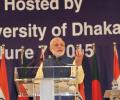
In a blunt attack on Pakistan, Prime Minister Narendra Modi on Sunday accused it of creating "nuisance" and "constantly" troubling India by promoting terrorism.

Prime Minister Narendra Modi has done the seemingly impossible by finalising the long-pending Land Boundary Agreement ahead of his Bangladesh visit, writes Prakash Bhandari.

Prime Minister Narendra Modi's initial weeks in office and the composition of his national security team give a sense of his government's foreign policy and national security priorities, says Harsh V Pant

Time to pack your bags and pamper the wanderlust in you.

An accused D G Vanzara gets bail months after Modi emerges as PM and hails it is as a return of 'Achche Din' while the blind-folded lady justice, almost mocks the rest of us, by suggesting that nobody is guilty for the cold blooded killing of Ishrat Jahan, Kauser Bi and the 2,000 odd innocent people in Gujarat, says Shehzad Poonawala.


How many of these will you include in your travel list for 2016?

How many of these have you tried already?

B S Prakash takes a tongue-in-cheek look at what India's neighbours think about the proposal of a SAARC satellite.
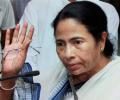
Banerjee along with other regional leaders are likely to play an important role in any future government in New Delhi, so it is in India's interest that regional leaders like herself realise the importance of progressive economics and good governance, says Tridivesh Singh Maini.

'Foreign policy-making cannot be shifted out of Delhi and the regional satraps, who do not have a national perspective, should not be allowed to dominate foreign policy. But regional inputs should be integral to foreign policy-making at every step of the way,' says Ambassador T P Sreenivasan.

'Crafting a coherent, transparent and consistent policy vis-a-vis our neighbours, leave alone the rest of the world, is unlikely to be high on the priority list of the new Indian government, which will be sworn in before June,' says Ramananda Sengupta.

Narendra Modi's promise to allow states a bigger say in strategising and building foreign policy is unexceptionable, says TP Sreenivasan.

Abstaining from voting on a UNHRC resolution on Sri Lanka was dictated as much by necessity and self-preservation as by a desire to place bilateralism at the front and centre of New Delhi's ties with Colombo, says Ramesh Ramachandran.

A journalist must perform various roles, be passionate yet detached, feels Gopalkrishna Gandhi

Those who know Shiv Shankar Menon will vouch that he did lots of things, substantial in the immediate neighbourhood and widespread in South Asia, but without making things public. Twenty per cent of Menon's job was visible, while 80 per cemt of his job was not known to the public, says Sheela Bhatt/Rediff.com

'If the State does want to come after you, in India, it can do pretty much anything. And often it isn't as though the orders are coming from the President or prime minister, no, the systems have been built in a way -- or we have allowed them to be built in a way -- that almost encourages crushing of liberties.'
