
The Indian Parliament has passed a bill amending the Transgender Persons (Protection of Rights) Act 2019, focusing on biological discrimination and excluding social orientations from its scope. The bill aims to provide legal recognition and protection to transgender individuals facing discrimination due to biological issues, while also introducing graded punishments for harm inflicted on them.

Government floor managers are busy talking to Opposition members to resolve the stand-off over Minister Sadhvi Niranjan Jyoti's remarks, in the Rajya Sabha.
Opposition MPs and transgender rights activists are urging the withdrawal of the Transgender Persons (Protection of Rights) Amendment Bill, 2026, citing concerns that the proposed changes could weaken the rights of transgender individuals.
Opposition MPs and transgender rights activists are calling for the withdrawal of the Transgender Persons (Protection of Rights) Amendment Bill, 2026, citing concerns that the proposed changes could dilute the rights of transgender individuals.
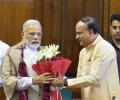
Modi expressed surprise at the stand of the opposition as members of all parties had been urging him for bringing the legislation

Officials said the government is keen to conform to the convention of the Union Budget for 2026-2027 being presented on February 1 despite it falling on a Sunday in 2026.

Opposition parties in India have submitted notices seeking the removal of Chief Election Commissioner Gyanesh Kumar, citing concerns over his appointment, conduct, and alleged manipulation of electoral processes.

Opposition MPs in India have moved notices in Parliament seeking the removal of Chief Election Commissioner Gyanesh Kumar, accusing him of bias, misconduct, and acting under the influence of the executive.
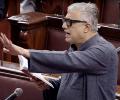
Trinamool Congress floor leader Derek O'Brien was suspended from the Upper House of Parliament on Tuesday for the remaining part of the Winter session after he threw a Rajya Sabha rule book at the Chair.

The Congress party in Haryana boycotted a special session of the state assembly, accusing the ruling BJP of using the platform for political propaganda related to a defeated Constitution amendment bill on women's reservation. The BJP criticised the Congress's move as anti-women.

Shah defended the government for not filing an appeal against the acquittal of all four accused, including the radical right-wing's Swami Aseemanand, in the 2007 Samjhauta Express blasts case.

"We, the undersigned parties, wish to register our anguish and serious concern over the manner in which the Government is hurriedly passing legislations without any scrutiny by Parliamentary Standing or Select Committees. This is a fundamental departure from the established practice and healthy traditions of enacting legislations," the letter said.

The National Sports Governance Bill was on Tuesday passed by the Parliament with Rajya Sabha giving its nod a mere 24 hours after Lok Sabha.

After a 6.5-hour debate, the upper house clears the bill. Amit Shah said the bill is not anti-Muslim and Indian minorities have nothing to fear from its passage.

The Rajya Sabha on Tuesday passed a bill on protection of rights of transgenders after a motion to refer it to a Select Committee of the Upper House was defeated.

Three laws passed in Parliament could boost central revenues, reshape GST cess flows, shift MGNREGA costs to states and create new budget headroom ahead of the 2026-2027 Union Budget, points out A K Bhattacharya.

Chadha thanked people for their love and blessings that he received during the period of suspension.

Opposition charged the government with making Parliamentary Standing Committees irrelevant.

Union ministers said Parliament passing over two dozen Bills was evidence of increased productivity of Narendra Modi government 2.0.
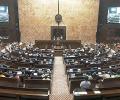
The Waqf (Amendment) Bill, 2025 was passed in the Lok Sabha early Thursday, with 288 members supporting it and 232 against it.

Sushmita Dev said it would have been better if there were more women MPs in the panel.
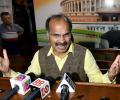
Congress leader in Lok Sabha Adhir Ranjan Chowdhury and some other MPs suspended from Parliament will not be able to attend the meetings of parliamentary committees of which they are a member or chairperson till their suspension is revoked.

The proposed law seeks bars on storing and processing of personal data by entities without the explicit consent of an individual. It, however, provides for exemptions for "reasonable purposes" such as "prevention and detection of any unlawful activity including fraud, whistle-blowing, merger and acquisitions, network and information security, credit scoring, recovery of debt, processing of publicly available personal data and the operation of search engines".

Salient features of the National Sports Governance Bill that promise to overhaul several aspects of sports governance and the grievance redressal system for athletes and administrators alike in the country.

Ramesh says that since the attitude of the Narendra Modi government is deliberately provocative and confrontational, it should not expect cooperation from the Congress.

Taking a leaf from the US, Canada and the UK, where students and research scholars get to work with Parliamentary panels, Lok Sabha Speaker Sumitra Mahajan is pushing for induction of interns in the Parliamentary standing committees.

Currently, the select committee is considering the Bill.
This after high drama in the House over what opposition charged was "intimidation" by the treasury benches to get the motion for sending the amendment to the RTI Act to the select committee rejected.

Launching a scathing attack on Prime Minister Narendra Modi, Opposition parties on Wednesday alleged that selective leak of information on demonetisation of 500 and 1000 rupee notes to 'friends of BJP' and demanded making public the names of those who had bought gold and foreign exchange of over Rs 1 crore since April.
Leader of Opposition Mallikarjun Kharge and some other members sought that the bill be referred to a standing committee for scrutiny.
Amid a stalemate between the government and the Opposition over the issue, the House failed to transact any significant business and was adjourned for the day.

Rejecting the demand for referring Insurance Bill to a Select Committee, the government on Thursday said the Congress was 'stonewalling' the key reform measure to deny credit to Prime Minister Narendra Modi before he goes to the United States.

The Insurance Laws Amendment Bill is likely to come up in the Rajya Sabha on March 12 for consideration and passage.

Consensus building is likely to be the biggest casualty.

'Non-BJP state governments and their leaders, navigating today's political landscape, know well they have no clue what awaits around the corner.' 'The chances of charges pressed and oneself getting parked in custody play out on an uneven playing field,' points out Shyam G Menon.
The former Union home minister claimed that the provisions in the bill can be misused as the police can arrest and take fingerprints and DNA samples of even those who are taking part in political rallies.

Successors of those who migrated to Pakistan and China during Partition will have no claim over the properties left behind in India, with Parliament on Tuesday passing a bill to amend a 49-year-old law.
After 17 tumultuous years, a nationwide Goods and Services Tax (GST) will rollout from midnight of June 30, overhauling India's convoluted indirect taxation system and unifying the $2 trillion economy with 1.3 billion people into a single market.

Among the parties that boycotted the proceedings of the House included the Congress, which was the among the first to walkout, followed by members of the CPI-M, CPI, TMC, NCP, SP, Shiv Sena, RJD, DMK, TRS and AAP.

Congress MP Mohammad Jawed and AIMIM president Asaduddin Owaisi have challenged the validity of the Waqf (Amendment) Bill, 2025 in the Supreme Court, arguing that it violates constitutional provisions. The petitions claim the bill imposes arbitrary restrictions on Waqf properties and their management, undermining the religious autonomy of the Muslim community. They also allege that the bill discriminates against Muslims by imposing restrictions not present in the governance of other religious endowments. The bill was passed in the Rajya Sabha and Lok Sabha, with the petitioners arguing that it introduces limitations on the creation of Waqfs based on the duration of one's religious practice, mandates inclusion of non-Muslim members in Waqf administrative bodies, and shifts key administrative functions to government officials, thereby diluting the autonomy of Waqf management.
 © 2026 Rediff.com - Advertise with us - Disclaimer - Privacy Policy - Sitemap - Feedback - About us - Terms of use - Grievances