
In July, tension emerged in Taksing, a remote village in the Upper Subansiri district of Arunachal Pradesh after locals sighted PLA soldiers.

Congress general secretary Jairam Ramesh has alleged that the BJP's "real and ultimate target" in seeking a two-thirds majority in the Lok Sabha is to amend the Constitution to end reservation, rather than genuinely implement women's reservation.

Through his commitment to democratic norms, debate, dissent and constitutionalism, Jawaharlal Nehru helped ensure that parliamentary democracy took deep root in independent India. Utkarsh Mishra evaluates Nehru's 17 years as India's first prime minister, examining his role in nation-building, democratic institution-building, economic planning, scientific advancement and foreign policy.

'After the Galwan clash, the rules of engagement changed with the army commanders allowed to use any means at their disposal as they deem fit for tactical operations.'

'China continues to perceive its relations with India through the prism of India-US relations, with the US using India to counter balance against China in the Indo-Pacific and beyond.'

The fierce battles of Galwan, Rezang La, Gurung Hill, and Walong taught the PLA a hard lesson: Fighting the Indian Army would never be easy or inexpensive.
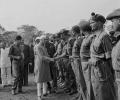
The well-fought defensive battles in Aksai Chin and eastern Arunachal, in remote and forbidding locations such as Galwan, Rezang La, Gurung Hill and Walong, effectively halted Chinese advances not once but twice during the campaign. These engagements, fought with grit and without adequate support, were not immediately known to the world in 1962, points out Dr Kumar.
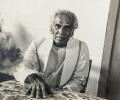
What appeared to be a generous act of friendship was, in truth, a manoeuvre within a much larger strategic game. The United States used the 1962 war not just to aid India but to test how far it could be pulled into the Western fold, points out Dr Kumar.

China, often considered the world's manufacturing muscle, is strengthening its software and outsourcing businesses too. India, beware!

India emerged from the war militarily bruised and strategically altered. The United States, under the guise of friendship, had succeeded in achieving what open alignment never could: The psychological and political repositioning of India within the Cold War order, points out Dr Kumar.
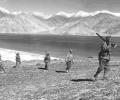
As India and China continue to face off across the Himalayas six decades later, the echoes of that earlier conflict remain unmistakable. The core of China's sensitivity lies not in maps or mountain passes, but in its perception of sovereignty over Tibet, points out Dr Kumar.

'There are times when India should stand up without hesitation and voice its indignation over the US' pressure tactic. This is one such moment,' asserts Ambassador M K Bhadrakumar.
While we are prepared to help the Chinese catch up with us in IT, they are not prepared to help us catch up with them in the engineering sector. They consider us rivals.

Prime Minister Narendra Modi and Chinese President Xi Jinping are expected to hold bilateral meetings on the sidelines of the SCO summit in Tianjin, as both nations look to strengthen ties amid global trade tensions.
Pranab Mukherjee was right when he suggested in Beijing sometime back that India-China relations will be one of the more significant factors that will determine the course of human history in the 21st century. If the present indications are anything to go by, human history is in for some tough times ahead
China appears to be making ground for claiming some 1,600 kms of Indian territory judging by reports in the state-owned media. Even as the two countries have been discussing the unresolved boundary issue for decades, the state-owned Xinhua and Global Times, an English language newspaper published by the People's Daily, the official mouthpiece of the ruling Chinese Communist Party, have described the Sino-Indian border as nearly 2,000 km long.
Buddhism, which spread from India to China 2,000 years ago, will play a new role in cementing Sino-Indian friendship and enhancing cultural contacts, China's top religious official has said.
Interacting with visiting reporters recently at the command's headquarters in Shillong, Barbora, the first officer from the northeast to head an IAF command, recollected the Chinese agression in the north-east in 1962.
work on the proposed custom station in the Chumthang belt, the gateway to Chinese Tibet, has already begun, says the Daily Times.

India is responding swiftly to the intended Chinese encroachment in a region it has seen as its traditional sphere of influence. The Indian Ocean is becoming the latest theatre of Sino-Indian rivalry, with China straining to breach India's old intimacy with island nations like the Maldives and Mauritius and sparking a diplomatic battle between the two countries.
Describing the Sino-Indian border row as a "complex issue", Chinese Premier Wen Jiabao on Tuesday said it cannot be resolved overnight and that "new progress" would be made in the negotiations as long as both countries showed sincerity and "mutual accommodation". "It is no easy task to resolve such a complex issue left from the past and we cannot expect that the issue will be resolved overnight," Wen said.

At the end of the discussion, the older Monpa said that if today the Chinese were to come inside India, "I will fight and kill them", prudently adding, "if they are of my age, if they are younger soldiers, I will not be able to fight". The entire village had a good laugh.
Sino-Indian trade is set to cross the $10 billion-mark this year for the first time and New Delhi is determined to further diversify and strengthen bilateral ties, Indian Ambassador to China, Nalin Surie has said.
India and China will hold joint military exercises next year and no such drill is planned for this year, the government said on Thursday.
The boundary question may not affect the present comfort level in bilateral ties, as both sides agree to look beyond the border dispute in promoting relations with each other. One cannot be optimistic, however, about the likely scenario in the long run.
Sino-Indian strategic relations are expected to get further fillip during the second innings of Chinese Communist Party chief Hu Jintao, who is all set to offer a red carpet welcome to Congress president Sonia Gandhi in Beijing this week.
According to him, the defeat of India at the hands of the Chinese was one of the factors leading to the death of Pandit Nehru.

'It is important India to stay focussed on its primary national objectives: Combating terrorism; not losing sight of other security and strategic concerns (on the Sino-Indian front for instance); ensuring a strong economy and registering growth which includes improving the lot of common people; and finally making certain that the social fabric remains intact and harmony among people is not jeopardised, at least any further,' asserts Nilanjan Mukhopadhyay.
Janata paty chief Subramanian Swamy said that there was a possibility that India and China may get sucked into a serious border conflict by 'miscalculation and self fulfilling hype'.
"China and India are partners of development instead of rivals. There is enough space for the two countries to grow and prosper together," Zhang said at a reception in his honour hosted by Unity International Foundation on Thursday evening. China has always attached great importance to the development of Sino-Indian relations, he said, adding "we hold that the two countries have more consensus than differences."
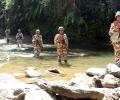
China's military has said it is willing to work with India to find a solution to the border issue, while also pushing for sound and stable defence ties. The statement comes after recent meetings between officials from both countries to normalize relations following a prolonged period of tension.

The Battle of Lhagyala on November 23, 1962, fought by the 4 Rajput Regiment against the Chinese PLA, remains a forgotten chapter of heroism, with no survivors left to tell their story.

Sources had earlier said that the areas and patrolling status were expected to be moved back to pre-April 2020 level.

The Indian Army began patrolling at Demchok on Friday, days after Indian and Chinese troops completed disengagement at the two friction points in eastern Ladakh, Army sources said.

'China's excessive military aid to Pakistan is the real elephant in the room as far as Sino-Indian relations are concerned. India should be confident enough to accept a degree of closeness between China and Pakistan, since China may wish to use this link for its foray into the Muslim world.' 'But the Chinese must be realistic enough to know that as time passes, the tactic of using Pakistan as a proxy to check India will yield diminishing returns. The US tried it for 60 years but failed, so will China,' says Colonel Anil A Athale (retd).

Union minister Kiren Rijiju on Friday said he interacted with soldiers of China's People's Liberation Army along the Sino-Indian border near Tawang during a visit to an Indian Army post on Diwali.

The exchange took place at five Border Personnel Meeting points along the LAC, the sources added.
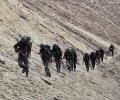
The government needs to answer the critical question of whether it has accepted any restrictions on its infrastructure creation activities, asserts Ajai Shukla.

Prime Minister Manmohan Singh has said that commitment by Indian and Chinese leaderships to maintain peace and tranquillity at borders pending boundary settlement is an important guarantor for further progress in Sino-Indian ties, particularly growth of 2.5 billion people.
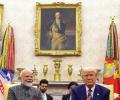
'Modi's intention was to create goodwill that will allow India to be seen by Trump as more than just a bad tariff problem.' 'He succeeded brilliantly on that count but none of these wins are unfortunately permanent.' 'Modi will have to do this again and again if Trump's grievances are to be durably assuaged.'
