

The fierce battles of Galwan, Rezang La, Gurung Hill, and Walong taught the PLA a hard lesson: Fighting the Indian Army would never be easy or inexpensive.

EARLIER: Lessons India Taught China In The 1962 War
Out of the three principal axes of the Chinese advance during the conflict, the only victory achieved by the People's Liberation Army with relative ease was along the Tawang axis.
It was a direct consequence of political interference and excessive media glare, to the extent that details of upcoming operations were published before their execution.
On the remaining two axes, in Aksai Chin and Walong, the Indian Army fought battles to the last man and the last round, forcing the PLA to pay a heavy price for their advance.
One clear lesson the PLA learnt in 1962 was that wherever the Indian Army fought, the cost of advance would be prohibitive.
A book written by a PLA officer who served in the Western sector, obtained by Professor B R Deepak of Jawaharlal Nehru University in 1991, before it was banned by China, offers rare testimony to this fact.
The PLA officer admitted, 'From the very outset of the war, the Indian Army's firepower was exceptionally intense. After two hours of fierce combat, although the Chinese forces managed to capture Galwan Valley, the cost was devastating. A total of 874 Chinese soldiers perished on the icy terrain of this river valley. It was only in the early 1980s that the remains of over 800 soldiers were finally recovered from the frozen snow.'
The defenders of the Galwan post showed extraordinary resolve. Even when faced with certain death, they did not surrender.
This exceptional resistance imposed caution on the Chinese command, slowing the progress of their operations. When the PLA turned its attention to the remaining Indian posts in the Galwan Valley, they found that every post, though isolated and with limited defensive potential, stood firm.
The story was the same everywhere. Surrounded by overwhelming numbers, the Indian defenders refused to surrender.
The stand at Rezang La
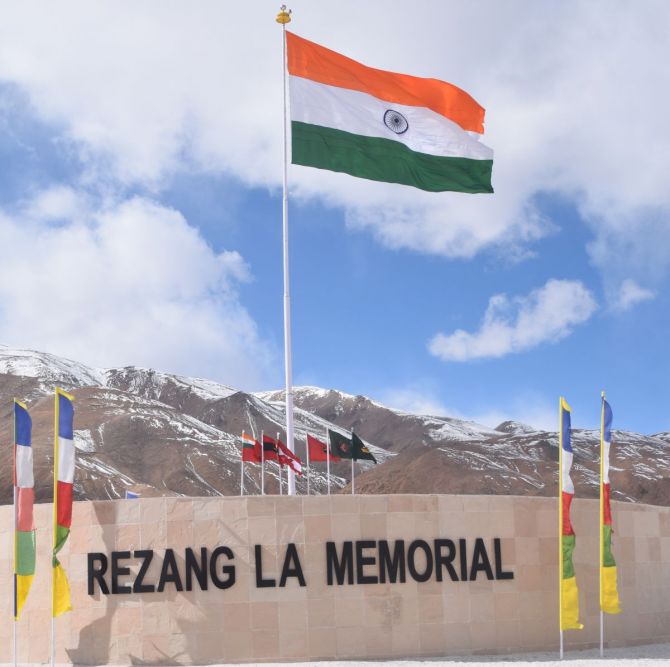
The battle of Rezang La was even more catastrophic for the PLA. Despite being virtually cut off, without artillery support, and attacked from three directions, the defenders fought with unmatched courage.
Out of 120 men, 114 went down fighting. Five were wounded and taken prisoner, and the company commander had sent one soldier back to report the situation.
When that lone survivor informed his superior that more than one thousand Chinese soldiers had been killed, he was threatened with court-martial for exaggeration.
The truth became clear only when troops later returned to recover the bodies.
Every Indian soldier's body bore, on average, thirty-five bullet wounds.
Of the one thousand mortar rounds held, only six remained unfired. The Chinese had to launch eight successive human-wave assaults to capture the position, losing an estimated 1,300 soldiers in the process.
The exact number of Chinese casualties will never be known, for the PLA has never acknowledged the scale of its losses, maintaining instead that 1962 was a 'big victory at a small price'.
Gurung Hill and the Chushul sector
The situation was no easier for the PLA at Gurung Hill, which they attacked simultaneously with Rezang La.
Despite repeated attempts, they failed to capture the Gurung Hill complex and had to withdraw after suffering heavy casualties.
Only after Rezang La fell did the Indian brigade commander decide to redeploy troops from Gurung Hill and its neighbouring posts at Muggar Hill, Spangur, and Tokung to higher defensive positions west of Chushul, in keeping with the overall plan to safeguard Leh.
The battles in the Chushul sector, at Rezang La and Gurung Hill, must have left a deep impression on the Chinese command.
The PLA lost an estimated 2,500 soldiers in the Ladakh sector alone. While India rightly honours its soldiers for their courage, it is also worth recognising that the PLA soldiers displayed remarkable endurance, continuing to attack despite being wiped out in successive waves.
Whether this was driven by a sense of nationalist duty or the coercive discipline of the Communist regime remains a subject worthy of study.
Walong: The Tiger's Mouth
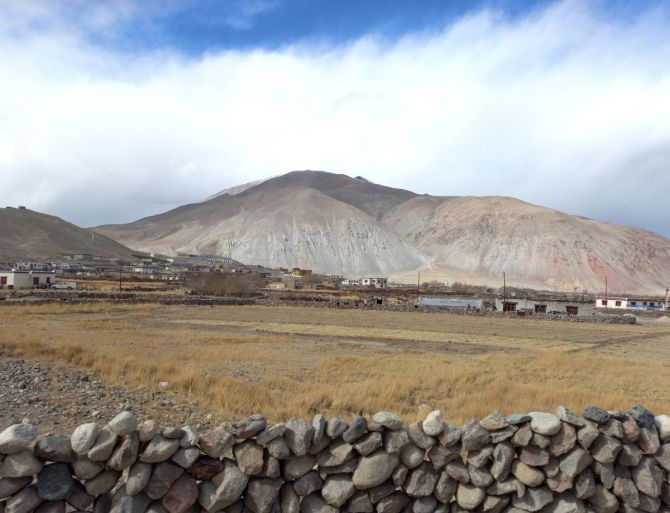
The greatest challenge for the PLA, however, came at a location they least expected -- the Walong sector.
The Chinese offensive began on October 21, 1962, but repeated assaults were repelled by determined Indian resistance.
At Namti, where Lieutenant Bikram and the troops of 6 KUMAON initially held the defences, the battlefield turned into a slaughter ground for the PLA, forcing them to halt and take a tactical pause by October 28.
Reinforcements were rushed in, and several command changes were made. General Ding Cheng, commander of the 54th Army and a veteran of the Long March, the Sino-Japanese War, and the Chinese civil war, was given direct operational control.
The 54th Army, stationed in Tibet since 1959 after the Tibetan uprising, was deployed almost in its entirety against one Indian brigade.
During this lull, the Indian Army also reorganised its defences. Brigadier N C Rawlley, Mahavir Chakra, who took command on October 31, 1962, made his intent unmistakably clear to his troops.
'There will be no withdrawal from this place,' he said. 'Everybody must get this straight.'
His words set the tone for one of the fiercest battles of the entire conflict.
The defences at Walong were so formidable that the Chinese nicknamed the position the 'Tiger's Mouth'.
In the ensuing fighting, the PLA suffered approximately 4,000 casualties. A village elder from Kaho, near the Line of Actual Control, recalled that mule trains carrying Chinese dead and wounded stretched for nearly four kilometres between Namti and Karoti.
Despite repulsing multiple Chinese assaults, the Indian brigade was finally ordered to withdraw to Yapak on 16 November 1962, as defences became untenable under overwhelming numerical pressure.
Yet, by then, the point had been made. The PLA had realised that advancing against determined Indian defenders meant paying an unendurable cost in men and morale.

A lesson that endures
The fierce battles of Galwan, Rezang La, Gurung Hill, and Walong taught the PLA a hard lesson: Fighting the Indian Army would never be easy or inexpensive.
This understanding has guided Chinese caution along the border ever since.
In later years, the Indian Army reinforced that lesson repeatedly, through the confrontations of Nathu La and Cho La in 1967, Sumdorong Chu in 1987, and again in more recent standoffs at Depsang, Doklam, and Galwan.
It was for this reason that General K V Krishna Rao later remarked that he did not consider 1962 a military debacle for the Indian Army; it was rather a political one.
The need for a balanced narrative
Sino-Indian relations today are once again following a familiar pattern, oscillating between cooperation and confrontation.
What has changed, however, is the global stature of both nations. India is no longer a young republic struggling to find its footing but an established regional power with international partnerships and strategic depth.
In this environment, the importance of presenting a balanced and timely narrative of every incident along the Line of Actual Control cannot be overstated.
The Government of India has done well in recent years to project a clear and factual account of incidents such as Doklam and Galwan.
As we advance, we must remain alert to the regional and global influences that may seek to exploit Sino-Indian differences for their own benefit.
The story of 1962 should therefore not be remembered primarily as one of defeat, but as a reminder of the courage, tenacity, and professionalism that compelled a far larger and better-prepared adversary to halt and reconsider, after being given an unmistakably bloody nose.
With inputs from Colonel Anil A Athale (retd) who compiled the official history of the conflict.
Dr Kumar is a Research Scholar who has extensively researched the 1962 Sino-Indian conflict and the Cold War dynamics.
Feature Presentation: Aslam Hunani/Rediff






 © 2026