
The identification of host dependency factors mediating virus infection may provide key insights into effective molecular targets for developing broadly acting antiviral therapeutics against SARS-CoV-2 and other deadly coronavirus strains, according to the researchers.
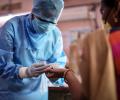
The first COVID-19 vaccine to reach phase I clinical trial is safe, well-tolerated, and capable of generating an immune response against the novel coronavirus in humans, says a new research published in The Lancet journal.
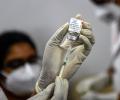
The NIH said results of two studies of blood serum from people who had received Covaxin suggest that the vaccine generates antibodies that effectively neutralise the B.1.1.7 (Alpha) and B.1.617 (Delta) variants of SARS-CoV-2, first identified in the United Kingdom and India, respectively.
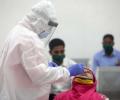
The first nasal vaccine against COVID-19, developed by Bharat Biotech, has received regulator's nod for conducting phase 2 clinical trials, the Department of Biotechnology said on Friday.

The states were requested to take a stock of hospital preparedness such as availability of drugs and medical oxygen, vaccination coverage against COVID-19 and influenza.

One in 15 individuals aged 10 years and above were estimated to be exposed to SARS- CoV2 by August 2020, ICMR's 2nd sero-survey said.
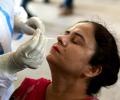
The Hyderabad-based firm completed clinical trials of the nasal vaccine with about 4,000 volunteers and there is no side effect or adverse reaction reported so far, company sources had said.

The highly transmissible Delta variant of SARS-CoV-2 has mutated further to form the 'Delta plus' or 'AY.1' variant but there is no immediate cause for concern in India as its incidence in the country is still low, scientists in New Delhi said.

But no extra risk after second dose, shows study led and funded by drug maker, reports Sohini Das.

BA.4 and BA.5 are sub-variants of the highly-transmissible Omicron variant of the virus.
The test named the "SARS-CoV-2 DETECTR" is easy to implement and to interpret, and requires no specialised equipment, said researchers from the University of California, San Francisco in the US.

ZyCoV-D is a three-dose vaccine administered intradermally.
The durability of immunity post COVID-19 vaccination persists for nine months or more and a precautionary dose of vaccine which will be administered to healthcare and frontline workers and citizens above 60 years with comorbidities is to mitigate the severity of infection, hospitalisation and death, the government said on Thursday.
These decisions were taken by the ministry based on the fresh recommendations by The National Expert Group on Vaccine Administration for COVID-19 (NEGVAC) and have also been communicated to the states and union territories, an official statement said.
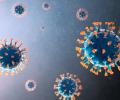
The Delta Plus variant have been detected sporadically in Maharashtra, Kerala and MP.

The Reserve Bank of India has on Wednesday lifted the ban on new customer acquisition by American Express which was imposed with effect from May 2021 due to non-compliance with local data storage norms. "In view of the satisfactory compliance demonstrated by American Express Banking Corp. with the Reserve Bank of India (RBI) circular dated April 6, 2018, on Storage of Payment System Data, the restrictions imposed, vide order dated April 23, 2021, on onboarding of new domestic customers have been lifted with immediate effect," RBI said. Similar bans were imposed on Diners Club International and Mastercard previously.

Lower levels of ACE2 gene expression in nasal epithelium, the first point of contact for SARS-CoV-2 and the human body, may explain why children have a lower risk of Covid-19 infection and mortality, according to a study. The researchers found that ACE2 gene expression in nasal epithelium was lowest in younger children and increased with age.
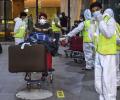
These seven countries are South Africa, Bangladesh, Botswana, China, Mauritius, New Zealand and Zimbabwe.

India has recorded 1,134 new coronavirus cases, while the active cases increased to 7,026, according to the Union health ministry data updated on Wednesday.
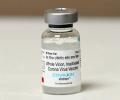
Results of an interim study recently published in The Lancet showed that two doses of Covaxin, also known as BBV152, had 77.8 per cent efficacy against symptomatic disease and present no serious safety concerns.
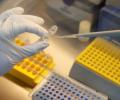
Results from early-phase non-randomised vaccine trials in a total of 76 people show that two formulations of the vaccine have a good safety profile detected over 42 days, and induce antibody responses in all participants within 21 days.
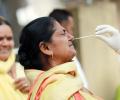
A 29-year-old NRI who recently came to Vadodara in Gujarat from South Africa has been found infected with the BA.5 sub-variant of the highly-transmittable Omicron variant of coronavirus, a health official said on Tuesday.
The reference to CRPP as a Maoist front organisation came in a written reply in Rajya Sabha by Jitendra Singh, Minister of State for Home Affairs.

Rediff.com Contributing Photographer Pradeep Bandekar sighted these stars on Tuesday.

The study, published in the Journal of Pediatrics, also challenges the current hypothesis that because children have lower numbers of immune receptors for SARS-CoV2, the virus that causes COVID-19, this makes them less likely to become infected or seriously ill.
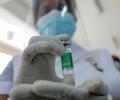
Anurag Agrawal, the Director of the Institute of Genomics and Integrative Biology, said the study on effectiveness of the available vaccines on the B.1.617 variant of SARS-CoV2 suggests that post vaccination, the infections are milder.
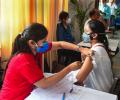
Researchers at Public Health Scotland and the University of Edinburgh, UK, found that the Pfizer-BioNTech vaccine offered better protection against the Delta variant compared to the Oxford-AstraZeneca preventive, known as Covishield in India.

A number of Indian medical experts on Monday supported calls from an eminent British Indian cardiologist for a full safety review into the use of Oxford/AstraZeneca's Covid-19 vaccine, administered in India as Covishield, over feared serious side effects such as heart attack and stroke.

The objective of the study was to determine the genetic diversity among Indian SARS-CoV-2 viral isolates in comparison to the strains that are occurring worldwide.
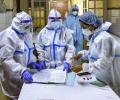
The research, published in the Journal of Internal Medicine on Tuesday, describes how different sized respiratory droplets emitted while speaking have a range of sizes, and can carry different amounts of virus.
British intelligence agencies now believe it is 'feasible' that the COVID-19 pandemic began with a coronavirus leak from a Chinese bio laboratory, a media report said here on Sunday, prompting Vaccines Minister Nadhim Zahawi to demand that the World Health Organisation (WHO) must fully investigate the origins of the deadly virus.

COVID-19 is on the verge of becoming endemic but Indian scientists are keeping a close watch on each new variant and the government would continue to maintain a high alert, Union health minister Mansukh Mandaviya has said, underlining that the virus has managed to survive and is going to stay.

The World Health Organisation said in its latest update that the XE recombinant (BA.1-BA.2) was first detected in the UK on January 19 and more than 600 sequences have been reported and confirmed since then.
Scientists at the CSIR-Centre for Cellular and Molecular Biology in Hyderabad have found prominently a different variant of SARS-CoV-2 in southern parts of India, a top official of the institute said on Thursday.
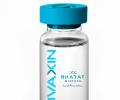
The vaccine induced robust binding and neutralising antibody responses which were comparable to those observed in the convalescent serum collected from patients who had recovered from COVID-19, according to the findings which have appeared on medRxiv, a preprint server.
A new analysis of genetic samples collected from a seafood market in central China's Wuhan city shows the presence of the SARS-CoV-2 virus in raccoon dogs sold at the venue, strengthening the case for the natural origin of the Covid-19 pandemic, according to a team of international experts.

The Centre and the states need to continue working in collaborative spirit as was done during the previous surges for COVID-19 prevention and management, Mandaviya said.

Antibodies produced by two doses of mRNA vaccines against the original and early variants of the SARS-CoV-2 virus wane substantially over time, and offer essentially no protection against Omicron, according to a study that highlights the importance of a booster dose.
