
India's defence expenditure surged to $92.1 billion in 2025, making it the world's fifth-largest military spender, according to SIPRI data. This 8.9 per cent year-on-year rise was primarily driven by operational and procurement needs following heightened regional tensions with Pakistan in May 2025.

'If you go by the capital expenditure, this is a good defence budget. But we will have to see if the government can keep defence spending at 2 per cent or higher in 2027-2028.'

'The share of the private sector is at its all-time high of around Rs 42,000 crore in FY26, reflecting its expanding role in the defence ecosystem.'

China's latest defence budget surges to $275 billion, fueling its ambitious military modernisation program and intensifying geopolitical dynamics in the region.

A lesson for India is to clearly define objectives beforehand, so that the adversary or other parties do not attempt to mitigate them midway.
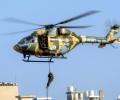
'The tools of warfare are changing. The MoD must deepen its engagement with technology thinkers that can present compelling visions of where warfare may be heading.'

Domestic LPG and commercial cylinder prices in India have seen a significant increase, driven by rising global energy costs linked to the conflict in West Asia. This marks the second price hike in less than a year, impacting households and businesses.

The purge in Washington does not pause the war. Strikes continue, Hormuz remains closed, and Brent crude is still dancing around $109 a barrel. For India, the command chaos in the Pentagon is another layer of uncertainty piled on five weeks of conflict that was already straining every buffer Delhi has.

The intriguing bit is that Trump is likely to attend the talks in Islamabad this weekend -- if he does, it will be the clearest signal yet that the US is ready to exit the war with some sort of win to show, since he cannot afford to go for the talks and return empty-handed, notes Prem Panicker in his must read blog on the Iran War
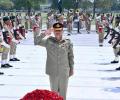
Creating a powerful new chief of defence forces has split the Pakistan military into four competing factions, points out Rana Banerji, who headed the Pakistan desk at RA&W.

'In such a scenario, Iran could proclaim itself victor, rebuild, re-enforce its diminished regional proxies to further destabilise neighbouring nations and take control of the Persian Gulf and Strait of Hormuz.'

Egypt, Pakistan, Saudi Arabia and Turkey met in Islamabad in what analysts say is the formal opening of a new diplomatic formation that could reshape the post-war regional order. Their immediate goal is a ceasefire; their larger ambition is to ensure that neither Iran nor Israel emerges from this war in a dominant position. Pakistan's foreign minister then flew directly to Beijing and mooted a Chinese role as guarantor of any eventual agreement. Prem Panicker continues his must read daily blog on the Gulf War.
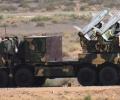
Even as the benchmark and broader indices were down sharply on Monday due to escalating tensions in West Asia, the Nifty Defence index ended the session in the green.

Israel and the United States had a plan. Iran punched back. And now the Gulf is reeling, the world is beginning to feel the pain and, as on date, no one in Washington or Tel Aviv appears willing to admit that the punch has landed, notes Prem Panicker, continuing his must-read blog on the war in the Middle East.

The question is no longer whether the war will expand. It has. The next few days will tell us whether the war stabilises around Hormuz or whether the Strait itself becomes the trigger for a far larger rupture. What to watch for over the next 48 hours is simple: Any move by the US toward direct naval control of the Strait; any credible Iranian attempt to disrupt or mine shipping lanes and, critically, whether energy infrastructure in the Gulf continues to be targeted.If those lines are crossed in tandem, the war will no longer be containable within the region.
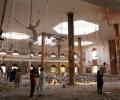
'Some success has been achieved in raising the costs of terrorism for Pakistan.'

'Make-in-India played a key role in India's effective action against terrorism during Operation Sindoor.'

The increase in India's military spending was "mainly a result of growing personnel and operations costs" which made up almost 80 percent of the total military budget in 2023, the SIPRI report claimed.

'The first and most basic responsibility of any government is to protect its people from external threats and internal harm.' 'Budget 2025-2026 has to focus on meeting this responsibility,' asserts R Jagannathan.
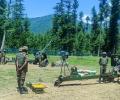
India fully utilised its military modernisation budget in 2024-2025 -- the first time in five years -- and signed a record Rs 2 trillion defence contracts.
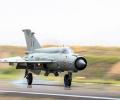
The MiG-21 episode demonstrates that procurement is always strategic.
Choices about what aircraft to acquire, who builds them, who supplies the spares, who trains the pilots and technicians are decisions with political consequences lasting for decades.

Mrs Gandhi's power ebbed and peaked with the times. Mr Modi's has almost been constant, barring the few months of hard dip after the 240 seats of 2024, points out Shekhar Gupta.

India will oppose the World Bank funding to Pakistan next month, arguing that Islamabad has used such funds in the past to procure arms and ammunitions. India previously lobbied against the IMF extending a USD 2.3 billion assistance to Pakistan earlier this month, presenting evidence of Pakistan's misuse of funds for military purposes. India feels that Pakistan has failed to act on terror emanating from its territory and has been diverting funds from multilateral agencies to buy arms and ammunition.

India will argue for Pakistan's return to the Financial Action Task Force (FATF) grey list due to its alleged failure to combat money laundering and terror financing. The move comes after recent tensions between the two countries following a terror attack in Pahalgam, India. India believes Pakistan has not adequately addressed the issue of terrorism emanating from its territory and has diverted funds from multilateral agencies towards arms purchases.
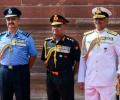
India has allocated Rs 1.72 trillion, or 27.67 per cent of the total defence budget to cater to modernisation of the country's arsenal. Modern militaries spend up to 50 to 60 per cent of their total defence budget so that they go into combat with superior weaponry and equipment.

India spends significantly less on defence than could be expected from a country that faces simultaneous armed threats from two hostile neighbours -- China and Pakistan.
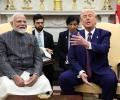
From bhikshus of Ashokan 3rd century BC and medieval Sufis to Oxfam, Omidyar and Soros now, non-State actors have any real power only when they work in conjunction with a real State, asserts Shekhar Gupta.

Red Square and VDNKh easily rank among the most striking places I've visited -- both for their historical significance and architectural splendour.
My admiration for Russian culture, vision and ambition grew with every step as I clocked the miles, Nitin Sathe tells us after a visit to Moscow and St Petersburg.
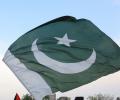
The International Monetary Fund (IMF) has slapped 11 new conditions on Pakistan for the release of the next tranche of its bailout programme and warned that tensions with India could heighten risks to the scheme's fiscal, external, and reform goals, according to a media report on Sunday.

Stunning landscapes, natural beauty, clean beaches, cultural wealth, mouth-watering food, shopping options, safety for solo travellers, warm hospitality, easy visas, and connectivity make Vietnam a must-visit destination, discovers Ramesh Menon.

'If you align your ambition with India's rise, the peak of your careers will unfold alongside the peak of India's power.'

Prime Minister Narendra Modi on Friday said the world has seen the power of India's indigenous weapons during Operation Sindoor, which is 'not over yet'.
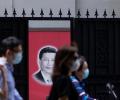
'China's opaque defence allocation processes are shrouded in mystery and have triggered security dilemmas among its neighbours and others,' notes China expert Srikanth Kondapalli.

'Currently, it takes between two and three years to formulate the request for proposal for procuring specific military equipment for the armed forces. It should not be this way.'

India's defence sector presents an ordering opportunity worth $138 billion between fiscal years 2023-24 (FY24) and FY32, said a latest note by Nomura, which has initiated coverage on two defence-related players - Hindustan Aeronautics (HAL) and Bharat Electronics (BEL) - with a 'buy' rating. The research and broking house sees an upside potential of 28 per cent and 32 per cent, respectively in these two stocks from the current levels.

South Korean declared an 'emergency martial law' on Tuesday with President Yoon Suk Yeol, accusing the opposition of plotting an 'insurgency' and 'trying to overthrow the free democracy' in the country, as reported by the New York Times.

A hike in China's defence budget has got defence experts and analysts debating the country's rising military power and clout.

To threaten China and Pakistan, and then to sharply cut back on military funding, bespeaks a remarkable trust in Beijing and Islamabad that is not borne out by anything they say or do, notes Ajai Shukla.
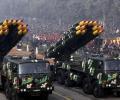
After lagging behind the broader market over the past three and six months, defence sector stocks have regained ground, reversing their performance from the past month. Concerns about slowing order inflows, execution hurdles, supply chain disruptions, and high valuations had weighed on the sector.
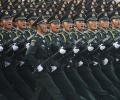
In a surprise development, a top Chinese military general has cast aspersions on the People's Liberation Army (PLA)'s much-publicised 'real combat-oriented exercises' as 'fake combat capabilities' at a time when Chinese President Xi Jinping has ordered it to prepare for 'maritime military struggles' to win wars.
