
Marco Rubio will visit Mumbai and Jamnagar to discuss energy cooperation as S Jaishankar says India-US trade talks are nearing a landing point, with a few issues unresolved.

India and Australia have signed significant agreements covering civil nuclear energy, maritime security, and critical minerals, reinforcing their partnership's role in ensuring a peaceful Indo-Pacific. The pacts facilitate uranium supply from Australia to India and enhance cooperation in defence, cyber, and critical technologies.

Prime Minister Narendra Modi and Russian President Vladimir Putin held extensive discussions to strengthen bilateral trade, defence, and energy cooperation, while also addressing the ongoing Ukraine conflict and exploring avenues for peace and resolution, with Modi reiterating India's call for dialogue and diplomacy.

India and Canada solidify their partnership with a landmark uranium supply agreement and discussions to finalise a comprehensive economic partnership, signaling stronger ties and cooperation on key global issues.
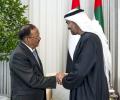
India is the only significant power that all parties trust, or at least do not distrust, notes former defence secretary Ajay Kumar.

India needs to increase the investment rate to 34-35 per cent from 31-32 per cent currently to achieve a growth rate of 7 per cent and above, said S Mahendra Dev, chairman, economic advisory council (EAC) to the Prime Minister, on Wednesday.
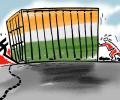
The India-Oman free trade agreement, operationalised on June 1, is set to create significant export opportunities for India's labour-intensive and value-added sectors, including textiles, gems and jewellery, and marine products, while also strengthening energy security.

Prime Minister Narendra Modi was accorded a grand welcome on his arrival in Jakarta on Monday, with Indonesian Air Force fighter jets escorting the PM's aircraft upon entering Indonesian airspace, marking a ceremonial welcome.

India and Israel have elevated their relationship to a special strategic partnership, focusing on enhanced cooperation in trade, technology, and defense, while also addressing regional peace initiatives.

New Delhi must look for formal, institutional statements issued directly from Washington rather than rely on casual pronouncements meant for local audiences, notes Ambassador Rajasekhar.

Vietnam is an emerging regional power and a closer relationship with Hanoi is closely aligned with Prime Minister Narendra Modi's Act East Policy, points out Dr Rajaram Panda.

India is one of the few nations, and perhaps the only nation, that has good relations with America, Israel and Iran. Knowing that a war in the Gulf would damage our economy, hurt supply of fertilisers and fuel, and cause general chaos, we should have tried to ensure this war did not begin, asserts Aakar Patel.

Both India and the EU are likely to announce a conclusion of trade talks on January 27.

Prime Minister Narendra Modi will visit the UAE, the Netherlands, Sweden, Norway and Italy to deepen India's bilateral ties amid geopolitical changes.
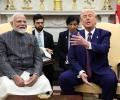
Prime Minister Narendra Modi and US President Donald Trump discussed enhancing economic ties and a potential trade deal during a phone conversation.

The proposed trade deal with the 27-nation European Union (EU) is expected to provide zero-duty access to the $95 billion European market for Indian textile and apparel manufacturers. Currently, India's share of the European market is just 6 per cent, or $5.5 billion.
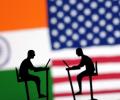
India and the United States have reviewed progress on a proposed interim bilateral trade agreement, discussing market access, digital trade, and non-tariff barriers, as they race to finalise a deal before a temporary 10 per cent US tariff regime expires on July 24.

Russian President Vladimir Putin and Chinese President Xi Jinping have reaffirmed their commitment to dismantling global hegemonism and building a 'multipolar world' during high-level talks in Beijing.

Prime Minister Narendra Modi and US Secretary of State Marco Rubio discussed various aspects of India-US bilateral ties, focusing on defence, trade, energy, and technology. Rubio extended an invitation from President Donald Trump for PM Modi to visit the US.
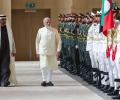
Prime Minister Narendra Modi has offered India's support to bring peace to West Asia during talks with UAE President Sheikh Mohamed bin Zayed Al Nahyan. Both countries signed agreements to strengthen strategic collaborations in energy and defence.
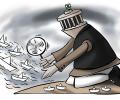
India finalised a free trade agreement with the UK, its 16th so far as the country aimed at boosting bilateral trade and investments. The other regions and countries with which India has signed such agreements include the four-nation European bloc EFTA, Japan, Korea and Australia.

'The biggest point of contention is market access for US agricultural and dairy products.'

Prime Minister Narendra Modi emphasized the strong partnership between India and the UK, highlighting its importance for global stability and economic progress amidst global uncertainty. Discussions covered trade, defense cooperation, and geopolitical issues.
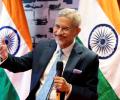
'The logic every one of our neighbours must realise is that working with India will give you benefits, and not working with India has a cost.'

The 2 countries signed 15 agreements including one on defence cooperation after Prime Minister Narendra Modi held 'productive discussions' with President Joko Widodo.

The Indian government informed Parliament that India and the US are engaged in negotiations for a mutually beneficial multi-sectoral bilateral trade agreement. The two countries also cooperate on strategic, economic, and defense matters, managing divergences through high-level dialogues.

Govt policy, not trade with Asean, stifles manufacturing.
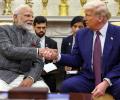
'India's farmers will be unable to compete with the US, given the subsidies that the latter provides its farmers.'

Countries that have signed the RCEP agreement can start negotiations with India for joining the pact once New Delhi submits a written request stating its intention for the same, according to a declaration. On November 4 last year, India walked out of mega free trade agreement RCEP (Regional Comprehensive Economic Partnership) as negotiations failed to address New Delhi's outstanding issues and concerns. The remaining 15 member countries have signed RCEP agreement and have stated that the pact would remain open to India.

China and Pakistan concluded their strategic dialogue, reiterating their opposition to unilateral actions in South Asia and discussing Kashmir, Afghanistan, and trilateral cooperation.

Asked for China's comments on India not joining the RCEP deal over concern of cheap Chinese products potentially harming its domestic industry, Chinese foreign ministry spokesman Geng Shuang told the media in Beijing on Tuesday that China welcomes India joining the deal.

Tata Sons will likely choose Singapore as a "key partner" for its semiconductor plans, a senior minister from the city-state said on Friday. Speaking to reporters after a meeting with Tata Sons chairman N Chandrasekaran earlier in the day, Singapore's minister for home affairs and law K Shanmugam said semiconductors was a "big discussion" point during the meeting. "If they (Tatas) want to, they can do business with anybody in the world.

In their talks, Modi and Merz are likely to deliberate on trade and investment ties as New Delhi is looking at deepening economic engagement with Europe against the backdrop of Washington's 50 percent tariff on Indian goods, people familiar with the matter said.
'In the Indian government there are no illusions about the United States reliability or the possibility of having any kind of preferential treatment from Washington when it comes to trade.'
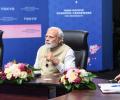
As US President Joe Biden launched a new trade deal with 12 Indo-Pacific nations, including India, to enhance trade, economic and investment opportunities, China, which sees the pact as a threat to its dominance in the region, went on the offensive against it, promising more opening up, while the official media here termed it as "economic Nato".

India on Thursday signed a free trade agreement, officially dubbed as the Comprehensive Economic and Trade Agreement (CETA), with the UK - its 16th trade pact so far - as the country aims to boost bilateral trade and investments.
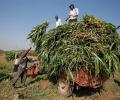
The World Bank on Tuesday raised the growth forecast for the Indian economy to 7 per cent for the current fiscal year on the back of recovery in agri sector and rural demand. World Bank had in June projected India to grow at 6.6 per cent for FY24. According to the World Bank Report released on Tuesday, India's growth continues to be strong despite a challenging global environment.
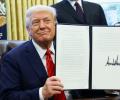
The Trump trade shock is a chance to push long-overdue reforms, rather than tinker with tariffs to appease the US, suggests M Govinda Rao.

Fight on toward goals that keep receding, or exit with most objectives unmet. Trump is agitated, his poll numbers falling below the Plimsoll line, his base fractured between those who back the war and those who remember that he campaigned on ending them.
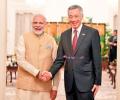
Modi hailed the close defence cooperation between the two countries and welcomed the completion of the logistics agreement between the two navies.
