
Construction of the approved reactor projects is expected to take five to six years after receiving financial approval.

'The Atomic Energy Commission has approved the FDI policy and it is going in for ministerial consultations.'

In many ways, this is only the beginning -- of a new chapter in India's nuclear story, and of a future where its vast thorium reserves could finally power its ambitions.
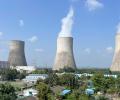
The Bill is likely to pave the way for amending two existing legislations -- the Atomic Energy Act 1962, and the Civil Liability for Nuclear Damage Act 2010.

India's 500 MWe Prototype Fast Breeder Reactor (PFBR) at Kalpakkam in Chennai has achieved first criticality, marking a significant advancement in the country's nuclear energy capabilities and long-term energy security.

The operator's liability in the case of an incident is limited to 3,000 crore for reactors with thermal power above 3,600 Megawatt; 1,500 crore for reactors with thermal power between 1,500 Mw and 3,600 Mw; 750 crore for reactors with thermal power between 750 Mw and 1,500 Mw; 300 crore for reactors with thermal power between 150 Mw and 750 Mw; and 100 crore for reactors having thermal power up to 150 Mw, fuel cycle facilities other than spent fuel reprocessing plants and transportation of nuclear materials.

Construction major L&T is gearing up to expand its footprint in the global nuclear supply chain, a senior company official has said, while calling for amendments to key legislations on the domestic front to pave the way for the entry of private players and foreign capital necessary for capacity enhancement.

They have agreed to include two major aspects of licence renewal and risk-informed regulation in the ambit of the ties.

Fuel loading at India's first prototype fast-breeder reactor in Kalpakkam is expected to start next week, marking a significant step in the country's nuclear program.
High energy costs, long a drag on India's manufacturing competitiveness, are finally easing. Power and fuel expenses accounted for 1.98 per cent of net sales in 2024-25, the lowest level in data compiled by the Centre for Monitoring Indian Economy (CMIE) over the past two decades.
United States President Barack Obama on Friday ordered a "comprehensive" safety review of all the nuclear power plants in the country in light of the current situation in Japan where high levels of radiation from quake-crippled reactors are threatening to spew-out disaster.

'Bharat Small Reactors are essentially similar to the existing 220 MWe Pressurised Heavy Water Reactors. The existing regulations are applicable for BSRs.'

AAERB's permission for RAPP-7 paves the way for the subsequent phases of reactor commissioning leading to its commercial electricity generation.

Whether the ambitious targets are achievable is a moot question as India's earlier target was 20,000 MW of nuclear power by 2020.

The Indian government has come out with a nice name for its tried and tested 220MW pressurised heavy water reactor -- Bharat Small Reactor.

Zaporizhzhia power plant spokesperson Andrey Tuz said the plant has not sustained any critical damage, although only one power generation unit out of six is operational as the fire continued at the facility.

Putin also told his French counterpart that Kyiv does not comply with the agreements reached with Moscow on the evacuation of civilians from combat areas, the Kremlin said.
"The Department of Atomic Energy and its agencies, including the Nuclear Power Corporation of India, have been instructed to undertake an immediate technical review of all safety systems of our nuclear power plants, particularly with a view to ensuring that they would be able to withstand the impact of large natural disasters such as tsunamis and earthquakes," he had said.
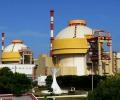
'Decisions on nuclear power have so far been taken by a small select group, primarily interested in profiteering from their actions, stating 'secrecy' as necessary from the national security point.' 'This argument is false, because we are dealing with the 'civilian' nuclear power sector, which is open even to the IAEA,' says Dr A Gopalakrishnan, former chairman of the Atomic Energy Regulatory Board.
Minister of State in PMO V Narayanasamy said the 'cold run' of the power plant will begin in the presence of Atomic Energy Regulatory Commission officials within ten days time and the tests will go on for 15 days from then.

The 25-year-old from the District of Columbia is 'the most intelligent contestant in recent memory'!
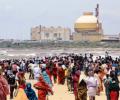
How on earth did Dr Manmohan Singh and his ministers conclude that the casualties of a disaster in a nuclear plant would be fewer than the deaths and injuries caused by the Bhopal gas tragedy? And that the compensation could, therefore, be capped at a smaller amount, asks T V R Shenoy.

To curb rising food prices, the Union government is contemplating using large-scale nuclear irradiation technologyfor increasing the shelf life of fruit and vegetables, particularly that of onions and potatoes.
The first unit of the Koodankulam nuclear power project is expected to start generating electricity in the next 40 days, Minister of State in the Prime Minister's Office V Narayanasamy said on Monday. He said the Atomic Energy Regulatory Board officials were at the Koodankulam project site and inspecting the plant.

While nuclear engineers cheer KNPP's first full operation, on nine other sites which house atomic reactors, scientists spend sleepless nights.
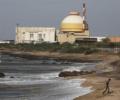
A petition has been filed in the Madras High Court against commissioning of the Kudankulam Nulcear Power Plant on the ground that authorities had not complied with all the directions issued by the Supreme Court while giving the green signal to the controversial project.

The ship will now arrive on August 16 and remain at the Hambantota port till August 22, they said.

Creating many more half-decent jobs for the 10 million plus new entrants to the labour force each year must surely constitute the primary development challenge for India today.
The government on Sunday maintained that it will ensure all safety aspects of the Kudankulam Nuclear Power Project are fully taken care of before it is commissioned.
The Central Information Commission on Tuesday directed the Atomic Energy Department to make public the cabinet note relating to proposals for new bills on web sites within seven days of tabling in the Parliament.
The Supreme Court on Monday sought response from the Centre and Atomic Energy Regulatory Board on implementation of safety guidelines issued by it for the Kudankulam Nuclear Power Plant in Tamil Nadu.
Former chairman of Atomic Energy Commission Dr. P K Iyengar, former chairman of Atomic Energy Regulatory Board Dr A Gopalakrishnan and former director of Bhabha Atomic Research Center Dr.A.N. Prasad say that there is a great deal of disquiet among the scientific community at large about the deal. They also said they met the Prime Minister Manmohan Singh and discussed about the after-effects of the deal, besides writing to the MPS.
The Atomic Energy Commission and its subordinate organisations have the mandate to put in place a comprehensive plan to ensure nuclear safety in the country, but that does not seem to have been done, writes Dr A Gopalakrishnan, former chairman of the Atomic Energy Regulatory Board.
After years of deadlock on liability issue, India and Russia have signed an agreement for building units 3 and 4 of the Kudankulam Nuclear Power Plant project at a cost of Rs 33,000 crore.

The reactor will start its initial production of 400 MW electricity within 20 days, Union Minister V Narayanasamy said.

Here's your weekly digest of the most weird, true and funny news from the across the world.

T N Seshan believed that toughness at every level is needed to keep the flock under him strictly duty bound, recalls Dr K S Parthasarathy, former secretary, Atomic Energy Regulatory Board.

The government must justify why we need to buy foreign reactors when we have developed up to 700 MWe unit-size pressurised heavy water reactors, a design which can be easily extended to 900 to 1000 MWe unit size. Why can't the 'Make in India' philosophy apply to indigenous nuclear reactors, more than 18 of which have been designed, built, and being operated by Indian engineers, asks Dr A Gopalakrishnan.

India's nuclear establishment is continuing its march of folly at the expense of safety in the false belief that atomic power is the energy of the future. It's not. Nuclear power is in relentless global decline, says Praful Bidwai.
