
'It is clear that Britain is a country with a limited future,' says Rajeev Srinivasan.
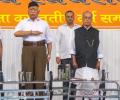
'For the last 10 years the Congress made the RSS an idea of intolerance, anti-minority, especially anti-Muslim, and an idea of fascism.' 'That has been demolished now by Pranab Mukherjee.'

'Since Modi is walking a tightrope between two worlds -- one of the saffron brotherhood and the other of the proposed smart cities and bullet trains -- it is understandable why he is averse to scrutiny lest he loses his balance by tilting too heavily on one side or the other. But, why has Sonia Gandhi acquired the reputation of a sphinx,' asks Amulya Ganguli.

If an elected government had been sworn in, Jung's tenure and the government would have been more or less co-terminus and Jung would have been just the ceremonial head of Delhi. Now, he will run Delhi, pending another round of assembly elections, says Aditi Phadnis
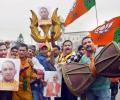
'His selection is to honour the sentiment of the communal majoritarianism, satisfy the upper caste and continue the process of Hindutva.'
.jpg)
Bata came up with new brands to beat industry competition.

The Union government has no 'Buy India' policy, but has a 'Buy Air India' policy.

The absence of a clear underlying economic ideology in the Budget was quite evident, say experts.
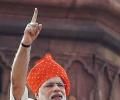
Prime Minister Narendra Modi has created a flutter with his first Independence Day speech. While diverted the national attention to social issues, Modi smartly avoided political traps.

'Mrinalini Sarabhai was gracious, well-read, liberal, very secular, and very well informed,' recalls film historian S Theodore Baskaran of the celebrated dancer who passed into the ages last week.

'there is absolutely no question that the Hinduism of the mob-lynchers, the people who have actually gone and killed others because of what they are eating or how they are worshipping or the faith they belong to or what they're doing professionally, those are, to my mind, not Hindus at all.' 'Hinduism needs to be reclaimed for the Hindus who are not bigots.'

To look for lessons from Nehru's life to find a way out of the Congress' quagmire is probably futile, says Rahul Jacob

The implementation of their recommendations means that an adequate apparatus to change this is at the disposal of the government.

'One big problem for the RSS is, while they spread their ideology of hard, Hindu-ised Indian nationalism, the absence of their own pantheon of modern nationalist giants. They missed out on the freedom movement quite comprehensively, in some ways comparable to the Muslim League and latter-day Communists. They have to find heroes elsewhere.' 'They borrow who they can from the Congress, like Madan Mohan Malviya and Sardar Patel, and then steal the entire lot of revolutionaries, from Bhagat Singh to Netaji, never mind that many of them were extreme leftists.'

'I have no problem with people from the right wing who speak with a certain integrity of position.'
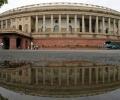
When Prime Minister Narendra Modi recently extended a Rs 8,000-crore (Rs 80 billion) central support for building roads in Jammu & Kashmir, Union Cabinet's approval for the big-ticket announcement came in barely 48 hours.
Verifiable 'distress-sharing' of available water may still be the way out of the Cauvery water row, says N Sathiya Moorthy.

Atal Bihari Vajpayee would seek to placate the hawks in the RSS by stating that the writing of history should not be one-sided. At the same time, he would project a moderate 'Nehruvian' image of himself as the archetypal liberal politician who would strive to attain a balance between conflicting viewpoints. A fascinating profile of the former prime minister and Bharat Ratna by Paranjoy Guha Thakurta and Shankar Raghuraman.

'Xi Jinping got a dose of Modi's medicine inside the tent where he was being hosted on the banks of the Sabarmati river.' 'Modi reportedly told him, looking deep into his eyes: "This was not expected of your country. Can you tell me when the troops are withdrawing?".'

'Today the Chinese think they can slap India, and there will be no consequences.' 'They must be made to feel the consequences through any and all means,' says Rajeev Srinivasan.
'Some in the Congress believe the party should, somewhat brazenly, claim the cause of fighting corruption as its own. But the Congress's idea of fighting corruption is nothing but tinkering with laws, it lacks the stomach to take on the corrupt,' feels T V R Shenoy.

Permissive communalism, as represented by the Sachar Committee report, cannot become the basis to counter the threat of majoritarianism, says D L Sheth.

'The Modi regime, after experimenting with its own versions of neighbourhood policy for 18 months, has now reached the exact stage where the Manmohan Singh government had left it in so far as our Pakistan policy is concerned,' says former senior RA&W officer Vappala Balachandran.
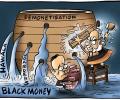
'Modi is likely to make more announcements to win or retain popularity, and put himself at the centre of things even more than now,' says T N Ninan.

India needs to have a re-look of whole gamut of its relations with major powers and also prepare for a more turbulent neighbourhood. But such is the tyranny of Indian status quo mindset that any talk of re-look at nuclear doctrine or foreign relations is treated as blasphemy, says Colonel (retd) Anil Athale.

The choice before the next government is not between being a soft State and a tough State; it is between being a smart State and a dumb State, says former foreign secretary Shyam Saran.

Partial dismantling of subsidies, movement towards a more transparent policy on natural resources and moves to make India more inviting for foreign investors, are some of Modi government's big achievements.

Our problem is that we look at these words from a non-Indic perspective, says Sanjeev Nayyar.

'India-US relations seem to have soured when the US expected India to not only balance China in the Asia-Pacific, but also make concessions to Pakistan as a price for US technological help,' says Colonel Anil A Athale (retd).

'As in the Panchatantra tale of the cat and the monkeys, it is possible for the clever swing State to play off the two competing powers.'

Non-Congressism is the answer to India's current difficulties, says Dr Shambhu Shrivastava, who gives a historical perspective of non-Congress experiments in 1967, 1977, 1989 and 1998.

From early indications, the Modi government's foreign policy seems to be pragmatic and reciprocal, says K G Suresh.
The West has always preferred a timid, half intelligent and a dependent India rather than a decisively independent and self-reliant one. A pliable Indian leadership suits the West best, says Tarun Vijay.

'The real test will be in defence-related deals, for instance the Javelin anti-tank missile: Is the US willing to co-develop something with India, on terms that will support the 'Make in India' initiative? Is there defence technology transfer? Or will it dump old junk on India?' asks Rajeev Srinivasan.
'Both reflect prejudice and short-sightedness peculiar to Mr Modi's way of thinking.'

'A lot will depend on the first Aayog and the power it derives.'

'A participant in many rounds of the border talks with China once told me that China seemed not interested in resolving the border issue as it wanted to keep it as a ready excuse to intervene in the sub-continent,' says Colonel (retd) Anil A Athale.

'What if Modi becomes the fascist the leftists paints him as? What if he does suspend the Constitution and declares himself the ruler, with support from the army? What exactly will you do, Mr Leftie?' asks Rajeev Srinivasan.

In any controversy, the participants cannot decide who is right or wrong. A democracy has a process in place to settle these disputes: the judiciary. Dinanath Batra in true democratic fashion availed of that opportunity citizen and Penguin's decision was the outcome of a legitimate legal battle, says Vivek Gumaste.

'Asked which Dilip Kumar films were among her favourites, she said she had seen not a single movie of his until that time. This became a sensational issue. She did not mean to offend Dilip Kumar. There was not a bone of diplomacy in her and she never acquired that calculating attitude even at the cost of some of the roles that she would eventually lose.'
