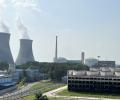
Government sources said amendments were being considered to the Atomic Energy Act to allow private sector participation and the Civil Liability for Nuclear Damage Act to limit the liability on suppliers of equipment to build atomic energy plants.
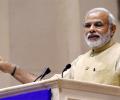
Prime Minister Narendra Modi, in his Independence Day address, highlighted technology and innovation as central to India's goal of becoming a developed nation by 2047. He called for India to lead in emerging technologies like AI, quantum computing, and space, announcing a massive AI skilling initiative for one crore youth. Modi stressed the importance of becoming a global innovation hub, bolstering energy security with nuclear power, and strengthening cybersecurity.

Adani Group Chairman Gautam Adani announced a capital expenditure programme of over 2 trillion for Adani Power, aiming for 45 gigawatts (Gw) capacity in five years, including a significant entry into nuclear power with a target of 10 Gw by 2035 through Adani Atomic Energy.

Construction major L&T is gearing up to expand its footprint in the global nuclear supply chain, a senior company official has said, while calling for amendments to key legislations on the domestic front to pave the way for the entry of private players and foreign capital necessary for capacity enhancement.

In many ways, this is only the beginning -- of a new chapter in India's nuclear story, and of a future where its vast thorium reserves could finally power its ambitions.

India's fresh investment plans in Q1FY27 surged 71 per cent to 14.77 trillion, primarily driven by four large nuclear power projects worth 6.5 trillion, according to investment monitoring firm Projects Today. Excluding these nuclear projects, fresh investment plans actually declined 4.27 per cent quarter-on-quarter.
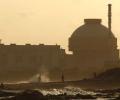
The Indian Nuclear Energy Pool, meant to insure risks from nuclear reactors, may take longer to be set up. While the idea of forming a pool was mooted earlier this year, it has reached a deadlock owing to differences among the stakeholders on certain clauses.

'There has definitely been a breakthrough in the nuclear logjam. It is good to see nuclear energy back on the rails,' says Dr Anil Kakodkar, former chairman, Atomic Energy Commission.
Ushering in reforms, Union Finance Minister Nirmala Sitharaman on Saturday proposed to open up the nuclear power sector for private players and announced a Rs 20,000 crore Nuclear Energy Mission for research in the field, with an aim to set up five small and modular reactors by 2033.

India's peak power demand is projected to hit 270 GW this summer, surpassing last year's record of 250 GW.
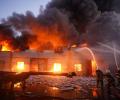
Glimpses of the devastation caused by Putin's War.

Karex, the Malaysian company that makes roughly one in five of the world's condoms -- about five billion a year, supplying Durex and Trojan among others -- announced this week that it is raising prices by up to 30 percent. The reason is the Strait of Hormuz.

Egypt, Pakistan, Saudi Arabia and Turkey met in Islamabad in what analysts say is the formal opening of a new diplomatic formation that could reshape the post-war regional order. Their immediate goal is a ceasefire; their larger ambition is to ensure that neither Iran nor Israel emerges from this war in a dominant position. Pakistan's foreign minister then flew directly to Beijing and mooted a Chinese role as guarantor of any eventual agreement. Prem Panicker continues his must read daily blog on the Gulf War.
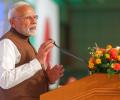
Showcasing India as an attractive investment destination, Modi said the country has political and economic stability as well as transparency and predictability in policy decisions.

Power major NTPC on Friday said it plans to foray into nuclear power generation.
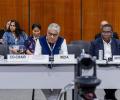
India will publish its revised Nationally Determined Contribution (NDC) for the 2035 period by December, Environment Minister Bhupender Yadav said on Monday, while urging developed nations to achieve net zero targets ahead of their current timelines.

'Our problem is not a budget deficit but a trust deficit. We need to trust our institutions and industries to innovate and lead. That is the way forward for India.'

One key development is the direct cargo connection between Chennai and Vladivostok, a crucial Russian port on the Northern Sea Route.

After witnessing cloudy skies this year, the country's renewable energy sector is expected to boom with a likely investment of over $15 billion in 2022 as the government focuses on electric vehicles, green hydrogen, manufacturing of solar equipment as well as achieving the ambitious 175 GW renewable capacity target. India, which has an installed renewable energy generation capacity of a little over 150 GW, aims to reach 175 GW in 2022. Out of the total mix, 100 GW would be from solar, 60 GW from wind, 10 GW from bio-power and 5 GW from small hydro power projects.
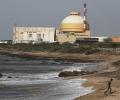
Kudankulam will house the largest nuclear power plants in India and the flagship project of Russian-Indian technological and energy cooperation.
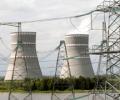
Under a 2010 nuclear liability law, nuclear equipment suppliers are liable for damages from an accident, which companies say is a sharp deviation from international norms
India is working on new technologies such as the small modular reactors that can be factory-built and help make clean energy transition, Science and Technology Minister Jitendra Singh said in New Delhi.
If nothing is done, the country is set to become 83 per cent energy-import-dependent by 2040.
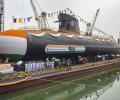
The status of the current submarine force level is alarming and we need to address the threat perceptions expeditiously. Critical decisions pertaining to national security cannot be delayed any further due to the rapidly changing maritime threat perceptions and growing strategic importance of the Indian Ocean region, asserts Commodore Venugopal Menon (retd).

24x7 power supply to farmers emerges as a political lightning rod in the state.
'Why should we disclose classified information to satisfy those who doubt our Hydrogen Bomb capability?'

The two countries also asked all nations to stop cross-border movement of terrorists and asserted that a decisive collective response from the international community without 'double standards and selectivity' was required to combat the threat of terrorism.
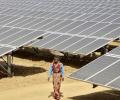
Arunabha Ghosh on why India will increasingly become an energy great power, but not an energy hegemon.
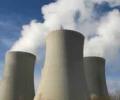
With the Trinamul government and NGOs stalling the Haripur nuclear plant, will the DAE allot the Russians another site elsewhere in India?

Vajpayee had always felt that India must act with conviction and panache. He decided that, irrespective of the attendant risks, he would undertake what many felt was a precarious course. A fascinating excerpt from N K Singh's Portraits Of Power: Half A Century Of Being At Ringside on Atalji's 96th birthday, December 25.

Russian President Vladimir Putin arrived in New Delhi late on Friday night for annual summit talks with Prime Minister Narendra Modi on Thursday that is aimed at building on the already close strategic ties, particularly in the fields of nuclear energy, hydrocarbons and defence.
.jpg)
Climate change and US-India collaborations in renewable energy resources will be up for discussion at the US-India energy summit coinciding with Prime Minister Narendra Modi's visit to Washington, DC, later this month, reports Aziz Haniffa.
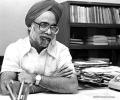
What stood out in his 15-year journey as a member of the political executive at the Centre was his glowing record as India's most successful and effective finance minister. Both as prime minister and finance minister, he understood the importance of gradualism, except when the economy or the polity was in a crisis.
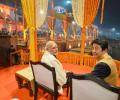
'Modi and Abe are working seriously for India-Japan bonhomie to grow stronger.' 'It is a win-win situation for both countries and the future look promising,' says Rajaram Panda, the Indian Council for Cultural Relations India Chair Visiting Professor at Reitaku University, Japan.

Dr Bhabha and Dr Sarabhai didn't feel guilty for their ambitions; it was for those 'mad scientists' that India is a powerhouse -- both at the atomic level and in the vastness of space, observes Kumar Abishek.

Once completed, the 10 reactors of 700 MW each will give much needed fillip to the domestic nuclear industry.
'I think some of us, like Mukesh Ambani, myself and those of us who head industrial units, ought to really focus on what we can really do to make the world a safer place, maybe 50 or 100 years from now.' 'For instance, how can we deal with climate change and global warming, right now?' 'The effects of it may not be felt now; in fact, we may pay a price for it today, but it will help the generations to follow.'

Prime Minister Narendra Modi's three-day visit to Britain has seen India and the UK agreeing on Rs 90,000 crore deals.

India and Russia on Thursday decided to expand cooperation in various sectors as they signed 16 pacts, including on joint manufacture of 226 military helicopters.

Marking a breakthrough in the protracted talks in the French Rafale jet deal, Prime Minister Narendra Modi announced on Friday that India will purchase 36 of these fighter planes that are ready to fly, citing critical operational requirement of the Indian Air Force.
