
Brave statements such as we will continue to be the fastest growing large country are of no consolation, because the direction of trade also determines the flow of investment, points out M Govinda Rao.
Donald Trump's Presidency of the United States will open new opportunities for India though certain sectors, especially pharma and IT, may face the heat if the incoming president decides to impose restrictions on imports and H1B visa regulations, experts said on Wednesday. Prime Minister Narendra Modi's friendly relationship with Trump will have a positive bearing on Indo-US relations but India may have to adapt its strategies to maintain cooperation in areas of mutual interest.
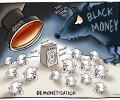
Months before 8/11, MP, Haryana probed note ban

According to the NIPFP, there is the possibility that even if the banking system matures over time, some transactions could bypass the system so as not to pay the BTT.

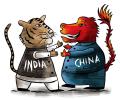
'We are not able to manufacture even low-end products as cheaply as China.' 'We are not buying Chinese goods today out of any love for China.'

A K Bhattacharya digs into the yet-to-be-public report on ways to curb black money and finds out that Modi's next moves could include action on dabba trading, hawala, and education.

India is among 75 countries with which Switzerland's Federal Tax Administration has exchanged information on financial accounts within the framework of global standards on Automatic Exchange of Information.

Finance firms in these SEZs likely to get tax breaks.

India's macroeconomic situation is certainly better than what it was a year ago, eminent economist Pinaki Chakraborty said on Monday, while expressing hope that the country will be back on the path of economic growth if there is no major third wave of the COVID-19 pandemic. In an interview with PTI, Chakraborty, who is the director of the National Institute of Public Finance and Policy (NIPFP), said that inflation may remain at an elevated level as there was a significant fiscal and monetary expansion in the last 18 months. "The current macroeconomic situation is certainly much better than what it was one year back. We are seeing recovery in most sectors," he said. Chakraborty noted that COVID-19 vaccination has been going on at a very fast rate in India.

They can carry huge amounts of data, have a lot of bandwidth, but operate at short ranges, between 200 metres and 2-3 km reports Surajeet Das Gupta
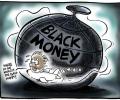
The studies found that sectors with the highest unaccounted income included real estate, mining, pharmaceuticals, pan masala, gutkka and tobacco, bullion and commodity markets, film industry, educational institutes and professionals.
The three leading think-tanks-- NCAER, NIFM and NIPFP-- conducting a joint study on the quantum of blackmoney, are likely to submit the report to government by December 2012, Parliament was informed on Thursday.

The Indian economy is expected to grow around 10 per cent during the current financial year on the likelihood of fewer COVID-19-linked supply disruptions and buoyancy in the global economy, said Poonam Gupta, director general of economic think-tank NCAER. The real challenge, however, would be to sustain a growth rate of 7-8 per cent in years to come, she said. "We could see annual growth in the ballpark range of about 10 per cent. "The reasons for this perceived optimism are: fewer supply disruptions; increased pent-up demand in the traditional and contact-intensive services; and a buoyant global economy.

Sajjid Chenoy, India economist at JP Morgan is the new part-time member.

The Modi government has handled inflation far better than any government in the past two decades. Both the stock market and currency indices have begun to show confidence in the economy, despite the mounting global headwinds of trade.


Measures that quickly boost demand and increase employment are needed to push up growth. Moreover, without announcing new planss, the government should strengthen schemes such as PM KISAN, MNREGA and programmes to build rural roads.

The panel might also decide on a new chairman.

Prime Minister Manmohan Singh has approved composition of the 7th Pay Commission, which will revise the salaries of over 50 lakh Central government employees.
If the protected growth in GST revenue is reduced to 10 per cent, the Centre would save more than Rs 25,000 crore in 2020-21 if none of the states show any revenue growth. This would nearly amount to 0.1 per cent of the gross fiscal deficit and help the government in avoiding fiscal slippage to some extent in subsequent years.

While buying health policies, customers should reveal any pre-existing diseases. This is the only way to ensure that the insurer does not reject claims.

Replying to a query, whether the government has made any assessment of black money stashed by Indians in foreign countries, Jaitley said there is no official estimation of that.

The venture is applying to the Reserve Bank of India for approvals.

India has joined global efforts to combat global tax evasion.

Several speakers noted that Budget carried the weight of expectations.

At the pre-Budget meeting at Niti Aayog, Modi called for a focussed effort from all stakeholders in order to achieve the target of $5 trillion economy. The participants urged the government to focus on credit expansion, exports growth, governance of PSBs, increasing consumption and job creation.
The government had no option but to cut spending to meet its borrowing targets.

Since the inception of the code, the threat of insolvency has brought many debtors in line
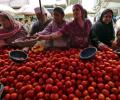
The rapid deceleration in prices has ignited a debate in New Delhi whether Asia's third-largest economy is heading towards deflation.

Citing national security and confidentiality clauses, the Finance Ministry has declined to disclose information on exchange of correspondence among India, Swiss and German authorities in connection with the black money probe.
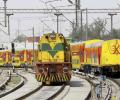
This comes as IR posted its worst operating ratio (money spent to earn every Rs 100) in 16 years, at 96.9 in 2016-17.

'The current crisis is one of incomes, driven by poor job growth, agrarian distress and poor investment sentiment,' notes Harsh Pati Singhania, director, JK Organisation.
Modi's government plans to support domestic demand

''Even without major reforms, with a business as usual scenario, and with current inflation trends, we should be clocking around 11 to 12 per cent nominal growth.' 'That is not happening and is a source of worry,' Rathin Roy tells Arup Roychoudhury.

It suggested reforms in the real estate sector.
Chief economic advisor Arvind Subramanian discusses the Budget, goods and services tax, Centre-state relationship and larger issues facing the economy

The Cabinet on Friday gave mandate to the 7th Pay Commission for revising salaries of over 50 lakh central government employees and remuneration of 30 lakh pensioners.

The panel suggested inclusion of alcohol and petroleum products in GST, as is being demanded by the Congress.

'Instead of doing reforms and restructuring, the present government is busy with the perception that everything is fine and the economy is hunky-dory.' 'Such hollow perceptions are very dangerous for the Indian economy in the long run.' 'The real risk to India is the lack of decent employment opportunities for youth in general and educated youth in particular.'
