
The boundary mess between India and Nepal needs a solution in a manner as mentioned by Nepal's Foreign Minister Shishir Khanal: 'On evidence not emotions', counsels Lieutenant General Shakti Gurung (retd).

India has rejected any role for third parties in resolving its border dispute with Nepal, following comments from Nepal's Prime Minister suggesting involvement of China and the UK.

Nepal's Prime Minister Balendra Shah addressed parliament on the ongoing border dispute with India, stating both countries have agreed to seek resolution through diplomatic means and expert consultation. Shah's remarks about Nepal also encroaching on Indian territories have sparked controversy.

Nepal has reiterated its commitment to resolving the border issue with India through diplomatic channels, emphasising historical agreements and understanding.

India has firmly rejected Nepal's objection to the upcoming Kailash Mansarovar Yatra via the Lipulekh Pass in Uttarakhand, dismissing Kathmandu's territorial claims over the region.

The Nepalese foreign minister was speaking to the media a day after holding wide-ranging talks with his Indian counterpart S Jaishankar that focused on ways to further expand ties in diverse sectors, including trade, critical technology, connectivity and energy.

'Our discussions focused on the India-Nepal development partnership and people-to-people ties.'

Nepal has reiterated its claim over the Lipulekh territory, stating it is an inseparable part of the country, after India and China agreed to resume border trade through the area. The Nepalese government has incorporated the territory into its official map and Constitution. India has rejected Nepal's claims, asserting they are not based on historical facts or evidence.
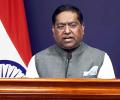
India on Wednesday categorically rejected Nepal's objection to a decision by New Delhi and Beijing to resume border trade through Lipulekh pass, saying Kathmandu's claims on the territory are not justified.
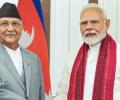
Nepal's claim on Lipulekh and Kalapani reopens a 200-year-old border dispute, while historical maps and treaties show the area belongs to India, asserts Lieutenant General Shakti Gurung (retd).

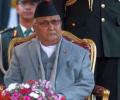
A profile of veteran Nepali politician K P Sharma Oli, detailing his rise to power, his various stints as prime minister, and his impact on Nepal's political landscape.

India maintains Lipulekh, Kalapani and Limpiyadhura belong to it.
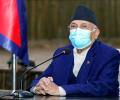
Former Nepalese prime minister KP Sharma Oli claimed that he was removed from power last year after his government published a new map of Nepal that included Kalapani, Limpiyadhura and Lipulekh as its territories.
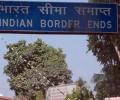
Both India and Nepal claim Kalapani as an integral part of their territory -- India as part of Uttarakhand's Pithoragarh district and Nepal as part of Dharchula district.

The ministry of external affairs said the artificial enlargement of territorial claims by Nepal is not based on historical facts or evidence.

Oli said the territories belong to Nepal 'but India has made it a disputed area by keeping its Army there'. "Nepalis were blocked from going there after India stationed its Army," he said.

Now, the bill will undergo a similar process in the National Assembly, wherein the ruling Nepal Communist Party commands two-thirds majority.
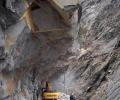
He claimed that India built a Kali temple, created 'an artificial Kali river' and 'encroached the Nepalese territory through deploying the Army' at Kalapani. The river defines the border between the two countries.
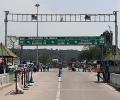
India has already termed as untenable the 'artificial enlargement' of the territorial claims by Nepal after its Parliament unanimously approved the new political map of the country featuring Lipulekh, Kalapani and Limpiyadhura areas which India maintains belongs to it.
The government had registered the amendment proposal in Parliament on May 22 after releasing the new political map of Nepal depicting Kalapani, Lipulekh and Limipiyadhura as its territories on May 18.
His visit comes ahead of the upcoming official trip of Indian Army chief Gen M M Naravane to Nepal in the first week of November. Goel called on Prime Minister Oli at his official residence at Baluwatar on Wednesday evening, the premier's press advisor Surya Thapa told PTI.
"India is open to engaging with all its neighbours on the basis of mutual sensitivity and mutual respect, in an environment of trust and confidence. This is a continuous process and requires constructive and positive efforts," Srivastava said.

Naravane is scheduled to meet Prime Minister K P Sharma Oli on Friday.

Gen Naravane on Tuesday said he was eagerly looking forward to the visit and exuded confidence that it will go a long way in strengthening the "bonds of friendship" between the armies of the two countries.
"This unilateral act is not based on historical facts and evidence. It is contrary to the bilateral understanding to resolve the outstanding boundary issues through diplomatic dialogue," External Affairs Ministry Spokesperson Anurag Srivastava said.
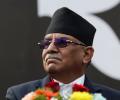
Former Nepalese foreign minister Ramesh Nath Pandey observed that the current situation is not encouraging for India-Nepal ties, saying the "present leaders" created irritants in the relationship in the past.
The meeting came days after Nepal Prime Minister K P Sharma Oli telephoned his Indian counterpart Narendra Modi to greet him on India's 74th Independence Day, in the first high-level contact after bilateral ties came under severe strain following issuance of a new political map by Nepal in May.
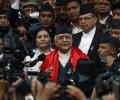
Nepal recently released the revised political and administrative map of the country laying claim over the strategically key areas of Lipulekh, Kalapani and Limpiyadhura.

Nepal said it was confident that both its "friendly neighbours" India and China will resolve their border stand-off at the Line of Actual Control through peaceful means.

According to India's assessment, the release of the new political map by Nepal and obtaining a legal backing to it from the lower house of Nepalese Parliament were part of a "myopic" agenda to gain mileage in domestic politics.

Nepal witnessed political turbulence in 2022 that dramatically turned rivals into allies and throned former guerrilla leader Pushpa Kamal Dahal 'Prachanda' as the prime minister for a third time, as Kathmandu made efforts to balance ties with immediate neighbours India and China with high-profile talks and visits.
In a dramatic turn of events, Communist Party of Nepal-Maoist Centre chairman Pushpa Kamal Dahal 'Prachanda' was appointed as the new prime minister of Nepal by President Bidya Devi Bhandari on Sunday.

Prachanda took the oath of office and secrecy from President Bhandari at an official ceremony at Shital Niwas.

The Chief of Army Staff is scheduled to hold extensive talks with the top civilian and military brass of Nepal including his counterpart General Purna Chandra Thapa on a range of key issues such as further boosting the management of the nearly 1,800 km-long border between the two countries.
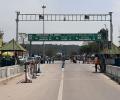
India has already termed as untenable the 'artificial enlargement' of the territorial claims by Nepal after its Parliament unanimously approved the new political map of the country featuring Lipulekh, Kalapani and Limpiyadhura areas which India maintains belongs to it.

The turning point in his career was undoubtedly Nepal where he was sent as ambassador and acted with a cool head.
Gen Naravane's visit to Nepal from November 4-6 is largely aimed at resetting bilateral ties that came under severe strain following a bitter border row between the two countries.
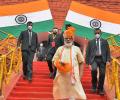
According to the details provided by Muraleedharan, the prime minister made five visits each to the United States, Russia and China, and multiple trips to some other countries like Singapore, Germany, France, Sri Lanka and the United Arab Emirates.
A house meeting has been scheduled for Saturday as per the Parliament's notice and the matter relating to the constitution amendment bill is likely to come during the meeting, parliamentary sources said. Meanwhile, in a conciliatory tone, India on Thursday said it deeply values its friendly ties with Nepal.
Local land records also say the land at Kalapani and Lipulekh belongs to the residents of two villages on the Indian side of the border, an official recently said.
