
'There is a consensus within the Indian security establishment -- at least among those who draw their conclusions from data instead of speaking from nationalist sentiment -- that India lacks the offensive capability to defeat Pakistan in a short war.'

For the family and supporters of blogger Avijit Roy, who was hacked to death in Dhaka in February, it is a time to reflect on where Bangladesh is heading, says Indrani Roy.

Notwithstanding its public denouncements against US' "unilateral" drone attacks, Pakistan approved the controversial strikes by the CIA for years under a secret deal with America, a damning media report said on Thursday.
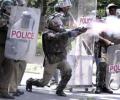
Two years after the Gopalgarh riots rocked Rajasthan, the violent episode has again hit headlines after the Central Bureau of Investigation, which is probing the case, closed 14 of the 19 First Information Reports filed in connection with the riots.

A lot of the terrorism that is affecting Pakistan is really a blowback of the Pakistani state's policy of using jihadist groups as instruments of state policy. And unlike some other countries with similar policies, Pakistan doesn't have the benefit of the political and social space for pulling back from the disastrous course, says Sushant Sareen.

If viewed as a part of the Al Qaeda's radicalisation effort to produce jihadists out of discontented Muslim youth in India, the call could well have a much larger dimension, both in the near as well as long term, directly impacting on national security, says Bibhu Prasad Routray.

The fever of banning meat spread on Thursday with such directives being issued in Rajasthan, Jammu and Kashmir and Ahmedabad.

Pakistan opposition leader Imran Khan on Sunday warned the Nawaz Sharif government that thousands of his supporters could enter the high-security Red Zone in Islamabad if the Prime Minister refused to quit, even as popular cleric Tahir-ul Qadri issued a 48-hour ultimatum demanding the same.

Zakir Naik, a gentle, rockstar televangelist, is dangerous as young Muslims may be swayed by his fundamentalist interpretations of Islam and justify victimhood and extremism, says Shekhar Gupta.

By revising the India-Bangladesh land boundary agreement, the NDA is going for short-term gains and losing the long-term perspective, says Gautam Sen.

Intelligence agencies draw a list of terror outfits that pose the gravest threat to India. Vicky Nanjappa reports

'This generation has seen no communication.' 'You have not given them any stake.' 'They don't have a feeling of belonging.' 'They have only seen a man in uniform with a gun.' 'That is why it is taking a more vicious form today -- the attacks on the security forces and the retaliation is causing heavy loss of lives.'

Rediff.com's Indrani Dey digs up chilling details of the ongoing investigation in the Bardhaman blast case, which exposed the a militant network that had been operating in West Bengal since many years.

Why Dalit leaders cross over to the BJP
.jpg)
We have in UP today the Bharatiya Janata Party and the Samajwadi Party representing the two extremes in a bid to capture power in this huge state that returns 80 members to Parliament, says Seema Mustafa.
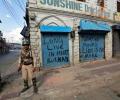
Separatists and their wide network must be neutralized for peace in the Valley

Thursday's savage murder of writer Avijit Roy in Dhaka raises troubling questions about religion-inspired terror in Bangladesh.
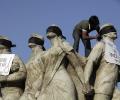
Bangladesh's main opposition Bangladesh Nationalist Party's three top women leaders were arrested on the second day of the 'democracy march' on Monday, as clashes erupted inside the supreme court premises between pro- and anti-government lawyers.

'Nobody is killing you in Kerala because you are Hindu unlike in North India where Muslims have been killed only because they are Muslims and were carrying some meat.'
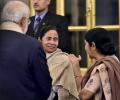
Prime Minister Narendra Modi has positioned himself as a credible partner for Bangladesh. He has scored by getting West Bengal Chief Minister Mamata Banerjee to travel with him to Dhaka, says Srinath Raghavan
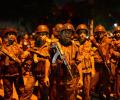
'I have noticed how a certain country wants to establish the presence of ISIS in Bangladesh.' 'Are these terrorists working under some religious inspiration or they are being lured by an obnoxious amount of money?' 'For some mysterious reasons, no action is taken by the government against suspicious organisations.'
.jpg)
Throughout a quarter century of proxy war, India has shown tremendous restraint in the face of grave provocation. It is inconceivable that any other nation would have refrained from launching trans-LoC operations to eliminate terrorist training camps and interdict known routes of infiltration, says Brigadier Gurmeet Kanwal (retd).

'It was a mission undertaken in darkness in every sense -- literally, because Afghanistan had no electricity at that time; and, metaphorically because Delhi historically dealt only with the Pashtuns of Afghanistan and the foreign ministry's vast archives had nothing to offer on the culture and politics of the northern tribes in the Hindu Kush.'

The Simulia madrassa, on the outskirts of Bardhaman town in West Bengal, allegedly had links with Gulshana Bibi and Amina Bibi, the women arrested after the October 2 blast in the town. The NIA alleges the madrassa trained poor Muslim women in jihad. The madrassa had an unwritten convention: The women trained there would be married only to men who were on the same 'mission.'

'My grandmother taking me to the jamatkhana was like a different world.' 'Like I had a key to a door which no one else seemed to have.' 'She doesn't take me anymore because she says I'm an embarrassment!'

How to deal with a country that has made export of terror a reason to make the world notice and fund it? Rediff.com contributor Sanjeev Nayyar offers a few suggestions

The million dollar question that begs for an answer is: Why is it that an amateurish attempt to convert a handful of Muslims by fringe Hindu elements garners so much attention while large scale systematic attempts to subvert Hinduism go unnoticed or are deliberately overlooked? If this is not double standards then what is, asks Vivek Gumaste.
.jpg)
The UP government, if it manages to remain in power now, must take immediate steps to ensure that no violence takes place as the country gears up for the elections. Action has to be taken to prevent this, not just through the law and order machinery, but through a secular campaign in which all non-communal political parties participate, says Seema Mustafa.

Taki in West Bengal's North 24 Parganas district is the last Indian outpost on the border with Bangladesh. It is one of hotspots for Bangladeshi infiltration into India. While most poor Bangladeshis cross over to look for work, terror groups take advantage to ferry their men and material into India. Indrani Roy/Rediff.com reports.
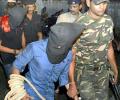
'Counter terrorism does not appear to be good guys fighting the bad ones; it is about people being picked up, detained and charged with crimes they did not commit.'

Indian intelligence agencies have often claimed that left-wing extremists are trying to make inroads in the militancy-hit regions of north-east to foment further unrest. But Jaideep Saikia, noted terrorism and conflict analyst, claims, "People who speak of Maoism taking roots in the north-east have not read history".
