
'We can integrate AI and tech into education, but that is just a means and not an end.' 'Ultimately, we need to control what happens in a classroom and we need to let teachers innovate their teaching style to suit the needs of Gen Z and beyond.'

As many as 274 fugitives have been repatriated from 36 countries in the last 7 years, an average of around 40 per year and a 10-fold jump from the 2004-13 period when around four fugitives were brought back every year, the government said on Tuesday.

Dinesh Trivedi's success or failure in this fragile diplomatic equilibrium will have consequences extending well beyond the Indian high commission in Dhaka. It will shape India's eastern strategic environment for years to come.

Notwithstanding the economic complementarities and the host of agreements for deepening economic relation on a host of areas, both sides share common viewpoints on the foreign policy domain and seek common grounds to serve as a counterweight to China, notes Dr Rajaram Panda.

'India should hold several high-level chess tournaments that would attract the world's top players so that the country will have a say in the game.'

Hyderabad-based Midwest Ltd has become the first Indian private company to secure overseas critical mineral mines, sealing a deal with Indonesia's state-run PT Perusahaan Mineral Nasional (PERMINAS) to ensure a long-term supply of rare earths.

'Our leaders, including Mallikarjun Kharge and Rahul Gandhi, are in touch with all Opposition parties, including the DMK and the AAP.'

The Congress escalated its campaign against alleged examination irregularities by marching to Prime Minister Narendra Modi's residence, transforming the issue into a direct challenge to his political authority and demanding the resignations of top government officials.

As a ruler he was a pragmatist and adaptable, and trying all the time to strengthen and perpetuate the empire that he and his forefathers had built.He seldom, if ever, allowed his policies to be determined by his religious beliefs, notes Rudrangshu Mukherjee.

The Union Ministry of Home Affairs has formed a High-Level Committee on Demographic Changes to study the impact of illegal immigration and other factors on India's demographic landscape.

For the foreseeable future, the most likely outcome remains continuation of the status quo. Taiwan will remain self-governing without formally declaring independence, while China continues to apply sustained pressure short of war, predict Krishnan Srinivasan and Manoj Mohanka.

An innovation roadmap, a mechanism to double annual bilateral trade within next five years, and a joint artificial intelligence framework were among 13 outcomes to emerge from wide-ranging talks between Prime Minister Narendra Modi and President Emmanuel Macron on Sunday.

Through his commitment to democratic norms, debate, dissent and constitutionalism, Jawaharlal Nehru helped ensure that parliamentary democracy took deep root in independent India. Utkarsh Mishra evaluates Nehru's 17 years as India's first prime minister, examining his role in nation-building, democratic institution-building, economic planning, scientific advancement and foreign policy.

Few leaders since Independence have been able to establish such a direct connection with the electorate or shape the national conversation to the extent that Narendra Modi has done over the past decade, points out former Union minister Dr Karan Singh.

India has established a high-level inter-ministerial body, the AI Governance and Economic Group (AIGEG), to steer the country's national AI governance strategy. The AIGEG will coordinate policy across ministries and oversee cross-sectoral governance issues, supported by a Technology and Policy Expert Committee (TPEC).

India's newly formed Artificial Intelligence Governance and Economic Group (AIGEG) is set to advocate for a unified legal framework for AI companies, including developers of large language models and chatbot systems, alongside broader operational rules.

National Security Advisor Ajit Doval called for decisive action against terrorism and said there cannot be 'double standards' in the fight against it, while addressing an international security forum in Russia.

HDFC Bank has launched an independent review by external law firms following the abrupt resignation of Chairman Atanu Chakraborty, who cited 'ethical concerns and practices within the bank' as the reason for his departure.

'Today, we see people go on ChatGPT to ask 'can you plan my holiday' and then they have to go outside of the ChatGPT window to make all the bookings and so how can we complete that really high-intent use case that a user has come to ChatGPT with and help them complete that all the way within the chat GPT window.'

Atanu Chakraborty has resigned as chairman of HDFC Bank, citing ethical concerns, marking an unusual departure and prompting the appointment of an interim chairman.

Dr Subhash Kashyap not only enhanced Parliament's image in India and abroad, but also the position of Lok Sabha secretary-general which succeeding secretary-generals have upheld thorough neutrality, objectivity and high degree of professionalism, notes Rup Narayan Das.

The NDA government has gradually nuanced its position on the issue of demographic challenge.

Chinese President Xi Jinping has arrived in Pyongyang for his first official visit in seven years, meeting with North Korean leader Kim Jong-un to reaffirm their long-standing friendship and pledge further development of bilateral relations amidst Pyongyang's deepening military ties with Moscow and China's assertions against Japan's 'new militarism'.

The 2026 FIFA World Cup, co-hosted by the United States, Mexico, and Canada, is set to be football's largest tournament but will unfold against a backdrop of significant geopolitical tensions, including conflicts, strained alliances, and complex immigration policies, challenging its traditional role as a symbol of global unity.

Through policy interventions, Indian cities need to be reimagined as a network of inter-connected assets and services which serve to strengthen the social contract between citizens and their cities by improving their quality of life, the Economic Survey has flagged.

Union Home Minister Amit Shah said infiltration and other reasons are causing 'unnatural' demographic change, which poses a significant challenge to the present and future of any nation.

The West Bengal cabinet has decided to discontinue assistance-oriented schemes based on religious categorisation for Imams, muezzins and purohits from June. The cabinet also approved the 'Annapurna' scheme of Rs 3,000 monthly support to women from June 1, and granted in-principle consent for their free travel in state-run buses.
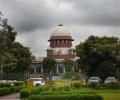
The Supreme Court has stated that roads cannot be blocked for religious activities and that while religious denominations have autonomy in worship, the government can interfere if secular activities are affected.

Trump seems to have estimated that Ghalibaf is a pragmatic politician who is receptive to close relations with the US and is enthusiastic about fostering business and economic ties in particular, points out Ambassador M K Bhadrakumar.

The Indian government has launched the Urban Challenge Fund (UCF) with a total outlay of Rs 1 lakh crore, aiming to leverage private and market finance for urban infrastructure projects by providing state support in capacity building and credit guarantees.

The BJP-led government in Bihar secured a vote of confidence in the state assembly, with Chief Minister Samrat Choudhary pledging economic development and significant investments. The motion was passed amidst heated debates and accusations between the ruling NDA and the opposition, highlighting political tensions and differing views on issues like women's reservation.

Sadhvi Satish Sail, model and entrepreneur, is crowned Femina Miss India World 2026.

'Nepal today is far more aware, self-confident, aspirational, and assertive.' 'India's policy so far has not been geared to this shift. It is time to redraw our Nepal strategy.'

Phunchuk Stobdan's forte was candour and strong views on India's defence. Naturally, India's adversaries were in awe of him, fearing his views and unyielding stand on boundary issues, remembers Tarun Vijay.

If Trump wants peace with Iran, Pakistan will offer to help. If Trump seeks Pakistan's aid to spy on Iran, then too Munir will not hesitate to chip in. At the same time, the ISI will not hesitate to tip off Iran now and then, points out M R Narayan Swamy.

Congress leader Shashi Tharoor discusses India's role in the US-Iran peace talks taking place in Islamabad, emphasising the importance of peace over competition with Pakistan and highlighting India's regional interests.

A top Swiss official has emphasised the growing importance of science and technology in international affairs, leading Switzerland to prioritise anticipatory science diplomacy in its foreign policy. Collaboration with India reflects a shared vision between two global innovation leaders.

Vijay Varma delivers a tour de force performance in Nagraj Popatrao Manjule's Matka King, a compelling eight-part series that chronicles the rise and fall of a gambling trailblazer in 1960s-1970s Bombay, notes Sukanya Verma.

The Indian embassy in Tehran has earlier stated that it is facilitating the safe movement of nationals who wish to leave Iran.

In a region increasingly shaped by competition and coercion, such collaboration strengthens security without confrontation, builds capacity without dependency and promotes order without domination, points out Dr Kumar.
