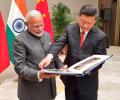
China's foreign ministry on Monday parried questions on a possible meeting between Prime Minister Narendra Modi and President Xi Jinping on the sidelines of the BRICS summit in Russia this week.

Chinese Foreign Minister Wang Yi has called on India to implement the consensus reached by Prime Ministers Narendra Modi and Xi Jinping at their summit in Russia, urging a restart of bilateral ties. Wang emphasized the importance of respecting each other's core interests, enhancing mutual trust, handling differences effectively, and bringing the relationship back on track. He suggested practical steps such as resuming flights, easing visa procedures, and planning commemorative activities for the 75th anniversary of diplomatic relations. Wang also highlighted the shared interests and opportunities for cooperation between the two countries, advocating for mutual development and strengthening coordination in international affairs.
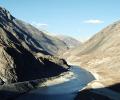
External Affairs Minister S Jaishankar reiterated India's stance on the Depsang and Demchok areas in Ladakh, stating that Indian security forces will patrol up to the historical limits. He also firmly rejected Nepal's alleged territorial claims, asserting that India's position on the border is clear and will not be altered. Jaishankar also addressed the situation in Myanmar and India's 'Neighborhood First' policy, highlighting the government's commitment to regional cooperation and development.

One could argue that India is not troubled in the same way as China is by a declining population and structural problems in real estate/construction and finance. But India has serious trade and fiscal imbalances, and excessive dependence on capital expenditure by the government, points out T N Ninan.
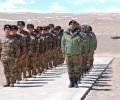
Chinese foreign ministry spokesperson Mao Ning told the media in Beijing on Monday that the two sides held an in-depth exchange of views on expediting the resolution of relevant issues.

China and India have maintained "candid and in-depth communication and coordination" to promote disengagement in areas along the Line of Actual Control (LAC) in eastern Ladakh after the eighth round of talks to resolve the current standoff, the Chinese military said on Thursday.
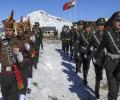
India and China held two days of military talks in an "open and constructive manner" for an early and mutually acceptable resolution of the remaining issues along the Line of Actual Control in eastern Ladakh and agreed to maintain peace on the ground.
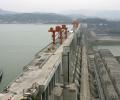
China has approved the construction of the world's largest dam on the Brahmaputra River in Tibet, close to the Indian border. The USD 137 billion project, which is expected to dwarf even China's own Three Gorges Dam, has raised concerns in India and Bangladesh, the downstream riparian states. Concerns in India are centered around China's potential to control water flow, potentially enabling the release of large amounts of water to flood border areas in times of hostilities. The dam is part of China's 14th Five-Year Plan, and the Chinese government claims that the project is safe and prioritizes ecological protection.

'Once we deal with the disengagement, there is the larger issue as both of us have brought a very large number of troops up to the border.' 'So there is what we call the de-escalation issue, and then there is the larger, the next step is really, how do you deal with the rest of the relationship?'
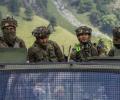
Two days after the India-China military talks, the joint statement, issued in New Delhi by the Indian Army said both sides had a 'candid and in-depth exchange' relating to disengagement along the Line of Actual Control (LAC) in the Western Sector of India-China border areas.

Chinese Foreign Minister Wang Yi has expressed readiness to join hands with India's National Security Advisor Ajit Doval to "properly handle" issues related to the situation on the ground in the border areas, amid the protracted border row in eastern Ladakh.

Disengagement from the LAC will remain a chimera because China has given enough indications that the PLA will not move back any more. China has even deployed drones to monitor and deny any patrolling by Indian troops even in the buffer zones which are all in Indian Territory, explains Lieutenant General Prakash Katoch (retd).

'With continued focus on votes, upcoming by-polls and purchasing politicians, the political hierarchy has little time for national defence.' 'They would do well to heed a veteran scholar, who says, "There will be war with China in the next few years. The next full scale war will have the involvement of Pakistan and terror elements, insurgents and intelligence assets operating inside India",' warns Lieutenant General Prakash Katoch (retd).
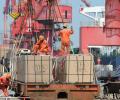
The China-India bilateral trade in the first half of the year totalled $57.48 billion, up 62.7 per cent year on year, perhaps the highest in recent years amid the Ladakh impasse and the COVID-19 pandemic, according to data released by China's Customs. Though Indian exports to China picked up with 69.6 per cent year on year increase, the trade deficit, a structural problem for India for long, climbed to 55.6 per cent. According to data released by China's Customs, India's exports to China reached $14.724 billion, up 69.6 per cent year on year in the first six months and India's imports from China amounted to $42.755 billion, up 60.4 per cent.

'The border deal offers a hedge for India against Trump's unpredictability when it comes to his approach to competition with China.'

'Disengagement is merely the first step in a lengthy process of arriving at a new normal along the LAC in Eastern Ladakh and the entire land boundary.' 'The Indian government should insist on the restoration of the status quo ante in Eastern Ladakh.'

'The design of the logo of this competition is a symbol of the rich cultural heritage and all-round progress of glorious Bihar.'

'The greatness of India can be experienced by meeting Indians on the frontiers of India.' 'Every citizen on the border is a soldier'
The border standoff between the Indian and Chinese militaries erupted on May 5 last year following a violent clash in the Pangong lake area and both sides gradually enhanced their deployment by rushing in tens of thousands of soldiers as well as heavy weaponry.
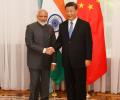
'The fact that Modi and Xi exuded confidence to accelerate the negotiations for a border settlement alone underscores that the Russia-India-China triangle has become very dynamic,' notes Ambassador M K Bhadrakumar.

A broad consensus has been achieved by India and China on restoring the 'ground situation' along the Line of Actual Control (LAC) pursuant to talks, including for patrolling and grazing cattle in the traditional areas, Defence Minister Rajnath Singh said on Thursday.
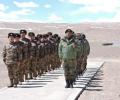
The US hopes that the differences will be resolved peacefully, officials said in Washington.

The 16th Brics Summit beginning Tuesday in Kazan, Russia, is expected to see more focus on creating a sharper energy policy for Brics that ensures closer partnership among members in both energy security and energy transition, official sources said. The same is expected to be a part of the Kazan declaration, currently being negotiated, they added.

The processing time for students applying under the Student Direct Stream (SDS) was significantly shorter and approval rates higher, something that will change after Canada ended the scheme on Friday.

In a joint declaration issued after the 16th BRICS Summit in the Russian city of Kazan attended by Prime Minister Narendra Modi and Chinese President Xi Jinping, among others, the leaders reiterated unequivocal condemnation of terrorism in all its forms and manifestations while reaffirming that it should not be associated with any religion, nationality, civilisation or ethnic group.

During a weekly press briefing, the Foreign Office Spokesperson Mumtaz Zahra Baloch said that invitations have been sent to the heads of countries to participate in the meeting which will take place on October 15-16, the Dawn newspaper reported.

Chinese ambassador to India, Xu Feihong, on Wednesday expressed hope that the recently completed Indo-China border disengagement in Eastern Ladakh would smoothen relations and pave the way for a better understanding between the two neighbours in the days ahead.

China has stayed on top for two consecutive months in the MSCI Emerging Markets Investable Market Index (EM IMI), after ceding the position to India in August. At the end of October, China's weight in the key EM gauge stood at 24.72 per cent, up from 21.58 per cent at the end of August. India's weight during this period has slipped to 20.42 per cent from 22.27 per cent.
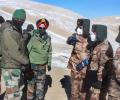
India and China on Tuesday agreed to hold the next round of the Senior Commanders meeting at an early date to achieve complete disengagement from all friction points in eastern Ladakh to create conditions for the restoration of normalcy in bilateral ties.

331,602 Indians are studying in the US, making India the 'top sender' of international students to America for the first time in 15 years, as it overtook China for the academic year 2023-2024.
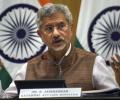
The last Indian external affairs minister to visit Pakistan was Sushma Swaraj. She had travelled to Islamabad in December 2015 to attend a conference on Afghanistan.

Prime Minister Narendra Modi on Tuesday conveyed to Russian President Vladimir Putin that India stands ready to provide all possible cooperation towards ending the Russia-Ukraine conflict and that dialogue and diplomacy is the only way to bring peace to the region.

Quarterly earnings of corporates, trading activity of foreign investors and inflation data are the key factors that are expected to drive the momentum in the equity markets this week, analysts said.

Jaishankar described as a "reasonable supposition" to expect some improvement in the relations between India and China following the last round of disengagement but hesitated to say that there could be a reset of the ties.

Almost five years later, the three services have still not fully understood that joint/theatre commands are not a discussion point; they are the prime minister's diktat on a military reform measure that is in line with what armed forces around the world have implemented, points out Ajai Shukla.
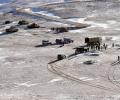
Both countries have reached a mutual agreement for disengagement of troops from the most contentious area of North and South Pangong Lake.

China on Thursday said the meeting between Prime Minister Narendra Modi and Chinese President Xi Jinping in Russia's Kazan on Wednesday carries a "great significance" as they reached an "important common understandings" to improve the bilateral ties.

Colombo seems to be veering to the middle path between China and the US on global matters, but in regional matters of strategic security, it is increasingly identifying with India, points out N Sathiya Moorthy.

Lisa Curtis, who served as deputy assistant to President Trump and as National Security Council senior director for South and Central Asia from 2017 to 2021, said she expected the same bumps for India and the US, as in Trump's first term, including tariff, dependence on Russia over arms supply and oil purchase from Iran. Curtis, however, said both countries could never enter an alliance but develop a partnership that is "short of an alliance". She hoped them to achieve a cooperation that deters China, but also prepares both countries in case of a crisis or conflict, be it in the Taiwan Strait, the South China Sea, or another flare-up on the India-China border.
The development comes after after reaching a consensus in the 16th round of military talks, the two sides said in a joint statement this evening.
