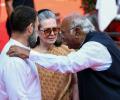
'They want to keep the pot boiling all the time.' 'The BJP wants to set a political narrative that the Gandhis are doing wrong things.'
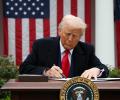
On India, the chart showed that the country charged 52 per cent tariffs on the US "including currency manipulation and trade barriers," and America will now charge India "discounted reciprocal tariffs" of 26 per cent.
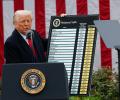
US President Donald Trump announced a 26 per cent "discounted reciprocal tariff" on India, half of the 52 per cent levies imposed by India on American goods, as he described India as "very, very tough."
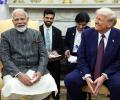
"Their Prime Minister just visited -- he's a great friend -- but I told him, 'You're not treating us right. You charge us 52%, while for years, decades even, we've c'harged you next to nothing. It wasn't until seven years ago, when I took office, that we started pushing back, beginning with China.'"
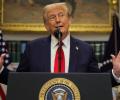
United States President Donald Trump has once again held out the threat of tariffs to BRICS (Brazil, Russia, India, China, South Africa) nations if they try to replace the US Dollar with any other currency.
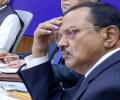
National Security Advisor Ajit Doval arrived in Beijing on Tuesday to take part in the India-China Special Representatives' talks to be held on Wednesday aimed at restoring the bilateral ties stalled for over four years' due to the military standoff in eastern Ladakh.
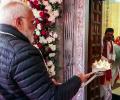
Prime Minister Narendra Modi visited the Mukhwa temple in Uttarakhand, the winter abode of Goddess Ganga, and offered prayers. The visit is expected to boost winter pilgrimage and tourism in the state. Modi also flagged off a trek and bike rally and addressed a public meeting in Harshil. This comes a day after the Cabinet Committee on Economic Affairs approved two major ropeway projects to Kedarnath and Hemkund Sahib worth over Rs 6,000 crore.
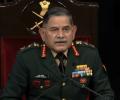
Army Chief General Upendra Dwivedi Monday said there is still a 'degree' of standoff between the Indian and Chinese militaries along the Line of Actual Control in eastern Ladakh and both sides need to sit down and firm up a broader understanding on how to calm down the situation.
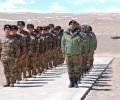
The Working Mechanism for Consultation and Coordination on India-China Border Affairs (WMCC) was established in 2012 as an institutional mechanism for consultation and coordination for the maintenance of peace and tranquillity in the border areas.

In their first structured bilateral talks in nearly five years, Prime Minister Narendra Modi and Chinese President Xi Jinping Wednesday agreed that India and China can have a 'peaceful and stable' relationship by displaying maturity and mutual respect and endorsed the pact on the resolution of the dragging eastern Ladakh border row.
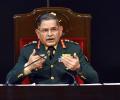
The General said it was "too early" to take a call on the role of Bangladesh, where a change in government may bring about a change in the relationship between it and India.

The external affairs minister also recalled how Pandit Nehru was hesitant in taking assistance from the United States following the 1962 war with China as he was unsure how it would be seen.
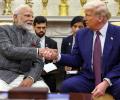
India should convert the Trump threat to an India opportunity, re-embracing a more liberal trade regime as a way of reviving manufacturing output and exports.
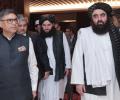
India's Foreign Secretary Vikram Misri has arrived in Beijing for a two-day visit during which he will hold talks with Chinese officials. The visit comes amid ongoing efforts to de-escalate tensions along the Line of Actual Control (LAC) in eastern Ladakh and to resume bilateral cooperation in various fields, including the Kailash Mansarovar Yatra.
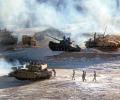
The actions on the ground would be confirmed and are expected to be followed up soon.

Kazan in Tatarstan, south west Russia, is where the annual BRICS summit will be held this week.
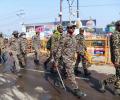
The Union Budget 2025-26 on Saturday allocated Rs 2,33,210.68 crore to the Ministry of Home Affairs with the majority of the fund -- Rs 1,60,391.06 crore -- being given to central police forces like Central Reserve Police Force (CRPF), Border Security Force (BSF) and Central Industrial Security Force (CISF) which are responsible for internal security, border guarding and security of vital installations.

The Tata Group is one of the very few Indian MNCs which has carved out a niche in China's highly competitive market, notes Rup Narayan Das.
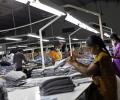
In the shadows of a sliding rupee, India's knitwear hub Tiruppur is weaving a success story. While the domestic currency edges closer to the 86 mark against the US dollar, triggering concerns for many sectors, this textile town in Tamil Nadu is finding opportunity in adversity: Between April and December alone, Tiruppur's exports reached Rs 26,000 crore, almost eclipsing last financial year's total of Rs 30,690 crore.

Asked about the recent meeting between Modi and Xi, and if Russia had any role in it, Alipov said, "We have not played any role in it, but we are happy that it took place in Kazan... We wholeheartedly welcome the meeting."

Prime Minister Narendra Modi and Chinese President Xi Jinping will hold bilateral talks on Wednesday on the margins of the Brazil, Russia, India, China, South Africa (BRICS) summit in Russia, in their first structured meeting since the eastern Ladakh border row erupted in May 2020.
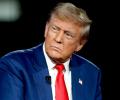
A leading expert predicts that the incoming Trump administration will likely continue its pro-India policies, including the Indo-Pacific strategy and Quad, but highlights potential challenges such as trade disagreements, immigration issues, and a possible quid pro quo for technology sharing. The expert also notes that the Trump 2.0 administration may prioritize great power politics over strategic altruism, potentially impacting human rights and religious freedom concerns.
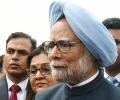
Condolences have poured in from across the globe, including from the United States, Canada and Sri Lanka following the demise of former Prime Minister Manmohan Singh.

An improvement in political relations, anchored in a restoration of peace and tranquillity at the border, could open up opportunities for expanded economic and commercial relations between them, suggests former foreign secretary Ambassador Shyam Saran.

Jaishankar said, "The immediate part which awaits us is what we call the de-escalation, which is the build-up of forces along the Line of Actual Control."

China's Defence Ministry says the militaries of China and India are making "great progress" in implementing the disengagement agreement to end over four-year-long standoff in eastern Ladakh. Spokesman Sr Col Wu Qian said Defence Minister Rajnath Singh and his Chinese counterpart Admiral Dong Jun had a positive meeting in Vientiane, Laos, last week, and the two sides are implementing the settlement reached between the two counties. The two ministers agreed to implement the important consensus reached between the top leaders and promote stable relations between the two countries, the spokesman said.
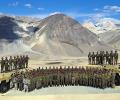
If China is accommodating regarding Depsang and Demchok, a resolution of the Sino-India territorial dispute in Eastern Ladakh could be possible.
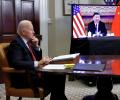
Washington is signalling to Delhi that it can rely on American support in any great game vis-a-vis China. Delhi shouldn't fall into the trap, argues Ambassador M K Bhadrakumar.
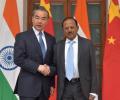
The two sides have already held 21 rounds of talks under the framework of SR dialogue which was set up to find an early solution to the border dispute.

India and China will complete the disengagement process in the Gogra-Hotsprings area in eastern Ladakh by September 12, the External Affairs Ministry said on Friday.
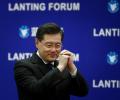
Qin, who is visiting New Delhi to attend the G20 Foreign Ministers meeting on Thursday, is expected to meet Jaishankar on its sidelines though the foreign ministry here is tight-lipped about it.
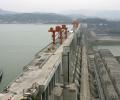
China has defended its plan to build the world's largest dam on the Brahmaputra River in Tibet, assuring that the project will not affect riparian states and safety issues have been addressed through decades of studies. The dam, estimated to cost USD 137 billion, has raised concerns in India and Bangladesh, but Chinese authorities maintain that the project has been thoroughly studied and safeguards are in place. The dam is part of China's efforts to develop clean energy and respond to climate change.

China on Tuesday confirmed that it has reached an agreement with India to end the standoff between the two armies in eastern Ladakh.
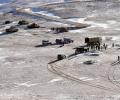
The MEA said the two sides agreed to continue discussions through diplomatic and military channels to resolve the remaining issues "at the earliest" so as to create conditions for the restoration of normalcy in the bilateral relations.

In the meeting, Doval conveyed to Wang that peace and tranquillity in border areas and respect for the Line of Actual Control are essential for return of normalcy in bilateral ties, according to the ministry of external affairs.
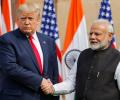
The China threat continues to resonate in the strategic partnership between India and the USA, points out Rup Narayan Das.

The Army said Gen Pande witnessed Parvat Prahar exercise besides interacting with officers and troops deployed in the region. The exercise featured a display of operational capabilities by artillery guns and other key weapon systems.

'India and China have the wise and sage leadership to steer this complex relationship in the coming decades.'

India and China have implemented a pact on patrolling in Depsang and Demchok along the Line of Actual Control (LAC) in eastern Ladakh, as per agreed modalities and timelines. The agreement was reached on October 21 and includes provisions for disengagement and patrolling in the last two friction points in the region. The pact has been effected and implemented as agreed, with both sides resuming patrolling activities and grazing, where applicable, as per longstanding practice before the friction began. The terms of the disengagement agreements reached prior to the latest pact continue to hold in relevant areas in eastern Ladakh. The agreement applies mutually to both sides and is without prejudice to India's positions on the LAC or boundary lines. India and China are each carrying out one round of patrolling in Depsang and Demchok, but they have maintained their deployment of troops along the LAC. The focus now is on de-escalation of the overall situation. The agreement was endorsed by Prime Minister Narendra Modi and Chinese President Xi Jinping in a meeting in Kazan, Russia, signaling attempts to normalize ties.

Diwali Recipe: Shilpi's Makhane Ki Kheer
