
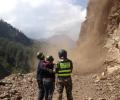
Flash floods in Tibet's Gyirong County, near the China-Nepal border, have resulted in five deaths and 558 missing individuals, including 260 foreign nationals. The disaster also caused significant casualties in Nepal and disrupted infrastructure. Rescue operations are underway, and concerns are rising over a newly formed barrier lake that poses a risk of further flooding.

A massive flash flood near the China-Nepal border in Tibet has left hundreds missing and caused significant casualties. Chinese Premier Li Qiang visited the affected Gyirong Township to oversee rescue and relief operations, with the PLA mobilising forces for search and rescue.

Devastating flash floods near the Tibet-Nepal border have led to the evacuation of over 1,000 people, including tourists, from Gyirong County. The floods caused casualties in both Tibet and Nepal, disrupted infrastructure, and prompted a Level-IV alert due to a rapidly forming barrier lake with a high risk of breaching and causing further downstream flooding.

A massive mudslide near the China-Nepal border in Tibet has left three people dead and 588 missing. Chinese President Xi Jinping has ordered all-out rescue efforts, with the PLA mobilising forces for search and relief operations in the affected Gyirong County. The Indian Embassy has also issued an advisory for stranded Indians.

China has issued a Level-IV alert due to a newly formed barrier lake at the Tibet-Nepal border, warning of a high risk of breaching and flooding downstream areas. The lake, formed at the confluence of Chhochen Khola and Purepu Tsangpo rivers, has accumulated an estimated two million cubic metres of water, with inflows expected to increase, raising concerns for areas including Gyirong Port.

Nepali security forces have intensified search and rescue operations across the flood-hit areas, using helicopters and ground teams to evacuate survivors and search through mud and debris.
The operation remains challenging as destroyed roads and bridges have cut off several remote communities, while hundreds of people are still missing.

Chinese President Xi Jinping has ordered extensive rescue operations following devastating flash floods and mudslides near the China-Nepal border in Tibet. The disaster has caused heavy casualties, left nearly 400 people missing, including 105 Indians and 37 NRIs, and damaged infrastructure. Emergency teams have been deployed, and efforts are underway to evacuate residents and provide medical aid.

Chinese officials warn that glaciers on the Tibetan Plateau are becoming increasingly unstable, leading to a higher risk of flash floods and other disasters, as evidenced by a recent deadly ice-rock avalanche near the Nepal-Tibet border. The region has seen a significant reduction in glacier area, and scientists are calling for advanced monitoring systems to predict these complex events.

One week ago, on August 26, 2026, deadly flash floods and mudslides devasted Nepal. Powerful floodwaters and landslides tore through river towns, leaving behind widespread destruction and grief. Rescue efforts across the affected districts continue even as hopes fade of finding survivors.

The death toll from devastating flash floods in Nepal has surged to 1,252, with more bodies recovered and fresh flood risks emerging due to continuous rainfall in the Bhotekoshi River's upstream areas. The disaster, triggered by an ice-rock avalanche, has also left 4,875 people missing and prompted calls to address climate change's impact on the Himalayan region.

China on Friday said the collapse of a high-altitude glacier in Nepal may have triggered the massive flash flood disaster that engulfed the Tibet-Nepal border, killing hundreds and causing widespread damage.

Scientists are examining how a possible glacial collapse and ice-rock avalanche may have triggered the devastating flash floods along Nepal's Bhote Koshi River, with preliminary assessments indicating that debris may have temporarily blocked the Lhende River and created a landslide dam that subsequently gave way.

Nepal is grappling with a deepening flood crisis as the death toll from devastating flash floods in Rasuwa and surrounding districts has tragically risen to 538, with authorities now warning of a fresh flood threat and initiating evacuations.

Nepal's devastating flash floods have claimed 1,127 lives, with thousands still missing a week after the disaster. Rescuers are intensifying efforts to find survivors and recover bodies across affected regions, while police work to identify victims and relocate families from high-risk areas.

The death toll from flash floods in central Nepal has surged to 734, with nearly 2,500 people still missing. India has intensified its rescue and relief efforts, sending additional aid, technical teams, and forensic experts, while also working to locate and rescue over 275 missing Indian nationals.

China on Friday inaugurated its second railway line in Tibet, built at a cost of $2.16 billion, close to Indian border in Sikkim, enhancing mobility of its military in the remote and strategic Himalayan region.

China plans to build a new highway along the Line of Actual Control (LAC) with India as part of Beijing's efforts to strengthen its strategic position and project its power, a media report said on Wednesday.

The 7.9 Richter Scale temblor that struck Nepal on Saturday also affected parts of Tibet. The two border ports to Nepal were seriously affected.

The death toll in Nepal from this week's earthquake has risen to 110, authorities said on Thursday even as a fresh tremor, measuring 4.5 on the Richter scale, was felt in Nepal on Thursday.
Over a dozen aftershocks jolted Nepal on Wednesday, keeping people on edge a day after a powerful 7.3-magnitude earthquake killed 76 people in the Himalayan nation that had just begun to rebuild itself following the devastation from the temblor less than three weeks ago.

The two countries sealed 10 agreements, including the much-publicised transit trade treaty which will end Nepal's total dependency on Indian sea ports for third-country trade.

Though Beijing asserts the Dalai Lama's successor needs its approval, observers say it remains concerned as the present Panchen Lama, the number two spiritual leader who was appointed by it after unseating the boy nominated by the Dalai Lama, has not gained much traction in Tibet.

The new rail and road cargo service launched on Friday, linking Guangdong, Tibet and Nepal, aims to boost trade with the South Asian neighbour as China pushes forward its Belt and Road (Silk Road) initiative, state-run Xinhua news agency reported on Saturday.

The death toll in southwest China's Tibet Autonomous Region due to Saturday's earthquake and its aftershocks, climbed to 25 on Tuesday, even as rescuers continued to reach out to the affected people in the remotest of areas.
