
The Indian rupee ended slightly lower at 64.01/02 per dollar compared with Tuesday's close of 63.98/99 per dollar due to month-end dollar demand by importers.

The rupee has depreciated 2.35 per cent in the past three months and one per cent in the past month, despite strong capital flows and falling oil prices.

Some experts, however, see a silver lining in the fall and said the volatility has come down sharply and that bodes well for the Indian currency

Bucking a strong trend in share market, the Indian rupee on Monday gave up all its initial gains and slipped 18 paise to close at 61.94 against the Greenback on rising dollar demand from importers.

Increased month-end demand for the US currency from importers put pressure on the rupee

Extending its losing streak for the fourth straight day, the rupee weakened by five paise to 61.01 against the US dollar in early trade today at the Interbank Foreign Exchange market on high demand for the American currency from importers.

Benchmark share indices opened lower on Monday, amid weak global cues, as investors turned cautious ahead of the US Federal Reserve stance on interest rate.

The Rupee is seen strengthening against the dollar.

The dollar strengthened against major world currencies.

Forex dealers said besides dollar's gains against other currencies, fresh demand for the American unit from importers and a weak opening in the domestic equity market put pressure on the rupee.


The immediate concern for the rupee is the sharp spike in oil prices

The rupee depreciated further by 7 paise to 65.12.

There's sustained demand for the American currency from importers and banks

India Ratings on Mondy projected a 7.7 per cent growth this fiscal driven by consumption demand.

Global currency market sentiment is likely to be driven by the US deficit and debt ceiling negotiations, with markets likely to turn more risk averse closer to October 17, the date by which the US Congress must approve raising the country's borrowing limit.
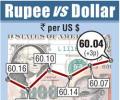
The rupee had gained 6 paise to close at 60.07 against the dollar in Thursday's trade on fresh selling of the American currency by banks and exporters in view of strong capital inflows.

The improvement in the current account deficit is expected to provide a major reprieve to the government and the Reserve Bank of India which have been battling to prop up the rupee.

The rupee largely shrugged off the high volatility in stocks and rebounded sharply towards the fag-end trade following bout of dollar selling by exporters

In line with rally in stocks, the Indian rupee on Monday appreciated for the second straight session and closed with a eight paise gain at a one-week high of 61.36 against the Greenback.
Hawkish guidance by the US Fed raises concerns it could tie the hands of RBI from trimming rates.

The central bank will auction Rs 220,00 crore (Rs 220 billion) of government cash management bills every Monday, it said in a statement, without specifying for how many weeks the sales would last.

Surging value of dollar may be posing the biggest threat to US corporate earnings.

The dollar gained against other currencies overseas.

If you plan to send your child to the US five years from now and expect the rupee to depreciate five per cent every year, adding US funds to your portfolio might be a good idea, says Ashley Coutinho.

The rupee recovered by 11 paise to trade at 60.84 against the US dollar in early trade today on selling of the American currency by banks and exporters.

French stocks, particularly those exposed to the country's large tourism sector, are likely to suffer the biggest falls

The falls meant that both crude futures were at their lowest levels since mid-April
The rupee had last ended at 67.22 per dollar on March 16, 2016.

Market experts on why the bulls will be on the rampage first thing on Monday after the scrapping of enhanced surcharge on FPIs and other measures to ease the systemic liquidity squeeze and boost demand. Prasanna D Zore reports.

Investors brace up ahead of the key macrodata- IIP and CPI numbers due to be unveiled tomorrow.

The rupee weakened by 27 paise to trade at six-week low of 60.45 against the US dollar in early trade today at the Interbank Foreign Exchange market on high demand for the American currency from importers.
Indian rupee appreciated by 35 paise to end at two-week high of 63.03 against the greenback.

Chinese shares opened lower, with the Shanghai Composite Index down 1.8% and the CSI300 index down 2.2%.

Reacting to market specific developments, the domestic unit touched a low of 66.74 in intra-day trade before concluding at 66.65.

Sensex gains 2.4%, Nifty crosses 7,000; investors feel exit polls have vindicated their stand
.jpg)
Sentiments turned buoyant after RBI on Monday cut the marginal standing facility rate, at which it lends emergency funds to banks, by 0.5 per cent to 9 per cent with an aim to improve liquidity and boost economic activities.

Tracking a recovery in local shares, the Indian rupee on Friday snapped a two-day declining trend and bounced back by 39 paise to end at 61.44 against the Greenback on fresh dollar selling by exporters and some banks.

RBI would get the comfort of meeting its 8 per cent January Consumer Price Index-based inflation target, BofA-ML said, adding that 'we expect the RBI to cut 75 bp in 2015 from February with inflation on course to 6 per cent in January 2016'.

The combined 10 Asian currencies have appreciated by 6.6%.
 © 2026 Rediff.com - Advertise with us - Disclaimer - Privacy Policy - Sitemap - Feedback - About us - Terms of use - Grievances