
RBI governor Raghuram Rajan, on Monday, said the current level of the rupee is "pretty reasonable" and any attempt to devalue it may lead to a surge in inflationary pressures and "offset any benefits"

The huge pressure on the currency market largely went unnoticed because of the demonetisation exercise.

The dollar gained strength with the emergence of the US as the only developed economy showing signs of recovery.

Possible slowdown of FII money into debt and equity markets could add pressure on currency.
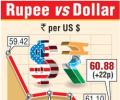
The rupee had dipped by a massive 67 paise to an all-time closing low of 61.10 against the dollar on Friday.

The rupee dropped on renewed demand for the American currency.
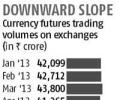
Exchange-traded currency futures volume down 80% since Jun

Month end dollar demand from oil importers has forced rupee to trade weak.

The rupee closed at Rs 66.21 in its last trading session.

Asian shares ended higher after a string of positive US economic data.

RBI is unlikely to stem the slide against the dollar as the greenback is rising rapidly against all currencies in the world.

Asian stocks sagged on Monday, with risk sentiment dampened as Shanghai shares wobbled after the Chinese markets resumed trading following a four-day long weekend.

The breadth was neutral with 1,329 advances and 1,320 declines.

The rupee is likely to strengthen to 60-61 level by this fiscal-end on expectations of improvement in current account deficit (CAD) and higher inflows from overseas investors.

The silver lining is that a pick-up in the US economy could help emerging market exports.

Rupee is seen to remain in the range of 67.50-68.80 in the short-term

Decline in the rupee coupled with a slide in the crude oil prices have dented the sentiments.

The 30-share Sensex ended down 604 points at 28,845 and the 50-share Nifty ended down 181 points at 8,757. The Bank Nifty ended down 602 points at 19,146.

Sun Pharma was the top gainer after SPARC received Sebi nod to raise up to Rs.250 crore through a rights issue

A weaker rupee might stimulate Indian exports and nullify some of the effects of Chinese devaluation.

On the sectoral front, rate-sensitive sectors such as Bankex and Auto gained by 1% and 0.7% respectively while BSE Consumer Durables gained 1.4%.

The 30-share Sensex ended lower by 46 points at 27,842 and the 50-share Nifty slipped 17 points to trade at 8,378.

The large current account deficit and the growing vulnerability on the external front have largely contributed towards the secular decline and the current volatility of the rupee.

November IIP data show a fall of over 20%, led by automobiles, gems & jewellery and home appliances; turnaround seen as unlikely.

The world seems to have caught severe pneumonia, or worse, as China had flu.

Market breadth continued to remain strong, with 1899 gainers and 674 losers on the BSEs.
Broad-based buying aided sentiment and the market registers record turnover at Rs 6.86 lakh crore

There's surplus liquidity and RBI, with plentiful forex reserves, is ready to pump whatever extra is needed

Experts caution against tough times in Indian equity markets in 2015.

To be sure, this is not some stunning new revelation that our equity markets are beholden to foreign flows.

The fall in reserves was due to a sharp fall in foreign currency assets.
According to Merrill Lynch (BofA-ML) report, Domestic capital markets are likely to remain volatile in the September-November period due to factors like US Fed's policy action, second quarter corporate earnings and Bihar state elections.

Sectors such as Auto, Banks, Capital Goods, FMCG, Metal, Oil & Gas and Power are trading marginally lower.
.jpg)
The 30-share Sensex ended 117 points higher at 26,560 and the 50-share Nifty gained 31 points to end at 7,936.

The broader markets underperformed benchmark indices as the BSE Mid-cap and Small-cap tumbled over 2%.

Benchmark share indices gained for the fifth straight session on Thursday led by index heavyweight Reliance Industries.

Sensex, Nifty end the day in red on unfavourable cues from global markets.

The 30-share Sensex is down 359 points at 26,378 and the Nifty has dropped 78 points to trade at 7,883

The 30-share Sensex ended 271 points higher to end at 28,930 and the 50-share Nifty climbed 76 points to close at 8,776.

Sensex dull at close, Infosys rules, ITC drags.
 © 2026 Rediff.com - Advertise with us - Disclaimer - Privacy Policy - Sitemap - Feedback - About us - Terms of use - Grievances