
Astronaut Shubhanshu Shukla discusses the Gaganyaan mission and its potential to inspire other nations in space exploration, drawing on his experiences as an IAF test pilot and his time on the International Space Station.

Gaganyaan astronaut Prasanth Balakrishnan Nair stressed the critical importance of AI sovereignty for national cybersecurity, citing the increasing difficulty in distinguishing between real and fake content due to AI. Speaking at the Kerala Cyber Suraksha Summit, Nair highlighted that future conflicts and industries would involve a 'whole-of-nation approach,' blurring physical and digital boundaries. He urged greater awareness of digital threats and emphasised India's need to build on its technological capabilities in AI and cybersecurity, drawing parallels with the success of Chandrayaan-3. Other speakers also underscored the rising threat of cyberattacks and the potential for Kerala to contribute to national technology requirements.
The successful Artemis II mission has boosted confidence in India's upcoming Gaganyaan mission, as both aim to demonstrate similar spaceflight capabilities. Experts highlight the collaboration between ISRO and NASA and the shared training programmes for astronauts.

'The prime minister has given us the task of taking at least 300 satellites to orbit in the next five to six years.'

The Department of Space has directed that requests for voluntary retirement or resignation from Group 'A' Scientific and Technical personnel associated with the prestigious Gaganyaan human spaceflight programme and other important missions should not be accepted as a matter of routine.

'ISRO will not manufacture any launch vehicles. That will all be done by the private sector or public sector undertakings.'

Russian cosmonauts aboard the International Space Station have conveyed special greetings to the people of India as the nation prepares to mark its 80th Independence Day, holding the Indian tricolour and underscoring the enduring partnership between the two countries in space exploration.

From a surge in startups to crewed mission preparations, 2025 marks a transformative year as India eyes $44 billion space economy by 2033.

Built as an expendable, short-duration turbojet engine for single-mission applications, it can power tactical cruise missiles, anti-ship missiles, and long-range loitering munitions.

India is set to take its first steps towards its own human space flight when the uncrewed Gaganyaan mission soars to the skies later this year. Private players in the space sector are also gearing up for launching satellites on home-built rockets.

The appointment comes as Agnikul prepares for Mission 02, a flight that will attempt, for the first time on Indian soil, the recovery of an orbital-class rocket booster and the extension of a rocket's upper stage into an on-orbit platform.
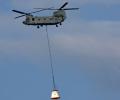
ISRO successfully conducted the first Integrated Air Drop Test (IADT-01) to validate the parachute-based deceleration system for the Gaganyaan mission, demonstrating a crucial step towards India's human spaceflight program.

ISRO has announced plans for seven launch missions by March, including the first uncrewed mission for the Gaganyaan project and demonstrations of new satellite technologies.
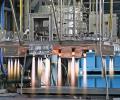
With these successful tests, ISRO has moved a step closer to India's first human spaceflight mission, Gaganyaan.
ISRO Chairman V Narayanan has emphasised the critical role of mission operations in ensuring the success of India's expanding space programme. He highlighted this at the Spacecraft Mission Operations conference, noting the importance of sustained teamwork and operational precision, particularly for long-duration missions like Chandrayaan-3 and the upcoming Gaganyaan programme.

The Human-rated LVM3 vehicle, the Crew Escape System and the Crew Module and Service Module are all in final stages of testing and integration.

The RusBeam 2800 is now India's largest electron-beam wire deposition 3D printer operating under vacuum. The machine was custom-built for India and is operated with software developed by Rosatom.

Astronaut Shubhanshu Shukla returns to Earth after an 18-day mission aboard the International Space Station, marking a significant milestone for India's space program and carrying out crucial scientific experiments.
Chandrayaan-4 will involve at least two separate launches of the heavylift LVM-3 rocket that will carry five different components of the mission which will be assembled in orbit.

The Bharatiya Antariksh Station represents the next phase of India's human spaceflight ambitions, enabling long-duration presence in space, advanced microgravity research and technology development, and supporting future human exploration missions.

The sesquicentenary of 'Vande Mataram' was the overriding theme of the ceremonial event held at the Vijay Chowk and presided over by President Droupadi Murmu, who arrived at the venue in a traditional buggy to the sound of bugles, adding a ceremonial grace to the occasion.
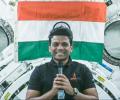
Group Captain Shubhanshu Shukla, the first Indian to visit the International Space Station, has been awarded the Ashoka Chakra, India's highest peacetime gallantry award. The award recognizes his contributions to the Axiom-4 mission and India's advancements in human space exploration.
ISRO Chairman V Narayanan announces ambitious space program goals, including landing Indians on the Moon by 2040 and launching the 'Gaganyaan' mission in 2027. The agency is also working on a national space station and uncrewed missions.

President Droupadi Murmu addressed Parliament, urging unity on national issues like 'Viksit Bharat', swadeshi, and national security. She highlighted government initiatives and the nation's progress.

Rakesh Sharma was the first Indian to go into space in 1984.

The role of the space sector in armed conflicts came into sharp focus during Operation Sindoor, which saw extensive use of drones and loitering munitions and tested the capabilities of air defence systems such as indigenously developed Akash Teer.

The broader theme of the performance will be -- 'Swatantra Ka Mantra - Vande Mataram' and 'Samriddhi Ka Mantra - Viksit Bharat', officials said.

These upcoming launches carry added significance in light of setbacks suffered in recent years.

The upcoming Republic Day Parade will center around the sesquicentenary of 'Vande Mataram,' featuring themed decorations, performances, and special guests.
Rigorous testing demonstrates the engine's mettle, it said, adding the CE20 engine identified for the first uncrewed flight LVM3 G1 also went through acceptance tests.

Training modules also cover academic courses, Gaganyaan flight systems, nicro-gravity familiarisation through parabolic flights, recovery training, mastering of flight procedures and training on crew training simulators, according to ISRO sources.

ISRO aims to send humans into space on a Low Earth Orbit of 400 km for a three-day mission and bring them safely back to earth.

IAF's four fighter pilots undergoing rigorous training for the landmark Gaganyaan mission, and who earned the 'astronaut wings' on Tuesday, have a stellar resume. They have a flying experience in the range of nearly 2,000-3,000 hours and two of them are recipients of the prestigious 'Sword of Honour'.

Modi welcomed Shukla, who was wearing an ISRO astronaut's jacket, with a warm hug and walked with him with his arm on the astronaut's shoulder.
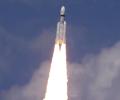
Currently, some of the rocket hardware for the human space programme has reached the Satish Dhawan Space Centre in Sriharikota and the integration of the crew module was going on at the Vikram Sarabhai Space Centre, Trivandrum, ISRO chairman S Somanath said.

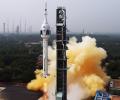
The test vehicle development flight (TV-D1) is aimed at testing the crew module that will carry Indian astronauts during the human spaceflight late next year.
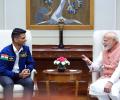
Shukla said the two missions presented a major opportunity for the country and the sustained commitment of the government to the space sector, despite setbacks such as the Chandrayaan-II mission was laudable.
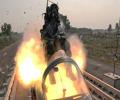
The DRDO conducted the test in collaboration with the Aeronautical Development Agency and Hindustan Aeronautics Limited.

The Sneham actor also shared a photograph of her and Nair posing with the ISRO chairman S Somanath.

Weighing 6,100 kg, the communication satellite would be the heaviest payload to be placed into the Low Earth Orbit (LEO) in LVM3 launch history from Indian soil.
