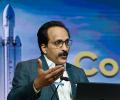
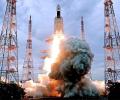
His statement came a day after the ISRO successfully launched its TV-D1 test vehicle ahead of the human space flight mission Gaganyaan.
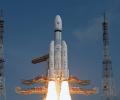
The test vehicle development flight (TV-D1) will be conducted at the Satish Dhawan Space Centre in Sriharikota in Andhra Pradesh to test the crew module that is scheduled to house Indian astronauts during the human spaceflight late next year.

Indian Space Research Organisation (ISRO) will conduct three more test vehicle missions under the ambitious Gaganyaan programme after the maiden TV-D1 test flight, which is scheduled on October 21, the space agency's chairman S Somanath has said.
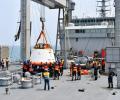
Nerves gave way to smiles at the spaceport in Sriharikota as delays and an anomaly-triggered 'hold' forced Indian Space Research Organisation (ISRO) scientists to revise the launch schedule of a test vehicle carrying payloads related to the country's ambitious human space flight mission, Gaganyaan which soared into skies after initial hiccups.
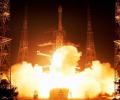
Indian Space Research Organisation is gearing up for one of its busiest times with seven more launches planned this financial year, even as India's first human spaceflight remains scheduled for 2027, its chairman V Narayanan said.
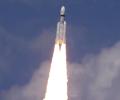
For the Gaganyaan programme, LVM3 rocket is re-configured to meet the human rating requirements and has been christened as 'Human Rated LVM3', ISRO said and it would be capable of launching the Orbital Module to an Low Earth Orbit of 400kms.

ISRO's Thiruvananthapuram-based Vikram Sarabhai Space Centre successfully conducted a series of drogue parachute deployment tests at the rail track rocket sled facility of the Terminal Ballistics Research Laboratory in Chandigarh during August 8-10.

Group Captain Shubhanshu Shukla, India's second astronaut, shares his journey from a shy child hearing stories of Rakesh Sharma to becoming part of the Axiom-4 mission to the International Space Station. He emphasizes the role of the IAF in his transformation and inspires India's youth to explore space.

ISRO is set to launch its communication satellite CMS-03 from Sriharikota. The satellite, weighing 4,410 kg, will be the heaviest launched from Indian soil into a Geosynchronous Transfer Orbit (GTO).

The first test-flight will be followed by sending a female-looking spacefaring humanoid robot -- Vyom Mitra -- in outer space likely next year.
He said the test vehicle is ready at Sriharikota and the assembly work of the crew module and crew escape system has also begun.

Indian astronaut Shubhanshu Shukla, currently on the ISS as part of the Axiom-4 mission, has acknowledged ISRO's efforts in ensuring his safe travel. He spoke with ISRO chairman V Narayanan about his well-being and the experiments being conducted on the ISS.
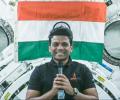
Group Captain Shubhanshu Shukla, the second Indian to travel to space, is expected to arrive in India this weekend after completing his mission to the International Space Station (ISS). He will meet with Prime Minister Narendra Modi and participate in National Space Day celebrations.
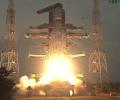
The heaviest communication satellite to be launched from the Indian soil onboard a new generation, homegrown 'Bahubali' rocket was successfully placed into the intended orbit on Sunday, the Indian Space Research Organisation said.

Lucknow celebrated the successful return of astronaut Group Captain Shubhanshu Shukla from the International Space Station (ISS). Family, friends, and the community rejoiced as Shukla, the first Indian astronaut to visit the ISS, made a successful splashdown in the Pacific Ocean.
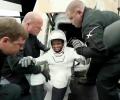
Astronaut Shubhanshu Shukla and the Axiom-4 mission crew safely returned to Earth after an 18-day stay at the International Space Station, splashing down off the coast of San Diego.

Scientists are working on conducting various tests for the ambitious Gaganyaan mission and the agency is coordinating with the Navy and others in this connection, he said.

He unveiled the country's ambitious space project's timeline during a media interaction.

Indian astronaut Shubhanshu Shukla stands on the cusp of history as he prepares to set off on a space odyssey, marking India's return to space flight 41 years after his idol Rakesh Sharma orbited the earth for eight days as part of Soviet Union's Interkosmos programme.
The mission is targeted for launch in the fourth quarter of 2024.

If Rakesh Sharma represented the dreams of a nascent India looking outward, Shubhanshu Shukla embodies a confident India reaching for the controls.
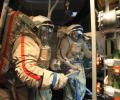
Finance Minister Nirmala Sitharaman on Wednesday allocated nearly Rs 12,544 crore to the department of space as India plans a human spaceflight -- Gaganyaan -- next year and sets out to explore the moon and neighbouring planets.
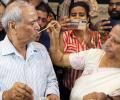
Group Captain Shubhanshu Shukla, the Indian astronaut who along with three others returned recently from a successful space mission, is in Houston in the United States, as he readjusts to life on Earth, his father said on Thursday.
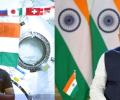
Shukla created history on Wednesday by embarking on a journey to the International Space Station (ISS) as part of a commercial mission operated by Axiom Space, along with three other astronauts.
'You can observe a lot of things from space.' 'Another thing is communication, in real time, especially in war-like situations.' 'During Operation Sindoor, we could play our part well.'

Vyomamitra, a combination of two Sanskrit words Vyoma (Space) and Mitra (Friend), took everyone by surprise when she introduced herself to the audience gathered there.

The Axiom-4 mission astronauts, including Shubhanshu Shukla, have returned to Earth after a 20-day mission to the International Space Station. The crew splashed down off the coast of San Diego and are undergoing medical check-ups and rehabilitation.

ISRO Chairman V Narayanan announced the development of a massive rocket capable of placing 75,000 kg payloads in low earth orbit, highlighting India's growing space capabilities and future satellite launches.

Astronaut Shubhanshu Shukla returns to India after his mission to the International Space Station (ISS). He was welcomed by Union Minister Jitendra Singh, Delhi Chief Minister Rekha Gupta, and ISRO Chairman V Narayanan. Shukla is expected to meet Prime Minister Narendra Modi and participate in National Space Day celebrations.

The first Gaganyaan flight scheduled for 2022 will carry three astronauts, who will be picked from among the test pilots in the armed forces.

Officials of the Bengaluru-headquartered space agency said the first and second waves of the pandemic have "severely affected" the Gaganyaan programme.
ISRO to launch a 6,500 kg communication satellite built by the US, marking a significant milestone in the Indian space program after the successful launch of the NASA-ISRO NISAR mission.

Astronaut Shubhanshu Shukla, aboard the International Space Station, interacted with students in Lucknow, answering questions about life in space, the challenges of readjusting to Earth, and the benefits of space exploration.
According to sources in the Bengaluru-headquartered space agency, under the Department of Space, delivery of hardware by the industry was hit due to the lockdown imposed in several States to contain the pandemic in recent months.
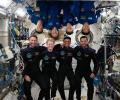
The Axiom-4 mission marked the return to space for India, Poland and Hungary after over four decades.

Astronaut Shubhanshu Shukla will undergo a rehabilitation program after returning from an 18-day mission to the International Space Station (ISS) as part of the Axiom-4 mission. The mission involved various experiments and research activities.

Indian astronaut Shubhanshu Shukla will enjoy a range of Indian dishes, including rice varieties, moong dal halwa, and mango nectar, during his 14-day mission aboard the International Space Station (ISS). He will also have the option to choose from international cuisine, as approved by NASA. ISRO and DRDO have developed the Indian food options for astronauts of the Gaganyaan mission and Shukla will be able to savor them with NASA's approval.
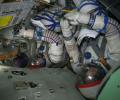
The Gaganyaan mission aims to send a three-member crew to space for a period of five to seven days by 2022 when India completes 75 years of Independence.
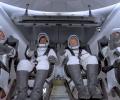
The Axiom-4 has successfully undocked and is making its way back to Earth, as observed by Axiom Space and the National Aeronautics and Space Administration (NASA) on Monday.
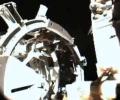
The Indian Space Research Organisation (ISRO) has successfully de-docked the SpaDeX satellites, a significant achievement that clears the path for future missions such as exploring the moon, human spaceflight, and building India's own space station. The de-docking, announced by Union Minister Jitendra Singh, follows a successful docking experiment conducted in January. The SpaDeX mission involved launching two satellites, SDX01 and SDX02, to demonstrate the docking technology in space.
