
'We were exporting copper at that time. Now India is importing copper to the tune of around $1.2 billion. Moreover, there was a larger impact on the dependent MSMEs.'

The latest number broke the previous record set on April 13, when the cases hit 29, 317.

'The assessment of most people is that there is a stable economic and political environment in India and that is attractive to investors.'

The Eknath Shinde-led Maharashtra government has come under fire following the Centre's announcement that Tata-Airbus C-295 transport aircraft project would be set up in Gujarat, with the opposition seeking to know why the project that was supposed to come up in Maharashtra went to the neighbouring state.
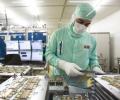
Mumbai-based Indian Semiconductor Manufacturing Company (ISMC) and Singapore-headquartered IGSS Ventures have one strategy in common: They have told the government in their application for semiconductor fabrication plants that they will export the bulk of the chips they make in India in the initial five or 10 years. The third applicant, Vedanta-Foxconn, which is also building a fab plant, has said it will concentrate on the needs of consumer electronics and mobile device markets, and earmark 80 per cent of output for domestic consumption, but has not specified its customers. Finding a viable domestic market could well be the biggest challenge for India's renewed tryst with semiconductors. Fab plants do not sell directly to end users but to intermediary chip design companies - such as Qualcomm or MediaTek.

Apple Inc has announced the India prices of the new variants of its bestselling smartphones - launched on Tuesday - as it assembles the device in the country. The new iPhone 15 range starts at Rs 79,900 for the 128 GB variant (the same price as the iPhone 14 when it was launched last year) and goes up to Rs 199,900 for the top-end Pro Max with a 6.7 inch screen and 1 TB (terabyte) storage. The world's most valuable company also launched three new upgraded Apple watches, starting with the SE at Rs 29,900 and going up to Ultra 2 at Rs 89,900.

The government is likely to extend fiscal incentives for production of toys, bicycles and leather and footwear in the forthcoming budget as it looks to expand production linked incentive (PLI) scheme to cover more high-employment potential sectors, sources said. The government has already rolled out the scheme with an outlay of about Rs 2 lakh crore for as many as 14 sectors, including automobiles and auto components, white goods, pharma, textiles, food products, high efficiency solar PV modules, advance chemistry cell and speciality steel. The scheme aims to make domestic manufacturing globally competitive and create global champions in manufacturing, and it is yielding solid results, sources said.

It started out as a Production Linked Incentive (PLI) scheme to make India an export hub. But after many a twist and turns, the latest 2.0 PLI for IT hardware, for which the 40 eligible candidates have applied till its deadline, is now focused on 'import substitution'. The scheme will help in reducing India's over-dependence on imports (80 per cent of laptops are imported), especially from China which include laptops, tablets and servers.
Mining mogul Anil Agarwal-led Vedanta Resources' credit profile will unlikely be weighed down by the group's planned Rs 1.54 lakh crore foray into semiconductor manufacturing, S&P Global Ratings said on Monday. "This is because the company has reiterated that the $20 billion related investment will be carried out outside of Vedanta Resources. "The business will be undertaken in a separate entity under Vedanta Resources' holding company Volcan Investments Ltd," it said.

The development comes at a time when growing tension in US-China trade ties is forcing companies to explore alternative manufacturing sites in order to derisk operations.

The ex-CM said he had the honesty to face the protesters. He said the government should hold a dialogue with locals before coming up with any project.

Apple chief executive Tim Cook on Wednesday met Prime Minister Narendra Modi as the iPhone manufacturer is looking to invest more in the world's second-largest smartphone market. Cook, on his first trip to India in seven years, opened Apple's first retail store in the country in Mumbai on Tuesday and will launch another in Delhi on Thursday. Looking to replicate what China did to Apple's business in the last 15 years, the tech giant is eyeing India's massive market with an expanding middle class to power sales growth, and potentially make it a home base for the production of millions of Apple devices.

The new mantra was to align Apple's ambition with the government's, focusing on Modi's favourite themes of Make in India, employment generation and India as a high-tech export hub.

Apple's newest phone iPhone 14 will be made in India as the global tech titan bets big on the manufacturing prowess of the world's second-biggest smartphone market after China.

Indian conglomerate Vedanta has earmarked $15 billion for foray into the electronic chip and display manufacturing space, and plans to scale up the investment to as much as $20 billion, a senior company official said. Vedanta's group firm Avanstrate, which will spearhead the semiconductor business, expects to roll out electronic chips and displays from Indian manufacturing plants by 2025, the official of the group's semiconductor arm said on Friday. "Semiconductor is a long-term business. We are looking at about $10 billion on display.

Thackeray, whose Maha Vikas Aghadi government fell after a rebellion in June last year by his cabinet colleague Eknath Shinde, who went on to become CM, also warned he would extract revenge for his ouster.

Vedanta chairman Anil Agarwal on Saturday pressed for further liberalisation of the defence sector and called for corporatisation of defence factories to make the country self reliant in respect of arms and ammunition. There are 52 defence factories for manufacturing arms and ammunition in the country but most of them are running at 10 per cent capacity, he said. "We (India) can be the largest producer of arms and ammunition. "If the defence factories are corporatised it will bring in a new way of thinking," Agarwal said while addressing the inauguration of a post graduate programme for executives virtually from London.

Shiv Sena president Uddhav Thackeray on Wednesday dared the Bharatiya Janata Party to defeat it in the ensuing Mumbai civic polls, saying his party's bond with the city was unbreakable, and also hit out at Maharashtra Chief Minister Eknath Shinde over his rebellion and for laying claims to his late father's legacy.

The Opposition is also expected to target the Eknath Shinde-led government on shifting of mega projects like Foxconn to Gujarat, according to political observers.

While 100 per cent FDI is allowed in single-brand retail, if the foreign investment exceeds 51 per cent, the 30 per cent mandatory local sourcing norm kicks in.

Apple Inc is commencing assembly of its iPhone 12 model in the country, a move that is expected to help the US tech giant further consolidate its position in the burgeoning smartphone market in India. Apple has partnered with third-party manufacturers like Foxconn and Wistron to make some of its phones in India. These include iPhone SE, iPhone 10R and iPhone 11.

The BJP's massive victory will make it hard for the party to derive a criterion for selecting ministers, as the claimants will be many and the berths, few.

The letter shared with the media on Saturday comes amid Maharashtra losing several big-ticket projects to neighbouring Gujarat.

Vedanta group chairman, Anil Agarwal, 69, is well known for his business journey from a scrap dealer from Bihar to a London-based globe-girdling metal and oil and gas conglomerate with revenues of $19 billion. Now his abilities to keep his group from over-leveraging itself will be put to the test. Over the years, Agarwal, now based in London, set up the conglomerate via acquiring iron ore producer Sesa Goa, Cairn's oil producing assets in India, and Electrosteel Steel.

SoftBank-based e-commerce marketplace Snapdeal has deferred its Rs 1,250 crore IPO, joining the list of startups that have decided to shelve their initial public offering (IPO) plans this year. Snapdeal, which competes with Amazon and Flipkart, filed a request this week with the Securities and Exchange Board of India (Sebi) to withdraw its draft red herring prospectus (DRHP) amid a sell-off in tech stocks worldwide. "Considering the prevailing market conditions, the company has decided to withdraw the DRHP. The company may reconsider an IPO in the future, depending on its need for growth capital and market conditions," a Snapdeal spokesperson said.

Micron plans an assembly testing, marking and packaging project of $1 billion, and talks are on to set up a memory chip plant for captive requirements.

At a time when the overall narrative is around India being an attractive investment destination, the two American multinationals are more specific in projecting India as their centrepiece.

Apple is hoping to assemble in India 25 per cent of all iPhones produced globally to reduce its heavy dependence on China.

Maharashtra fell behind Gujarat in attracting foreign investment during the MVA's tenure but in the next two years the present government would take Maharashtra ahead, said Fadnavis.

He staked everything to ensure the BJP returned to power; and now that it has, he stands to lose a lot, points out Aditi Phadnis.

Sounding a note of caution, former Reserve Bank Governor Raghuram Rajan has said that India is "dangerously close" to the Hindu rate of growth in view of subdued private sector investment, high interest rates and slowing global growth. Rajan said that sequential slowdown in the quarterly growth, as revealed by the latest estimate of national income released by the National Statistical Office (NSO) last month, was worrying. Hindu rate of growth is a term describing low Indian economic growth rates from the 1950s to the 1980s, which averaged around 4 per cent.

The US-based company, in collaboration with partners like Wistron and Foxconn, had recently started assembling iPhone 11 in India.

Indian companies are planning to increase investments in the new year to expand capacity, acquire companies, and go on a hiring spree, a survey of top executives showed. They, however, cited rising costs, weak consumer demand, and increasing interest rates as major concerns for 2023 which may impact their plans.

Amazon on Tuesday said it will begin manufacturing Amazon devices, including Fire TV sticks, in Chennai later this year in partnership with Foxconn's subsidiary, Cloud Network Technology.

The Apple iPhone comprises 44 per cent of the global smartphone market's revenues and it is the second most-such device to be shipped after Samsung. More than half of smartphones used in the US are iPhones. More than 7 million iPhones are expected to be sold in India in 2022, extending the user base to 20 million, according to market research and analyst firm Techarc. Hence, the news about Apple scaling down its production target for iPhone 14 in India has made news.
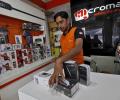
According to research firm IDC, a slowdown in smartphone shipments began showing up as early as late February, though companies insist that the March quarter was fine, albeit on a low base.

Bhupendra Patel can never really break free of intervention from New Delhi. But if he can win over the Gujaratis and improve the BJP's tally substantially, he will have proved that he should be taken seriously.

Chinese mobile brands are deeply entrenched in the Indian market. A move to bar them may send a bold diplomatic message. But its cost for the local industry is anybody's guess. In the event that Chinese brands face curbs, two handset makers - Samsung and Apple - squarely stand to gain.

The government on Monday extended the period of production-linked incentive scheme for large-scale electronics manufacturing with a focus on mobile phones by a year until 2025-26. The base year of the scheme 2019-20 remains the same but the companies will have the option to choose their five-year period either from the base year or the year 2020-21 for calculation of the incentives under the scheme. "Now we have extended the tenure of the scheme from 2020-21 to 2025-26. "Earlier, it would have ended in 2024-25.
The new online store, which will be launched on September 23, will provide customers with the same premium experience found in Apple Store locations around the world, delivered by online team members who are ready to offer their expertise, Apple said in a statement.
