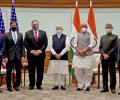
China on Tuesday urged US Secretary of State Mike Pompeo to stop sowing discord between Beijing and countries in the region, undermining regional peace and stability, amidst his visit to India for a high-level dialogue aimed at further ramping up their overall defence and security ties, and boost strategic cooperation in the Indo-Pacific.

Pompeo, who arrived in New Delhi on Tuesday night, will hold detailed discussions with External Affairs Minister S Jaishankar in the afternoon and have a working lunch with him.

China remains the elephant in the room and has to be tamed, which the United States alone is unable to do and therefore calls allies to come on board.

The meeting between Jaishankar and Pompeo comes at a time both India and the US are at loggerheads with China.
Pompeo said that for 40 years, successive US administrations just looked the other way and allowed China to trample on America.
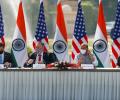
Henry Kissinger once said, 'It may be dangerous to be America's enemy, but to be America's friend is fatal.' India will have to wait and see, observes Rajeev Srinivasan.

Last month, President Trump offered to be the "mediator" between India and Pakistan on the Kashmir issue when he met Prime Minister Imran Khan for the first time at the White House.

'He may respect others, but he is unlikely to admire them'

'Analysts see BECA as a 'force multiplier' for India.' 'But China too is known to have such capabilities.' 'The military gap with China will continue to remain a fact of life, BECA notwithstanding,' argues Ambassador M K Bhadrakumar

On Tuesday, Pompeo and Esper will hold the 2+2 talks with External Affairs Minister S Jaishankar and Defence Minister Rajnath Singh, covering the entire expanse of defence and security ties as well as key regional and global issues.
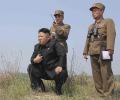
'Hardliners who are against denuclearisation may be working secretly on North Korea's nuclear activities, despite official claims that dismantling its nuclear arsenal has already begun.'' 'Does it mean that Kim does not have full control over the military,' asks Dr Rajaram Panda.

'India has a strong and proud tradition of strategic autonomy, and we respect that'

Dr Lobsang Sangay entered the United States White House on Friday -- a historic feat. This is the first time in the last six decades the head of the Central Tibetan Administration (CTA) has been invited into the White House, the CTA said in a statement.
We do not know, because there has been no discussion, no transparency and most likely no real thinking on this matter at our end, observes Aakar Patel.

In a joint statement, Biden and Harris wished a happy Diwali to everyone celebrating the festival of lights across the US, India and the world.
If push comes to shove, Trump is probably planning to order the US army to clear his path for a second term. What if the armed forces refuse to obey their commander-in-chief?, asks Ambassador M K Bhadrakumar.

The newly-announced cabinet is expected to take oath on Monday at the President's House.

Early this month, Trump had unceremoniously fired Secretary of State Rex Tillerson and nominated Mike Pompeo

'Even as discord over US-India trade and commerce colours diplomatic relations, defence relations between the two countries remain on a firm footing,' points out Ajai Shukla.

With the situation in Ladakh tense and no resolution in sight the trigger to take the India-US relationship to a transformational one is already there, observes Lieutenant General Syed Ata Hasnain (retd).
Iranian Ambassador to India Ali Chegeni said his country is 'not for war'. "We are looking for peace and prosperity for everybody in this region," he said.

A 55-year-old from Hubei province could have been the first person to have contracted the viral infection on November 17 last year and cases rapidly began piling up since then, it said, without revealing the gender of the individual.

Is North Korea really dismantling its nuclear programme? Rajaram Panda explains the many challenges to denuclearise the Korean Peninsula.

General Mattis has been the most steadfast champion in Trump's cabinet of the US-India defence relationship. If Trump chooses a more pliable successor, the Pentagon's attention could go off India.

COVID-19 has emerged as an important form of diplomatic currency around the world as nations try to showcase their soft power gains. In this race, India has an edge as India is already a pharmaceutical giant having produced some 60 per cent of global vaccines and now justly seeking to strengthen ties and expand its influence in its neighbourhood and beyond, observes Dr Rajaram Panda.

'This is a historic juncture when the US is in great need of an alliance with India to strengthen its hands in the fierce struggle with China in the Asian theatre,' points out Ambassador M K Bhadrakumar.
China is now the most significant strategic concern in Washington, as in most of the world's capitals, especially the democracies. Today, strategic autonomy has acquired a sharper definition: To ward off the Chinese challenge to India's territorial integrity, sovereignty and regional stature, observes Shekhar Gupta.
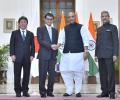
The India-Japan 2+2 dialogue added strategic heft to the special relationship in the wake of growing Chinese assertiveness on regional affairs, points out Dr Rajaram Panda.

'Xi Jinping is keen that the second Trump-Kim summit happens soonest.' 'Kim is reported to have told Xi that he expects to achieve a result from a second summit that the international community would welcome,' points out Dr Rajaram Panda.

India strongly condemned the terror attack, saying targeting of a religious place in the midst of the COVID-19 outbreak reflects the "diabolical mindset" of the perpetrators and their backers.

Interestingly, in his entire remarks, Modi never once mentioned regional security, Ambassador M K Bhadrakumar points out.

Indians at large harbour a notion that their country is cherrypicking out of the American basket of goodies, but the policymakers in Delhi and the political leadership are well aware that it can only be a pipe dream since a military alliance with a superpower is a profound irrevocable commitment, observes Ambassador M K Bhadrakumar.
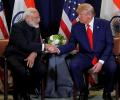
'I give Modi full credit, for brilliantly using his personal diplomacy, his personal stature, to accomplish his goals...'

As the pandemic unfolded, the India-China relationship has come under severe stress. To restore normalcy, agreements between the two countries must be respected scrupulously in their entirety. Where the Line of Actual Control is concerned, any attempt to unilaterally change the status quo is unacceptable, declares External Affairs Minister Dr Subrahmanyam Jaishankar.
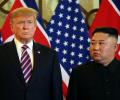
'Despite much hype of optimism, everyone went home empty-handed without a clear picture where they are heading in the future,' notes Dr Rajaram Panda.

'Trump forgets that Kim is not one who likes to be treated publicly as a pauper; he wants to come to the table as an equal, and from a position of perceived strength, not as a suppliant,' says Dr Rajaram Panda.

'In the run-up to the summit, Trump had indicated that he might strike a nuclear deal in the course of a single meeting or over several days, but as it transpired, Trump departed Singapore soon after the meeting.' 'This raises questions if his aspirations for an ambitious outcome had been scaled back,' says Rajaram Panda.
'There is hope that in the next 48 to 72 hours there will be some kind of movement forward to de-escalate and not heighten the tension.'
