
The Supreme Court has sought a response from the Election Commission on a plea by Trinamool Congress MPs alleging irregularities in the revision of electoral rolls in West Bengal.
The Delhi High Court Chief Justice, D K Upadhyay, has submitted a report to the Chief Justice of India, Sanjiv Khanna, regarding the alleged discovery of cash at Justice Yashwant Varma's official residence. The report follows an in-house inquiry initiated by Justice Upadhyay after a fire at Justice Varma's residence on Holi night. The Supreme Court Collegium will now examine the report and may take further action. The Supreme Court has also stated that a proposal to transfer Justice Varma to the Allahabad High Court is separate from the in-house inquiry.

The Supreme Court has taken suo motu cognisance of the controversy surrounding the definition of Aravalli hills and is scheduled to hear the matter. The court had previously accepted a uniform definition and banned fresh mining leases in the area.

Former Chief Justice of India T S Thakur has decided to skip the book release function of former R&AW chief A S Dulat's book, "The Chief Minister and The Spy", citing the political storm over certain parts of the book concerning National Conference president Farooq Abdullah. Thakur stated that the controversy and its political overtones would be an embarrassment for him, given his long association with the Abdullah family and his desire to remain apolitical. He also noted that Farooq Abdullah has publicly "disowned, if not denounced" the statements attributed to him in the book. The book release function was scheduled for Friday, April 18, 2020.
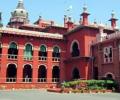
Thirty-six former judges have called on people, including parliamentarians, to denounce opposition leaders' move to impeach Madras High Court judge Justice G R Swaminathan, saying such an attempt would undermine democracy and judicial independence.

Chief Justice of India Sanjiv Khanna has recused himself from hearing pleas related to the alleged illegal felling of hundreds of trees in the Delhi Ridge area. The decision comes after a previous bench, led by former CJI D Y Chandrachud, sought a personal affidavit from Delhi Lieutenant Governor V K Saxena in the case, which also sought contempt proceedings against certain DDA officials. CJI Khanna stated that his prior involvement with the Delhi LG while serving as the NALSA chairman would make it inappropriate for him to hear the plea. The bench has ordered the listing of the pleas before a different bench starting November 27.

He will take oath on November 11, a day after incumbent Justice DY Chandrachud demits office on attaining the age of 65.
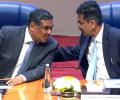
Chief Justice of India-designate Sanjiv Khanna on Friday lauded CJI D Y Chandrachud for his "monumental" contribution, saying he worked on a mission to improve the apex court and pursued his goal of making it "a sanctuary of inclusivity", which was accessible to all.

The Supreme Court on Wednesday asked the Commission for Air Quality Management (CAQM) to consider directing schools in Delhi-NCR to postpone open air sports competitions planned in November and December to 'safer months' keeping in mind air pollution levels.
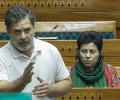
Congress leader Rahul Gandhi criticized Home Minister Amit Shah's response to questions on electoral reforms, calling it 'completely defensive' and alleging 'vote chori' (vote theft).

The Supreme Court has permitted the sale and bursting of green crackers in Delhi-NCR for Diwali, relaxing the ban on green firecrackers as a temporary measure from October 18 to 21. The court has asked pollution control boards to monitor pollution levels and file reports. The order also includes measures to prevent the sale of non-compliant crackers.

The CJI's remarks came amid mounting concerns in India over widespread incidents of attacks on the minority Hindu community in Bangladesh after prime minister Sheikh Hasina resigned and fled on August 5 following weeks of violent unrest.
The Supreme Court of India has struck down key provisions of the 2021 Tribunals Reforms law, citing violations of separation of powers and judicial independence. The court restored earlier directions on tenure for tribunal members.

Speaking after laying the foundation stone of the Bombay high court's new complex on land allotted by the Maharashtra government in Mumbai's upscale Bandra area, he noted the mega project was a collaboration between the state and the judiciary to provide modern infrastructure to citizens.

'Refusal does not invite immediate legal penalty; it invites Constitutional unease.'

Chief Justice D Y Chandrachud, who is demitting office on November 10, Wednesday deferred by four weeks hearing on pleas challenging the immunity granted to husbands in cases of marital rape.

Expressing concern over instances of 'unwarranted' confiscation of personal devices during raids, the CJI said they highlight the pressing need to strike a balance between investigative imperatives and individual privacy rights.

The Supreme Court dismissed Allahabad High Court judge Yashwant Varma's plea seeking invalidation of a report that found him guilty of misconduct in the cash discovery row.

The Supreme Court has agreed to hear a plea challenging the Karnataka government's decision to invite International Booker Prize winner Banu Mushtaq to inaugurate Mysuru Dasara this year. The controversy stems from allegations that Mushtaq made statements in the past that are perceived by some as "anti-Hindu" and "anti-Kannada".
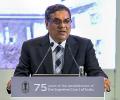
Justice Khanna was elevated as an additional judge of the Delhi high court in 2005 and was made a permanent judge in 2006. He was elevated as a judge of the Supreme Court on January 18, 2019.
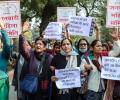
The Supreme Court on Monday stayed the Delhi high court's order suspending the life sentence of expelled Bharatiya Janata Party leader Kuldeep Singh Sengar in the 2017 Unnao rape case.

Chief Justice of India D Y Chandrachud on Thursday advised market regulator SEBI and the Securities Appellate Tribunal (SAT) to exercise caution amid a significant surge in equity markets and pitched for more tribunal benches to ensure that the "backbone is stable". Inaugurating the new SAT premises here, CJI Chandrachud pitched for authorities to consider opening up new benches of the SAT given the higher workloads because of higher quantum of transactions and newer regulations.
The Supreme Court expressed serious concern over the Enforcement Directorate summoning advocates for offering legal advice or representing clients during investigations, calling for guidelines on the matter.

People get 'so fed up' with the matters of courts that they just want a settlement, Chief Justice of India D Y Chandrachud said on Saturday while highlighting the role of Lok Adalats as alternative dispute redressal mechanisms.
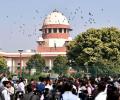
A bench comprising Chief Justice B R Gavai and Justices Ujjal Bhuyan and K Vinod Chandran dismissed the PIL filed by lawyer Vishal Tiwari after Solicitor General Tushar Mehta objected to it.
The Supreme Court on Friday asked the Law Commission to consider a plea as a representation of a Buddhist group that certain sets of personal Hindu laws, which are applicable to Buddhists also, are against their fundamental rights, including freedom to practice religion.

Justice Sanjiv Khanna, who has been part of several landmark Supreme Court judgements such as scrapping the electoral bonds scheme and upholding abrogation of Article 370, will be sworn in as the 51st Chief Justice of India on Monday.
The Supreme Court's opinion on the presidential reference can impact on any number of cases if and when governors, if not the President, take a literary view of the Supreme Court's 'ppinion' on their 'discretionary powers' without reference to the rider on 'reasonable time', points out N Sathiya Moorthy.

Shiv Sena-Uddhav Balasaheb Thackeray leader Sanjay Raut on Thursday demanded that Chief Justice India D Y Chandrachud recuse himself from the cases tied to the disqualification petitions concerning rebel Shiv Sena and Nationalist Congress Party MLAs.
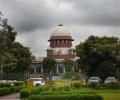
The Supreme Court ensured a widow received compensation 23 years after her husband's death in a train accident, highlighting the court's commitment to justice for the poor.

An exasperated Justice Chandrachud asserted he will not allow any lawyer to "dictate" the procedure of the court.
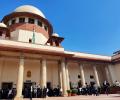
The Communist Party of India (Marxist) has approached the Supreme Court, contesting the legality of the Election Commission's order for a Special Intensive Revision (SIR) of electoral rolls in Tamil Nadu, alleging it is arbitrary and unconstitutional.

The Supreme Court is examining the extent to which courts can intervene when governors delay or refuse to act on bills passed by state assemblies. The court questioned the Centre on whether judicial review is barred in cases of gubernatorial inaction, sparking debate on the balance of power between states and the central government.

The Supreme Court on Friday upheld JSW Steel's Rs 19,700-crore resolution plan for debt-ridden Bhushan Power and Steel Limited (BPSL), bringing down curtains to a prolonged legal battle that spanned nearly eight years.

A bench comprising Chief Justice B R Gavai and Justice K Vinod Chandran took note of the submissions of a lawyer that the plea, filed through TVK's secretary Aadhav Arjuna, be listed for hearing.

In a significant development, the Supreme Court on Tuesday sought responses from the Centre, CBI, ED, Anil Ambani and the Anil Dhirubhai Ambani Group (ADAG) on a PIL seeking a court-monitored probe into alleged massive banking and corporate fraud involving the ADAG and its group companies.
The Supreme Court of India has ruled that no timelines can be imposed on governors and the president to grant assent to bills passed by state assemblies, clarifying the extent of their powers under Article 200 of the Constitution.

The CJI said there is an urgent need to emerge from the adjournment culture to a culture of professionalism.

The Supreme Court has allowed certified manufacturers to produce green crackers, but restricted their sale in Delhi-NCR without approval. The court has asked the Centre to review the ban on firecracker manufacturing in the region.

Chandrachud said it should be ensured that courts provide safe and accommodating environment for all members of the society.
