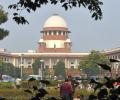
Supreme Court judge Surya Kant expressed his reluctance to order urgent listing of cases on the same day, except in extreme circumstances, highlighting the workload and sleep deprivation of judges.
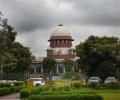
The Supreme Court has stayed the Calcutta High Court's decision that stalled the implementation of a revised list of Other Backward Classes (OBCs) in West Bengal, providing relief to the state government.

Disagreeing with the Centre's submission that the petitions seeking legal validation of same-sex marriage reflected an 'urban elitist' view, Chief Justice of India D Y Chandrachud said on Tuesday queerness is not urban or elite, or restricted to upper classes and privileged communities.
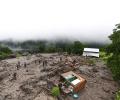
A bench of Chief Justice B R Gavai and Justice K Vinod Chandran also issued notices to the Union Ministry of Environment, Forest and Climate Change, the National Highway Authorities of India (NHAI) as well as the governments of Himachal Pradesh, Uttarakhand, Jammu and Kashmir and Punjab.
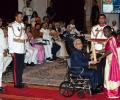
President Droupadi Murmu conferred the coveted Padma awards on 68 eminent personalities, including former Chief Justice of India Jagdish Singh Khehar, dancer Shobana Chandrakumar, actor Anant Nag, and Vice Chancellor of King George's Medical University Soniya Nityanand. The awards were given in various disciplines and fields, including art, social work, public affairs, science and engineering, trade and industry, medicine, literature and education, sports, and civil service. The Padma Vibhushan was awarded to Justice (retd) Khehar for public affairs, while nine individuals received the Padma Bhushan. The Padma Shri was awarded to leading immunologist and KGMU VC Nityanand, footballer Inivalappil Mani Vijayan, singer Ashwini Bhide Deshpande, actor Ashok Laxman Saraf, mask maker Reba Kanta Mahanta, and musician Ricky Gyan Kej, among others.
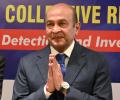
Lok Sabha Speaker Om Birla admitted a notice for the removal of High Court judge Justice Yashwant Varma and constituted a three-member committee to probe charges against him.

Supreme Court Justice B V Nagarathna dissented against the collegium's recommendation to elevate Patna High Court Chief Justice Vipul Manubhai Pancholi to the Supreme Court, citing concerns about seniority, regional representation, and the circumstances of his earlier transfer.
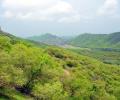
'The natural barrier that is Aravalli, you are demolishing it, then who will stop the desert?' 'In future, I predict that people will roam around with oxygen cylinders in Delhi because they won't be able to breathe.'

Raut claimed that by not deciding on the disqualification petitions, Chandrachud kept doors and windows open for defections.

Amid a heated debate over the three new criminal laws, Chief Justice of India DY Chandrachud on Tuesday refused to comment on them, saying the issues arising from these statutes were pending before the Supreme Court.

The Supreme Court has questioned the practice of Governors withholding assent to bills indefinitely, stating that it renders the constitutional provision of 'as soon as possible' meaningless.

The Centre has argued before the Supreme Court that state governments cannot use writ jurisdiction to challenge the actions of the President and Governor regarding bills passed by state assemblies, particularly concerning fundamental rights violations. The President seeks the Supreme Court's opinion on whether states can file writ petitions under Article 32 and the scope of Article 361.
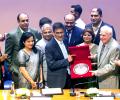
While that created a stir so did the decision on his penultimate day at work with the Supreme Court rechristening its summer vacation "partial court working days", an issue that has led to criticism that the apex court judges enjoyed long breaks.

The Supreme Court has questioned the Madras High Court's decision to form a special investigation team (SIT) to investigate the Karur stampede, which resulted in 41 deaths. The court raised concerns about the High Court's handling of the matter, particularly regarding the formation of the SIT and adverse remarks made against actor Vijay's political party.

Chief Justice of India Dr Dhananjay Yeshwant Chandrachud took time from his packed schedule to visit Block D, Additional Building Complex at the Supreme Court, to inspect the work in progress on the public canteen on Tuesday, August 8, 2023.

The Supreme Court of India has dismissed a plea against the construction of a new passenger jetty and terminal at the Gateway of India in Mumbai, upholding a Bombay High Court verdict that allowed the project to proceed. The project aims to improve passenger travel between South Mumbai and other locations.

The Supreme Court on Monday deferred to October 13 the hearing on a plea of telecom major Vodafone Idea Ltd seeking quashing of the additional adjusted gross revenue (AGR) demands for the period until 2016-17.

Chandrachud said there were several comments on the social media which alleged that the CJI is "so arrogant" that he got up in the midst an important argument in court.

The Supreme Court has upheld the deletion of the 'waqf by user' provision in the amended waqf law, stating it is not arbitrary and addresses potential misuse.

"The power of listening to others is important in every sphere of life. It is enormously liberating to yield that space to others. The problem with our society is that we are not listening to others...we are listening only to ourselves," he said.

Chief Justice of India Justice B R Gavai on Friday praised Justice Bela M Trivedi for her career trajectory from the subordinate judiciary all the way up to the Supreme Court, where she became the eleventh woman judge to be appointed in its history.

When the Constitution is viewed from the context in which it emerged, it is nothing short of remarkable, he asserted.

The Supreme Court is scheduled to hear a plea on August 8 seeking directions to the Centre for the restoration of statehood to Jammu and Kashmir. The plea highlights concerns about the delay and its impact on democratic rights and development.

In a significant development, the Supreme Court on Thursday recalled its controversial May 2 verdict that had ordered liquidation of Bhushan Power & Steel Limited (BPSL) while setting aside a resolution plan of JSW Steel Limited for the ailing firm. A bench comprising Chief Justice B R Gavai and Justice Satish Chandra Sharma observed that the May 2 judgment, authored by Justice Bela M Trivedi, since retired, did not "correctly consider the legal position as has been laid down in the catena of judgments".
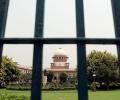
A group of lawyers, including senior advocate Harish Salve and Bar Council of India chairperson Manan Kumar Mishra, has written to the Chief Justice of India, alleging that a "vested interest group" is trying to put pressure on the judiciary and defame courts "on the basis of frivolous logic and stale political agendas".

The Supreme Court refused to stay a provision barring the declaration of tribal lands as waqf properties, upholding key provisions of the Amended Waqf Act.
Former chief justices of India, who have conveyed their views to a parliamentary committee on the bill proposing simultaneous polls, have endorsed the constitutionality of the 'one nation, one election' concept but have raised concerns over its various aspects, including the power given to the Election Commission, and offered suggestions.

Outgoing Supreme Court Justice Sudhanshu Dhulia bids farewell, expressing his deep connection to the legal community and the country.

The BJP lawmaker sparked a row when he said, "(the) Supreme Court is taking the country towards anarchy" and that "Chief Justice of India Sanjiv Khanna is responsible for the civil wars taking place in the country".
Supreme Court Justice M M Sundresh recused himself from hearing the bail plea of advocate Surendra Gadling, an accused in the Elgar Parishad-Maoist links case. The case has been adjourned multiple times.

On October 17, a five-judge Constitution bench headed by the CJI unanimously refused to accord legal recognition to same-sex marriage, saying there was "no unqualified right" to marriage.

Union Parliamentary Affairs Minister Kiren Rijiju on Wednesday underlined the government's resolve to take all political parties on board in moving an impeachment motion against Justice Yashwant Varma, saying corruption in the judiciary cannot be approached through a 'political prism'.
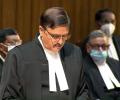
Justice Abhay S Oka, known for his unwavering commitment to liberty and constitutional values, bid farewell to the Supreme Court of India. In his final address, he stressed his dedication to upholding constitutional liberties, emphasizing that it was his "honest endeavor" to fulfill the dream of the Constitution's framers. He also expressed gratitude to the bar and his colleagues for their support and shared heartfelt memories from his time on the bench. Justice Oka's departure marks the end of a distinguished judicial career spanning over two decades, during which he served as a judge of the Bombay High Court, Chief Justice of the Karnataka High Court, and ultimately, as a Supreme Court justice.

President Droupadi Murmu on Saturday approved 139 Padma awards including seven Padma Vibhushans, 19 Padma Bhushans and 113 Padma Shris.

The Supreme Court is scheduled to hear on Monday Allahabad high court judge Yashwant Varma's plea seeking invalidation of a report by an in-house inquiry panel which found him guilty of misconduct in the cash discovery row.

Justice Chandrachud also dealt with questions about criticism by eminent lawyers on the allocation of cases to particular judges and 'bench hunting', and said the allocation of cases is not "lawyer-driven" and vowed to maintain the credibility of the institution of the Supreme Court.
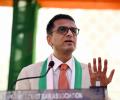
Chief Justice of India (CJI) D Y Chandrachud on Tuesday said the greatest challenge before the Indian judiciary is to eliminate barriers to accessing justice and make sure that the judiciary is inclusive and accessible to the last person in the line.
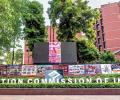
The Supreme Court on Monday granted protection from arrest to psephologist Sanjay Kumar in connection with two FIRs lodged by the Election Commission of India accusing him of spreading misinformation over Maharashtra's electoral rolls through posts on social media.
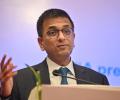
Besides launching initiatives for technological, administrative and infrastructural improvement, Chandrachud, like his illustrious father Y V Chandrachud, who was the Chief Justice of India for the longest time from February 22, 1978 to July 11, 1985, kept delivering significant verdicts in the last one year.

A two-judge bench of the top court had on August 11 directed authorities in Delhi-National Capital Region (NCR) to start picking up stray dogs from all localities "at the earliest" and relocate the animals to dog shelters.
