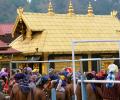
The Supreme Court is hearing petitions related to discrimination against women at religious places, including the Sabarimala temple. A nine-judge bench is examining the scope of religious freedom and the exclusion of women based on age and menstrual status.

The Supreme Court delivered a split verdict on the constitutional validity of Section 17A of the Prevention of Corruption Act, which mandates prior sanction for probing government servants in corruption cases. The case will now be placed before the Chief Justice for forming a larger bench.

The Supreme Court has granted anticipatory bail to a software firm owner accused of sexually harassing an employee and attempting to frame her and her husband in a criminal case. The court has directed him to cooperate with the investigation and not to influence witnesses.

The Supreme Court has agreed to examine whether a law banning married couples facing secondary infertility from using surrogacy to have a second child amounts to a restriction by the State on the reproductive choices of citizens.

The Supreme Court on Friday sought response from the Centre and others on a plea alleging that female sanitation workers at the Maharashi Dayanand University in Haryana were asked to prove through pictures of their private parts that they were menstruating.
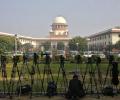
The Supreme Court of India is examining the conflict between an individual's 'right to be forgotten' and the freedom of the press, focusing on the removal of online news and judicial records related to acquitted individuals.

The Supreme Court has observed that it would move cautiously while examining challenges to provisions of the Hindu Succession Act, 1956, and that it would be wary of shattering the Hindu social structure and its basic tenets that have been in existence for thousands of years.

Supreme Court Justice B V Nagarathna dissented against the collegium's recommendation to elevate Patna High Court Chief Justice Vipul Manubhai Pancholi to the Supreme Court, citing concerns about seniority, regional representation, and the circumstances of his earlier transfer.

Justice BV Nagarathna said she had to dissent against the demonetisation move by the central government as in 2016, when the decision was announced, the Rs 500 and Rs 1,000 notes comprised 86 per cent of the total currency notes in circulation, and 98 per cent of it came back after they were banned.

The Supreme Court has directed the Centre to explore providing insurance covers to defence cadets who suffer injuries or disabilities during training, emphasizing the need to support these 'braveheart cadets'.

Prior to the swearing-in of Justices Hima Kohli, Nagarathna and Bela M Trivedi, only eight women judges, including sitting judge Justice Indira Banerjee, were appointed as apex court judges.
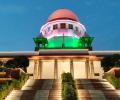
The Supreme Court of India will examine the age limits for surrogate mothers and other provisions of the Surrogacy Regulation Act and Assisted Reproductive Technology (Regulation) Act on February 11. The court has asked the government to file its written submissions on the matter. The laws set age limits for intended parents and surrogate mothers, restricting commercial surrogacy and emphasizing altruistic surrogacy. The court is also considering alternative mechanisms for compensating surrogate mothers and has proposed a designated authority for disbursing payments instead of intended couples.

The Supreme Court on Tuesday refused to entertain a plea seeking a stay on release of the movie The Kerala Story on grounds that it's a "worst kind of hate speech" and an "audio-visual propaganda".

The Supreme Court of India has criticized the Madhya Pradesh High Court's decision to sack a woman judge due to performance concerns, without considering the impact of a miscarriage on her ability to work. The court questioned the lack of similar criteria for male judges and highlighted the mental and physical trauma associated with a miscarriage. The case involves six women civil judges who were terminated by the state government over alleged unsatisfactory performance. While the high court reinstated four judges, the fate of the other two, including the judge who suffered a miscarriage, remains uncertain. The Supreme Court has issued notices to the high court registry and the judicial officers involved, seeking clarification on the termination criteria and emphasizing the importance of considering factors beyond quantitative performance assessments.

Referring to the enactment of the Chhattisgarh Auxiliary Armed Police Force Act, 2011 which created a trained force to aid and assist the security forces in maintaining law and order in the state, the bench said in its view it cannot be said to be an act of contempt of the order of 2011 passed by this court.
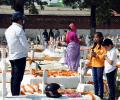
The Supreme Court of India expressed its disappointment and concern after a man was denied the right to bury his Christian father in a Chhattisgarh village, despite the presence of a designated burial area for Christians in the village graveyard. The man, Ramesh Baghel, had to approach the Supreme Court after the Chhattisgarh High Court dismissed his plea, citing concerns about potential unrest. The court criticized the high court's decision and the lack of action by local authorities in resolving the issue, noting that the body had remained in the morgue since January 7th. The case highlights a growing concern about religious intolerance and the need for greater sensitivity and respect for diverse communities in India.
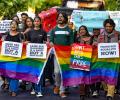
A five-judge bench of the Supreme Court will consider review pleas challenging the October 2023 verdict that declined legal sanction to same-sex marriage. The review pleas will be heard in chambers on January 9, with Justice P S Narasimha being the only member of the original bench that delivered the verdict.

The Supreme Court verdict on mining royalty case will give a further jolt to the Indian mining industry and will have very large financial implications, as arrears may work out to the tune of more than Rs 1.5 lakh crore to Rs 2 lakh crore, industry players said on Wednesday. The Supreme Court on Wednesday upheld the power of states to levy tax on mineral rights and mineral-bearing land, and allowed them to seek refund of royalty from April 1, 2005 onwards. According to a senior mines ministry official, the verdict will have a very large financial impact on mining, steel, power and coal companies.
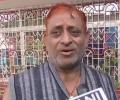
"My son used to say that there is a lot of corruption but he will fight as he is on the path of truth. He was broken from inside, though he didn't tell anyone anything," Subhash's father Pawan Kumar told ANI.
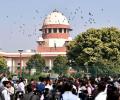
In 1997, the seven-judge bench ruled that the Centre had the regulatory power over the production of industrial alcohol. The case was referred to the nine-judge bench in 2010.
The Supreme Court of India has ruled that family members of an accused in domestic violence cases cannot be implicated without specific charges. The court emphasized the need for sensitivity in handling such cases, noting that emotions run high in matrimonial disputes and there may be a tendency to indiscriminately implicate family members. The court stressed that criminalizing domestic disputes without specific allegations and credible evidence could have disastrous consequences for the institution of family.

A bench of Justices BV Nagarathna and Ujjal Bhuyan also rejected the application for listing review petition in open court.
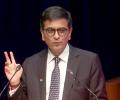
"The doctrinal error in the Krishna Iyer approach was, postulating a rigid economic theory, which advocates for greater State control over private resources, as the exclusive basis for constitutional governance," the CJI wrote in the 193-page judgment.
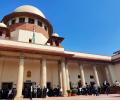
A bench of justices KM Joseph and BV Nagarathna deferred the matter after lawyer Ashwini Upadhyay mentioned it saying it be heard on April 5 or 6 as it was unlikely to be heard during the day.

In a judgment of far-reaching implications, the Supreme Court on Wednesday ruled that a Muslim woman can seek maintenance from her husband under Section 125 of the CrPC and said the "religion neutral" provision is applicable to all married women irrespective of their religion.
The Supreme Court of India expressed deep concern over the rising drug abuse problem in the country, highlighting the impact on youth and the need for urgent intervention. The court emphasized the need for rehabilitation rather than demonization of drug users and called for open discussions to address the issue. The judgment came while granting bail to a man accused in a heroin smuggling case. The court cited a 2019 report that indicated a significant number of people in India use opioids, cannabis, and other substances, with alarming trends in opioid dependence.

According to the cause list of July 10 uploaded on the apex court website, a five-judge bench headed by Chief Justice DY Chandrachud would consider in chambers the pleas seeking review of the October 17 last year verdict.

Justice BV Nagarathna also partially agreed with the majority verdict but criticised the CJI's views on Justice Iyer's judicial approach in dealing with "material resources" and state's power over them.
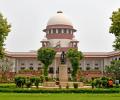
The Supreme Court on Friday asked the Madhya Pradesh high court to decide within three weeks whether it can reconsider its decision to terminate the services of six women judicial officers for their unsatisfactory performance.
The Gujarat government has said the apex court's observation in the January 8 judgment, holding the state guilty of "usurpation of power" and "abuse of discretion" for complying with an order of another top court bench, was an "error apparent on the face of the record" primarily on three grounds.

In another first, the venue of the ceremony was shifted to the newly-built auditorium instead of the CJI's courtroom, the traditional place for such a ceremony.

The Supreme Court on Monday sought responses from farmers and their associations, and the Centre to a plea by the Andhra Pradesh government challenging the high court decision which said the state legislature "lacked competence" to make any law for shifting, bifurcating or trifurcating the capital.
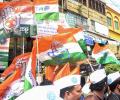
A bench of Justices BV Nagarathna and N Kotiswar Singh, which issued notice on the plea of the Congress against the March 13 high court order, however, said the ITAT can proceed on the political party's appeal.
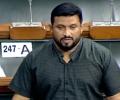
The Lok Sabha secretariat on Wednesday restored the membership of Nationalist Congress Party leader P P Mohammed Faizal, who was disqualified from the lower house in January following his conviction in a criminal case with a 10-year jail term.

The Supreme Court on Monday deferred to August 14 its hearing on CPI-M leader Brinda Karat's plea related to non-registration of FIRs against BJP MPs Anurag Thakur and Pravesh Verma for their alleged hate speeches in connection with the anti-CAA protests.
After a meeting of its working committee in New Delhi, the board adopted a resolution which stated that the recent judgment of the Supreme Court on the maintenance of Muslim divorcee women is "against the Islamic law (Shariah)".
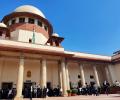
Additional Solicitor General Aishwarya Bhati, appearing for the Centre, informed the bench that the issue of single unmarried women opting for surrogacy is pending before a larger bench.
A bench of Justices BV Nagarathna and Prashant Kumar Mishra noted, in accordance with its May 9 order, notices have been published in local newspapers, including those in Gujarati and English, against the convicts who could not be served (the notice).

The case dates back to 2005, when the Punjab police arrested a man under the provisions of the Narcotic Drugs and Psychotropic Substances Act (NDPS) and later claimed that he escaped from custody. His father filed a habeas corpus and a few days later, a body was found and it was assumed that it was of the accused person arrested under the NDPS charges. Incidentally, the man was found alive after 14 years.

A cordial relation between the Bar and the Bench is absolutely necessary for smooth running of the administration of justice in the courts, the Supreme Court has said.
 © 2026 Rediff.com - Advertise with us - Disclaimer - Privacy Policy - Sitemap - Feedback - About us - Terms of use - Grievances