
Modi said there were a slew of 'matching priorities' between the business council and that of his administration, including dismantling trade barriers, promoting skills development, establishing manufacturing supply chains and infrastructure development.

The business council aims to give impetus to trade.

Consensus remained elusive on a common BRICS currency as business leaders from the five-bloc nations debated the pivotal issue at a business forum on the periphery of a summit of the five-member bloc being hosted here by South Africa. In their two addresses at the Summit so far, the leaders of Brazil, Russia, India, China and South Africa have made no or scant references to the issue either. "The BRICS Business Forum discussed the international payments system in detail. "Participants also debated the question of whether a BRICS currency is possible or desirable, with strong views expressed both for and against and little consensus reached," Sim Tshabalala, chief executive of Standard Bank Group, told several hundred captains of industry from the partner countries and over 40 other nations across the globe at the Summit.

The meeting will be attended by Russian President Vladimir Putin, Chinese President Xi Jinping, South African President Cyril Ramaphosa and Brazil's Jair Bolsonaro, according to the MEA.
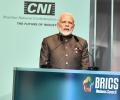
Modi also urged the BRICS Business Council to create a roadmap to achieve the $500 billion intra-BRICS trade target by the next summit.

The members resolved to foster a global economic governance architecture that is more effective and reflective of current global economic landscape

India's National Security Advisor Ajit Doval is expected to attend a major security meeting in Moscow next week, organized by Russia's Security Council. Doval is invited for the 13th international meeting of high representatives for security issues, taking place from May 27-29. The meeting, chaired by Sergei Shoigu, Secretary of the Security Council of the Russian Federation, will see participation from over 150 countries and international organizations. Pakistan's NSA, Lt Gen Asim Malik, is also expected to attend the meeting, leading to speculation of a possible face-to-face meeting between the two NSAs amidst heightened tensions between India and Pakistan following the Pahalgam attack and subsequent retaliatory actions.

The PM said there was a need to tackle the problem of terrorism in an organised manner.

'...it should not delude itself into thinking that India's security or its great-power ambitions will be advanced by those partnerships.'
'Instead, what India should focus on is on riding out the next three-and-a-half years of Trump's presidency with minimal damage to itself.'

'We should watch -- in the near term -- for signs that the two have totally fallen out at a personal, political level.' 'Trump and Modi know how to be dealmakers, but they also know how to hold a grudge.'

The decision was taken at the BRICS Summit in Durban which also launched a Business Council to encourage investment and trade in member countries and to expand business cooperation.

Srikanth Kondapalli on what to expect from the seventh BRICS summit meeting to be held in Russia in July.

India and China have not ruled out a Modi-Xi meeting during the summit.
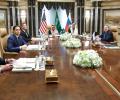
The US move to align with Russia is prompted by fear of a Sino-Russian joint threat. Russia, fully aware of its military vulnerability vis a vis China may cautiously welcome the American move, assesses Colonel Anil A Athale (retd).

'Happily,' says Ambassador B S Prakash, 'BRICS displayed new-found energy and built something real, a bank. Between needless nihilism and as yet unjustified euphoria, there are many stations for the BRICS train and we can watch its progress with renewed interest.'

'We will likely never know why Xi decided not to travel to New Delhi. One possible explanation could be his desire to avoid a meeting with US President Joe Biden.'

If it continues to do well economically, develops a large manufacturing sector, gains in technological heft, builds a more capable defence industry, improves its human development indicators, becomes more of a trading nation, and has greater internal cohesion. In short, it is a work in progress, suggests T N Ninan.
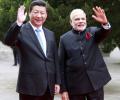
China's Vice Foreign Minister Li Baodong again harped on the need to build consensus over the admission of new members in the 48-member Nuclear Suppliers Group.
Modi knew in his heart that India does not have the financial muscle to support the new bank with offers of co-financing international projects, something China can do from the bank's base in Shanghai. If established in Mumbai, it may have employed a few Indian bankers and satisfied the national ego but there was little financial value to be drawn from it.

China continues to hold out on fingering Pakistan as the 'mothership of terror,' declaring Masood Azhar a terrorist at the UN, and India's membership of the NSG, says China expert Srikanth Kondapalli.

'You ain't seen anything yet,' EAM Jaishankar says about the India-US relationship.

India scripted history as the ambitious third Moon mission of the Indian Space Research Organisation (ISRO) touched down on the Moon's south pole, propelling the country to an exclusive club of four and making it the first nation to land on the uncharted surface.
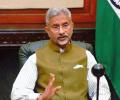
External Affairs Minister S Jaishankar will arrive in New York on Sunday to participate in the high-level 77th session of the UN General Assembly, which kicks off on September 20 with the opening of the general debate.

'The MEA, hopefully, made it clear that the Indian PM can't be seen in Xi Jinping's company when China has, for all intents and purposes, annexed over 1,000 sq kms of Indian territory in eastern Ladakh, and essentially that the Wuhan spirit and the Mamallapuram spirit have turned into vinegar.'

The South African Health Products Authority (SAHPRA) on Wednesday approved the use of Pfizer's Comirnaty COVID-19 vaccine after BioNTech and Pfizer announced that two doses of their vaccine may not be enough to protect against the Omicron variant.

India has realised that one can only deal with China from a position of strength and that is not palatable to Beijing, observes Dr Rup Narayan Das.

China's intended role for AIIB is not so different from the existing Western lenders like the World Bank.

'From the very start, PM Modi was insistent that visiting foreign leaders should be exposed to an India beyond its capital.' 'Through these experiences, he felt that the full Indian narrative would be much better understood across the world,' explains External Affairs Minister S Jaishankar. A riveting excerpt from Bluekraft Digital Foundation's Modi@20: Dreams Meet Delivery.

India and South Africa on Friday agreed to deepen engagement in key areas of defence production, manufacturing, mining and minerals and combating terrorism.

Here's the full text of President Ram Nath Kovind's customary address to the joining sitting of Parliament on the first day of the budget session.

"We are committed to building a new India. We have to do this as early as possible," he said.

'This has to be seen in the context not only of the legacy we inherited, but also of global economic weakness.'
'If after inheriting the very bad situation we have reached this level despite consecutive years of drought and no growth in the world economy, it is no accident.' 'It is a result of the sound macro economic policies followed by this government.' 'We have eschewed populism and stuck to a path of fiscal prudence.'

India and Russia on Thursday decided to expand cooperation in various sectors as they signed 16 pacts, including on joint manufacture of 226 military helicopters.

Terrorism and Afghanistan were the focus points of Prime Minister Narendra Modi's talks with Uzbek President Islam Karimov on his first visit to Central Asia.

Pakistan's prime minister is trying to use the unrest in Kashmir to save his government, says Ambassador G Parthasarathy, a former high commissioner to Islamabad.

'This novel format of diplomacy -- the informal summit -- will not only facilitate bilateral communication and reduce miscalculations at the very top level of the two governments, but possibly open the space for China and India to speak in one voice on various issues of mutual concern,' note Feng Renjie and Ding Kun Lei

Amid souring ties, the president visited Beijing for three days. On his return to India, a hope of better ties has arisen, says senior correspondent R Rajagopalan, who travelled with Pranab Mukherjee to the Asian superpower.

'The Modi-Xi and Modi-Obama meetings, with an interval of just 12 days, are juxtaposed superbly at a crucial point in the prime minister's life. Can Modi carve out a win-win situation with the superpower and the emerging superpower at the same time?'

 © 2026 Rediff.com - Advertise with us - Disclaimer - Privacy Policy - Sitemap - Feedback - About us - Terms of use - Grievances