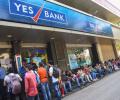
Banks can collapse, markets can be rigged, investment instruments can become worthless overnight, auditors can fail to blow the whistle, board directors can be asleep, and regulators can be incompetent, notes T N Ninan.

'While growth will bounce back from the current sub-5 per cent, it will stay lower than the already inadequate long-term average of 6.6 per cent,' notes T N Ninan.

'As the 1991 experience showed, the solution to a large trade deficit may be to open up the economy, not putting up protective walls,' points out T N Ninan.

The ones who came more recently were clutching the green cards that gave them an escape hatch through which to return to green pastures: Arvind Panagariya, Raghuram Rajan, Arvind Subramanian and other perfectly honourable gentlemen like them, points out T N Ninan.

'Why do we make finance ministers go into contortions, to tell us that near 6% is 3.5%?' 'Why not encourage more open and full accounting so that the country knows the real picture,' asks T N Ninan.
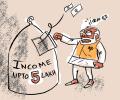
Mr Modi should be conscious that it was his choice to slash the number of tax-payers from 60 million to 15 million, notes T N Ninan.

'What is unusual about the current period of slow growth is that it has come without an external driver -- high oil prices and/or successive monsoon failures -- as was the case with all previous periods of slowdown, going back 50 years, notes T N Ninan.
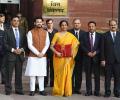
'There is a time for lowering one's expectations of the economy -- and therefore not trying to do too much in the Budget,' notes T N Ninan.
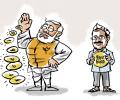
'Mr Kejriwal is almost exactly the package that Mr Modi offers: Personal aggrandisement, the building of a personality cult through full-page newspaper ads day after day, populist schemes involving subsidies (whether affordable or required), abandonment of secular principles, exaggerated claims and no checks on leadership,' points out T N Ninan.
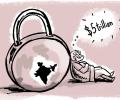
'There is a fiscal crisis building up, which might become apparent when the Finance Commission presents its report,' warns T N Ninan.

It became increasingly clear that the real negotiations the government had to conduct were with Indian business which was wary of yet another free trade agreement, points out T N Ninan.

'No one seems to have looked at the extent of money that is being borrowed by individuals, and the rising levels of household debt.' 'At their present rates of growth, personal loans in India could well become the largest category of bank credit in just two or three years,' cautions T N Ninan.
'Growth would have to be 7% in the October-March period, if the year as a whole is to clock 6%.' 'Who would bet on that when, in the world of real numbers, both exports and imports have continued to fall, car sales have continued to slump, and the industrial production index shows yet again a drop in output?', asks T N Ninan.
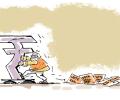
'Since the growth is not fast enough to provide jobs for the young, the fallout will be political and social,' warns T N Ninan.

'Fiscal purists would quarrel with the idea of selling assets to pay for current expenditure -- such as the payout to farmers and the health insurance programme -- for the obvious reason that the process cannot go on forever.' 'At some point, the list of assets available for sale will run out,' notes T N Ninan.consultations -- something already aired in connection with the lease of airports to the Adani group, says T N Ninan.
If anything has become clear during this campaign, it is this: Mr Modi can bat on almost any wicket and hit the ball over the ropes, points out T N Ninan.
'It is almost certainly wrong in assuming that the Modi government will use its strong mandate to undertake some serious reform measures.' 'For it is fairly clear that the government's priorities lie elsewhere, in the powerful home minister's domain,' notes T N Ninan.

'The digital economy will generate 60 to 65 million jobs by 2025, 20 million more than the 40 to 45 million existing jobs that are in danger of disappearing or getting automated,' points out T N Ninan.

'If an election promise has to be credible, silence on practical questions doesn't help matters,' notes T N Ninan.

'A major political party has come down on the side of Constitutional freedoms and internationally recognised human rights,' says T N Ninan.

If foreigners need reasonable taxes, why offer citizens something else? If foreign businessmen look for assurance on the rule of law, so do citizens, argues T N Ninan.

Niti Aayog's plan to create a 'New India' in less than four years should invite scepticism, argues T N Ninan.

'Persisting with the inequalities, indeed seeing them get worse, is no one's prescription for national unity,' notes T N Ninan.
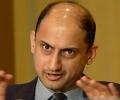
Today, with growth having slowed and macro-economic challenges in every direction, would the government have benefited from the advice of 'Harvard' economists? asks T N Ninan.

'Will Mr Jaitley listen, or is that expecting too much in pre-election season?' asks T N Ninan.

'Is India going to miss some more of its potential demographic dividend?' 'If so, it would be for two reasons: The demographic dividend can be fully exploited only if the people in the working age are actually working.' 'And second, if those working have proper education and skills, making them productive in the workplace.' 'On both counts, the country has fallen short,' points out T N Ninan.

'The fiscal situation is stressed (when is it not?!), economic growth has slowed, tax revenue has fallen short and the deficit is high if it is properly accounted,' points out T N Ninan.

'No matter how many government schemes there are for the poor, the system works more for the privileged, less for the little guy,' notes T N Ninan.

'And so, despite demonetisation, people in business feel safe with Mr Modi,' points out T N Ninan.
Change will have to begin with Mr Modi, who by all accounts has shown little active interest in macro-economic issues, preferring instead to focus on the effective implementation of projects and programmes, points out T N Ninan.

'Course correction today would be good politics and also good economics,' notes T N Ninan.
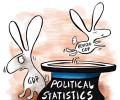
Whatever the claims about the new GDP numbers being technically superior to earlier estimates, their public credibility depends on their passing some reality checks, argues T N Ninan.

'The Budget will have to be substantially re-cast as soon as a new government takes charge after the elections.' 'Both revenue and expenditure numbers will have to be trimmed -- and then may better reflect the deceleration of economic activity caused by slowing consumption trends,' points out T N Ninan.
'Coalition governments, sometimes assumed to mean years of political instability, actually saw key institutions emerging with greater strength -- the Election Commission, the judiciary, the press, and civil society at large, among others.' 'The question now is whether the clock is being turned back in a new political phase,' asks T N Ninan.

'Unless cash has ceased to be king, the issue is the same in the aviation, telecom and ecommerce sectors: Sustainability,' notes T N Ninan.

'If businesses are focused on de-leveraging, they can hardly be investing. This is the price extracted by investment mistakes during UPA rule, and should have been foreseen. 'But Modi-I must share the blame, for muted reform of the financial sector, partisan policy in telecom, the harm done to exports by an over-priced rupee, and so on,' says T N Ninan.
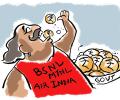
'Once we are past this electoral season, during which all promises are presented as free lunches, could we bring such non-populist issues into focus?' 'Like fixing the problems of the public sector?' points out T N Ninan.

New body to replace Plan panel might retain 40% of existing staff

'Though the prime minister has talked somewhat needlessly of pilot projects and the real stuff to come, India cannot be sure of a clean victory in any full-fledged conflict -- even if there is reason to engage in such,' points out T N Ninan.
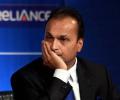
Who is to take their place? Will a new generation of entrepreneurs start up with better business sense, or at least better luck? But the so-called unicorns are mostly copy-cat entrepreneurs whose cash flow is funded by overseas (including Chinese) money, notes T N Ninan.
