
The Supreme Court granted bail to Suhail Ahmad Thokar, arrested under UAPA for allegedly conspiring with terrorist groups to recruit terrorists and radicalise youth after the repeal of Article 370.

The Supreme Court of India has questioned the continued provision of reservation benefits to children from economically and educationally advanced families within backward classes, highlighting concerns about social mobility and fairness.
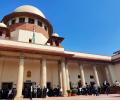
The Supreme Court has decided to hear cases exclusively through video conference on Mondays and Fridays. Judges have also resolved to encourage car-pooling arrangements amongst themselves in order to ensure optimum fuel utilisation.

In response to Prime Minister Narendra Modi's call for austerity, political leaders are reducing convoys and promoting public transport to conserve fuel.
The Supreme Court has raised concerns about the low conviction rates under the Unlawful Activities (Prevention) Act (UAPA), noting that over 90 per cent of trials result in acquittals. The observations were made while granting bail to an accused in a narco-terrorism case.

The Supreme Court of India has voiced concerns about the potential consequences of individuals questioning religious practices in constitutional courts, warning it could lead to the fragmentation of religions and civilisation. A nine-judge Constitution bench is hearing petitions related to discrimination against women at religious places and the scope of religious freedom.
The Supreme Court has expressed strong displeasure over statements made by politicians regarding the Shiv Sena symbol row case, cautioning them about making irresponsible comments.
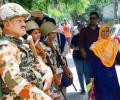
'98 lakhs in Bengal, 97 lakhs in Tamil Nadu, 2.83 crores in Uttar Pradesh.'

The Supreme Court of India has affirmed that the right to live with dignity includes the right to live without the threat of harm from stray dogs, dismissing petitions seeking to overturn earlier directives on relocation and sterilisation.

The Supreme Court of India has permitted euthanasia for rabid, incurably ill, or demonstrably dangerous stray dogs to mitigate the threat to human life. The ruling includes several directives to manage the rising stray dog population, emphasising public safety and animal welfare.

The Supreme Court of India has dismissed the use of information from 'WhatsApp University' as evidence in a case concerning religious freedom and discrimination against women at religious sites, including the Sabarimala Temple.
The Supreme Court has declined the Centre's request to postpone the hearing on petitions challenging the constitutional validity of the 2023 law, which excludes the CJI from the committee responsible for appointing election commissioners, stating the matter is of utmost importance.
The Supreme Court of India has observed that the practice of excommunicating Parsi women for entering into interfaith marriages is prima facie discriminatory, emphasising that the right of conscience is a birthright.

The Shahdara Bar Association has pledged its support to a woman advocate who was brutally assaulted by her husband. The Supreme Court has taken cognisance of the matter and issued directions to the Delhi Police.
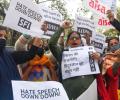
The Supreme Court of India has stated that the current legal framework is sufficient to address hate speech, declining to intervene and create new offences.
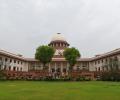
The Supreme Court of India is hearing petitions related to discrimination against women at religious places, including the Sabarimala temple in Kerala, and the scope of religious freedom practised by multiple faiths.
The Supreme Court of India has ruled that a minor child cannot be forced to carry a pregnancy to term, urging the government to amend laws to allow rape survivors to terminate unwanted pregnancies beyond 20 weeks.

The Narcotics Control Bureau (NCB) in Bengaluru destroyed 128.76 kg of seized narcotics, estimated to be worth Rs 38 crore, during a drug disposal drive. This marks the second such drive by the Bengaluru zonal unit in 2026, following the guidelines of the NDPS Act and Supreme Court. The NCB has destroyed a total of 1735 kg of seized drugs this year and encourages citizens to report drug trafficking.
The Supreme Court has stated that roads cannot be blocked for religious activities and that while religious denominations have autonomy in worship, the government can interfere if secular activities are affected.

'The grounds shown by the investigating officer (IO) for issuance of non-bailable warrant were 'entirely based on presumptions and conjectures, and are not supported by any material on record',' the court said.

The Supreme Court of India has emphasised that a husband's obligation to maintain his wife is a primary and continuing duty, ensuring she lives with dignity and in a manner commensurate with her marital status.
The Supreme Court of India has asserted its jurisdiction to determine what constitutes a superstitious practice within a religion, during a hearing on petitions related to discrimination against women at religious sites.

The Supreme Court of India has emphasised the importance of open access to all temples and 'maths' for everyone, warning that excluding any denomination would negatively impact Hinduism and divide society. This statement was made during hearings on petitions related to discrimination against women at religious sites and the scope of religious freedom.

The Supreme Court of India has stated that husbands must equally participate in household chores, such as cooking, cleaning, and washing, as marriage is a partnership, not an employer-employee relationship. The observation was made during a hearing regarding a divorce petition.

The Supreme Court of India has issued a series of nationwide guidelines aimed at improving road safety on national highways, addressing issues such as illegal parking and accident blackspots.

Chief Justice of India Surya Kant cautioned against the uncritical adoption of AI in the judiciary, emphasising the need for human judgement and ethical considerations in judicial decision-making.
Chief Justice of India Surya Kant has cautioned against the uncritical adoption of Artificial Intelligence in the judiciary, emphasising the need to balance technological advancements with human intellect and ethical considerations.

The Supreme Court of India has clarified the distinct parameters for suspending sentences after conviction compared to granting pre-trial bail, setting aside a Patna High Court order in a 2016 murder case.

The Supreme Court of India has ruled that individuals converting from Hinduism, Sikhism, or Buddhism cannot retain Scheduled Caste status, reinforcing existing constitutional provisions.

The Supreme Court has revoked the wrongful termination of a former Indian Air Force official, restoring his honour after more than three decades, in a case involving alleged criminal force against a junior colleague.
The Supreme Court of India has ruled that voluntary retirement is a distinct right of employees upon completion of the required years of service, clarifying the process and employer obligations.
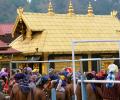
The Supreme Court of India questioned the Centre regarding the eligibility of non-devotees to challenge the customs of the Sabarimala temple in Kerala, during a hearing on religious freedom and discrimination against women at religious sites.
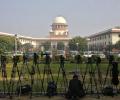
A nine-judge Supreme Court bench has commenced hearing on petitions related to discrimination against women at religious places, including the Sabarimala temple, and the scope of religious freedom across faiths.
The Supreme Court of India has stated that the time has come for a Uniform Civil Code (UCC), while hearing a plea challenging the Shariat law of 1937. The court suggested that the legislature should address the issue of discrimination against Muslim women.
The Supreme Court of India has agreed to examine a constitutional challenge regarding gender discrimination within Parsi personal law, specifically focusing on whether a Parsi woman loses her religious identity upon marrying outside the community.
The Supreme Court of India granted bail to a Punjab resident accused of attempt to murder, emphasising that incarceration without trial is a form of punishment. The court noted the accused had been in jail for two years without the trial commencing.
Rajya Sabha Chairman C P Radhakrishnan rejected the opposition's motion to remove Chief Election Commissioner Gyanesh Kumar, citing a lack of evidence of misbehaviour and the fact that some charges are under judicial review.
The Centre has asked the Supreme Court to reconsider its judgements decriminalising adultery and same-sex relationships, arguing they were based on a subjective application of 'constitutional morality'.

The Supreme Court has ruled that borrowers are not entitled to a personal hearing before banks classify their loan accounts as "fraud" under RBI directions, clarifying that a written response to a show-cause notice and access to the forensic audit report (with redactions) are sufficient for natural justice.

'The Supreme Court stated that once the delimitation plan is approved by Parliament and receives assent of the President, it cannot be undone. Nor can it be modified.'
 © 2026 Rediff.com - Advertise with us - Disclaimer - Privacy Policy - Sitemap - Feedback - About us - Terms of use - Grievances