.jpg)
SBI will hold 30 per cent in RIL joint venture

If indeed the gate opens for big industrial houses, the RBI needs to be smarter than them and demonstrate it through action, not reaction, observes Tamal Bandyopadhyay.

Since the bankcuptcy law came into effect from December 2016, with every quarter, the recovery rate has progressively been going down, notes Tamal Bandyopadhyay.

'Like doctors, health workers, police, bankers are also COVID warriors,' notes Tamal Bandyopadhyay.

Reserve Bank on Wednesday announced a slew of measures including loan restructuring for individual and small businesses hit hard by fresh COVID-19 wave. To augment supply of goods for COVID care, the central bank opened Rs 50,000 crore on-tap window to ease access to emergency health services to boost provision of immediate liquidity for ramping up COVID-19 related healthcare infrastructure and services in the country. This liquidity window is being opened till March 31, 2022, he said, adding that under the scheme, banks can provide fresh lending support to a wide ranging of entities including vaccine manufacturers, importers and suppliers of vaccine and medical devices, hospitals and dispensaries and suppliers of oxygen and ventilators importers and also patients for treatment.

The race to get a New Umbrella Entity (NUE) licence for digital payments may get crowded. As many as six consortiums are said to be in the fray to apply for an NUE licence, which would create a for-profit National Payments Corporation of India (NPCI)-like body for retail payments. A consortium led by Financial Software and Systems (FSS), a leading provider of payment products and payment processor, is in talks and may file an application to the RBI for an NUE license, said sources aware of the development. The other constituents of this group include Indian Bank, Central Bank of India, India Post Payments Bank, National Bank for Agriculture and Rural Development (Nabard), and a few small finance banks.

While it is okay to hunt for banks that offer higher rates, the safety aspect is equally important.

The government has no plan to print currency notes to tide over the current economic crisis triggered by the outbreak of COVID-19 pandemic, Finance Minister Nirmala Sitharaman informed Parliament on Monday. To a question on whether there is any plan to print currency to tide over the crisis, the finance minister said, "No Sir". Many economists and experts have suggested to the government to print more currency notes to tide over the difficult economic situation with a view to support the economy ravaged by the spread of COVID-19, and protect jobs.

Nationalisation has served its purpose. It's time to move ahead, keeping majority ownership of the government in a few banks to serve the people, argues Tamal Bandyopadhyay.

If the banks throw caution to the winds for building loan books, the hydra-headed bad loans may resurface and spoil the party, warns Tamal Bandyopadhyay.

The deluge of offerings in the primary market, a muted results season and increasing talks of a Fed taper may quicken the pace of overseas investors selling Indian equities in the near term. The next few weeks may see a dozen companies tap the market for initial public offerings and raise about Rs 30,000 crore. These include the likes of Zomato, Glenmark Life Sciences, Utkarsh Small Finance Bank and Seven Islands Shipping.

The RBI has set up a panel to review ATM charges, and fees levied by banks.

Despite a shaky Q3, conviction over the stock remained high, with 65 per cent of the analysts polled on Bloomberg retaining their 'buy' recommendation.

One thing is for sure: It smacks of the regulator's lack of confidence in the bank's board, points out Tamal Bandyopadhyay.

The payments banks are intended to house transactional accounts for individuals, focusing on payments and remittances.

The currency market won't care for our moans, groans, cries and sighs. The rupee will find its own level, explains Tamal Bandyopadhyay.
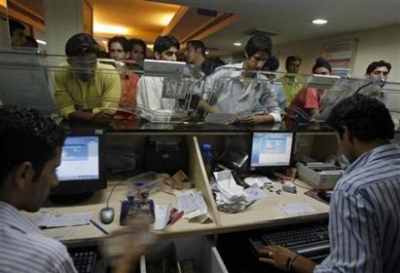
RBI had received 72 applications for small finance bank licences.

Many banks' profits will take a hit and a few of them could even end up being in the red because of treasury losses, triggered by a sudden spike in government bond yields in the rising interest rate cycle, notes Tamal Bandyopadhyay.

In its scheme of things, tackling inflation now comes ahead of ensuring growth in the world's sixth largest economy, points out Tamal Bandyopadhyay.

Rajan has set March 2017 as the deadline for banks to clean up their balance sheets.

'In times of recovery, we may see a rural-urban divide with the urban pockets affected more by COVID-19, but the MFI business model should encourage banks to handhold them in this hour of crisis,' notes Tamal Bandyopadhyay.

'The no-rate cut policy and preference to wait for the Budget and clarity on the fiscal front demonstrate RBI Governor Shaktikanta Das is maturing in his new role,' notes Tamal Bandyopadhyay.

Indeed, there were frauds, and the politician-banker-industrialist nexus played a role in the rise of NPAs, but governance issues in Indian banking are far more nuanced and complex, reveals Tamal Bandyopadhyay.

Shifting to floating rate deposits can work as an anaesthetic gel for some customers, points out Tamal Bandyopadhyay.

Brokerages are expanding the universe of stocks they cover amid a boom in the market. Several stocks in the mid-cap universe are now tracked by more analysts than they were a year ago. For instance, SBI Cards and Payment Services is now tracked by 17 brokerages, compared to just four a year ago.

We'll need to wait a couple of years to see how many restructured loans turn bad and whether some banks fall victim to their obsession for growth, explains Tamal Bandyopadhyay.

The growth opportunity for a business, people running the business, governance structure at a company, technology adoption and the firm's belief in frugality are the list of priorities which should be considered before choosing a stock to invest in, Jhunjunwala said.

More cos could join the likes of Burger King and Antony Waste in giving listing another shot.

Suitors for Punjab and Maharashtra Co-operative Bank (PMC Bank) may have to infuse additional capital of nearly Rs 750 crore so that the payout per depositor is more than the Rs 5 lakh sum assured by the Deposit Insurance and Credit Guarantee Corporation (DICGC). The Reserve Bank of India (RBI) has also slotted its board meeting on March 19 in Mumbai - a fortnight short of the current deadline to find a resolution for the beleaguered bank and the moratorium placed on it comes to an end. Sources close to the PMC Bank transaction said that the central bank wants the suitors "to go the extra mile so that depositors can get more than the Rs 5 lakh insured by the DICGC". This is also to ensure that the new owners of the bank - who are to be issued a small finance bank (SFB) licence - are serious and have deep pockets.

Flush with liquidity, banks are eager to lend. And, therein lies the problem, warns Tamal Bandyopadhyay.

The Indian financial system's asset quality improved despite the pandemic, but it could be due to special dispensations by the regulator, and banks would likely see increased stress on their books once the schemes expire. According to the annual trend and progress report of the Reserve Bank of India (RBI) released on Tuesday, the data available for this financial year so far indicate that banks' bad debts have moderated while provision coverage ratios (PCRs), capital buffers as well as profitability indicators have improved relative to pre-pandemic levels.

For the first time, consumers, including those at the so-called bottom of the pyramid, are monetising gold by taking loans from banks, offering the yellow metal as collateral, says Tamal Bandyopadhyay.

With the rise in interest rates, bond yields have been on the rise; this will dent banks' treasury profits. Also, many retail borrowers may find it difficult to service their loans when the loan rates rise, points out Tamal Bandyopadhyay.
Bankers need to take a call on whether they will allow technology firms to run banks or banks themselves will turn into tech firms, says Tamal Bandyopadhyay.
But there are challenges, observes Tamal Bandyopadhyay.

The government will issue Sovereign Gold Bonds (SGBs) in six tranches beginning April 20, the Reserve Bank of India said on Monday. The bonds will be denominated in multiples of gram(s) of gold with a basic unit of 1 gram and the tenure of the SGB will be eight years with exit option after fifth year to be exercised on the interest payment dates.

Even as you fight the ongoing health challenge, here are some tips to strengthen your personal finance in the time of coronavirus.

Sebi has asked intermediaries to stagger the offerings as much as possible, said people in the know and ensure adequate capacity building.
Mired in corruption, politics and with a history of suicides by its hapless depositors, PMC Bank's revival is a challenge very different from Yes Bank and LVB, both for the regulator and the rescuer, observes Tamal Bandyopadhyay.

Private equity (PE) is set to play a bigger role in banks. Of 21 recommendations accepted by the Reserve Bank of India (RBI) out of 31 made by its Internal Working Group (IWG), its stance on non-promoter holdings in private banks is seen with excitement, though it doesn't refer to PEs explicitly. On non-promoter holdings in these banks, the RBI said this will be capped at 10 per cent of the paid-up voting equity share capital in the case "of natural persons and non-financial institutions and entities"; and "at 15 per cent for all categories of financial institutions, entities, supranational institutions, public sector undertaking, or the government." While this is a modification of the IWG's stance for the non-promoter holding in banks at up to 15 per cent, it does open up a huge window for PEs, all the same. This is because, while the RBI has remained silent on the eligibility of industrial houses for bank licences, fresh high-quality capital in large amounts can only come from PEs.
 © 2026 Rediff.com - Advertise with us - Disclaimer - Privacy Policy - Sitemap - Feedback - About us - Terms of use - Grievances