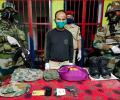
The Centre on Monday decided to extend the ban imposed on the National Socialist Council of Nagaland-Khaplang [NSCN-K)] along with all its factions, wings and front organisations for five more years due to its involvement in activities prejudicial to the sovereignty and integrity of India.

After the Naga leader's death, Chinese intelligence may ensure ULFA terrorist Paresh Barua takes over as leader of the anti-India rebel groups operating out of Myanmar, says Nitin A Gokhale.

Security forces in Nagaland and Arunachal Pradesh have mounted vigil in areas where the Nationalist Socialist Council of Nagalim (Khaplang) led by Burmese-origin Naga S S Khaplang has strong influence.

The Centre on Monday extended the ceasefire agreements with three insurgent groups of Nagaland for one more year till April next year.

Eighteen years ago the government of India signed a truce with the NSCN-IM to facilitate prolonged peace negotiations, which culminated in the August 3 peace accord.

Seven Assam Rifles personnel and one Territorial Army jawan lost their lives.
The NSCN-K had signed a ceasefire with the Centre in 2001 but unilaterally abrogated it in 2015 when the then 'chairman' of the group, S S Khaplang, was alive. Sumi is the prime accused in the killing of 18 Indian Army soldiers in Manipur in 2015 and the National Investigation Agency had announced a reward of Rs 10 lakh for his head.

The National Socialist Council of Nagaland-Khaplang, a guerilla outfit headed by its self-styled chairman S S Khaplang, has dictated the Indian and foreign oil companies engaged in oil extraction and fresh exploration work on the soil of Nagaland, "to stop all activities forthwith or face the consequences."
The chairman of the National Socialist Council of Nagaland (Khaplang faction) S S Khaplang has asked all the 12 elected legislators of the Tirap and Changlang districts of Arunachal Pradesh to quit the ruling government or face the consequences. The alleged letter categorically directed all the 12 MLAs to corner Arunachal Chief Minister Dorjee Khandu.
The infighting in Naga rebel group, National Socialist Council of Nagaland - Khaplang has led to its Myanmar-based chairman S S Khaplang expelling Khole Konyak from the post of commander-in-chief of the self-styled 'Naga Army' with immediate effect.
A political agreement by any group with the Centre to resolve the protracted Naga problem without the consent of the people would "only lead to more bloodshed among Nagas", the National Socialist Council of Nagaland-Khaplang has said.
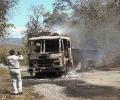
Three Army personnel were killed on Thursday and four injured when suspected NSCN rebels ambushed their vehicle in Arunachal Pradesh's Tirap district bordering Nagaland.
The NSCN-IM is no longer the force it used to be. Once the 'de facto government' of Magaland, it gradually reduced to an extortion racket. But missteps by the Centre could give it a new lease of life.

Rediff.com gives you a lowdown on the NSCN-K.
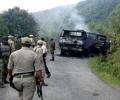
Nationalist Socialist Council of Nagaland-Issac-Munivah wanted to join the operations against NSCN-K militants.
Khaplang died following a cardiac arrest.
Nationalist Socialist Council of Nagaland-K leader S S Khaplang, whose outfit carried out the June 4 attack on the Army in Manipur, is believed to be ill and convalescing in a Yangon hospital.
Rijiju said the central government will rehabilitate all Indian citizens in the Naga group if they abjure violence.

The government declared NSCN-K, all its front organisations and formations as a terrorist organization under the Unlawful Activities (Prevention) Act, 1967, a home ministry spokesman said.
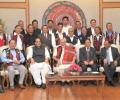
'NSCN-IM leader Muivah warns that the NSCN-IM has come very close to an honourable solution to the peace process with the Government of India, but if it does not materialise, then the Nagas will go away so far that it would be difficult to bring them back to the negotiating table easily,' note Sandeep Pandey and Meera Sanghamitra.
The decision has been taken at a meeting of the Union Cabinet chaired by Prime Minister Narendra Modi.

The leadership of the NSCN-K is scheduled to join the peace negotiations in March as part of the Naga National Political Group with Government of India's Interlocutor R N Ravi, reports Sujit Kumar Chakraborty.
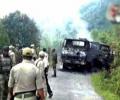
The newly-formed common forum of Northeast insurgent groups based in Myanmar has posed a renewed threat to security and peace in the troubled region.
Although India has sought inputs from the Myanmar army since most of those involved in Thursday's ambush would have sneaked across into Myanmar, the fresh operations would smoke out insurgents based in hideouts on the Indian side along the border.
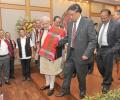
'According to top government sources, the territorial boundaries of the existing North-Eastern states will not be disturbed although cultural integration of Nagas living in states other than Nagaland will be facilitated through special measures,' reveals Nitin A Gokhale.
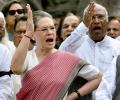
"We are actually shocked. The prime minister did not even take into confidence chief ministers of Manipur, Assam and Arunachal Pradesh, who are directly affected. Here is another show of arrogance of this government," Gandhi told media persons.
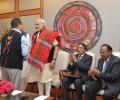
With an aim of ending insurgency in Nagaland, the government on Monday signed an accord with key outfit Nationalist Socialist Council of Nagaland- Isaac-Muivah which Prime Minister Narendra Modi described as a "historic" step to usher in peace in the state.

The operation in Nagaland and Manipur was carried out after the army received "credible and specific" intelligence.
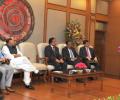
To expect that these past decades of grief, inter-group killings, anxiety and fear will be brushed aside because of the Naga peace accord is being unrealistic. Memories are built on old wounds and they heal slowly. So, it is important to be cautiously optimistic, says Sanjoy Hazarika.
 © 2026 Rediff.com - Investor Information - Advertise with us - Disclaimer - Privacy Policy - Sitemap - Feedback - About us - Terms of use - Grievances