
The fundamental issue between banks and fintech would be who will own the customer and who will be the service provider.

We don't know if this means that Dhoni is exploring a post-cricket career, but the cricket legend has apparently taken up farming.
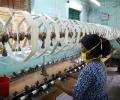
'Loss of these urban salaried jobs is, therefore, likely to have a particularly debilitating impact on the economy, besides causing immediate hardship to middle-class households,' points out Mahesh Vyas.

'Given the possibility that our unstable northern and western borders may become 'live' at short notice, any major systemic change which impacts combat effectiveness should be brought about in a cautious and progressive manner.'

'Having dedicated my life towards improving breast healthcare in my motherland. I shall continue to work with rock-solid determination following this "chosen" path.'

His remarks assume significance at a time when a large number of Indian students, many of them studying medicine, have been stuck in Ukraine following the Russian attack on that country.

'For the next two years, we expect the bulk of earnings growth contribution from sectors like financials and energy, where the outlook remains positive, while the sectors which are linked to domestic consumption and are currently witnessing strains on margins have low salience for Nifty earnings.'

Good sowing of kharif crops, better minimum support prices, and fewer Covid-19 cases (in villages) will help the rural growth story to continue, says Maruti.
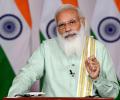
Earlier on Wednesday, the prime minister also chaired a meeting to review the availability and supply of oxygen and medicines in the wake of the surge of COVID-19 cases in the country.
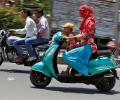
After a very weak December quarter and a poor year-to-date fiscal year volumes-when sales plunged to the lowest in nine years, the signs in the first 15 days of January haven't been encouraging either. "Though the severity of the current wave is not as high as the previous one, it has hit the sentiments hard impacting conversion of enquiries into sales," said Vinkesh Gulati, president, Federation of Automobile Dealers Association (FADA).
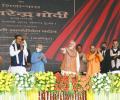
'I don't think there is a wave in favour of the Samajwadi Party, or against the BJP.' 'This election is largely about which party is able to build a larger social and political coalition.'
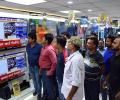
Nearly all FMCG companies like Marico, HUL, ITC and the rest have been indicating that the operating environment has been challenging, with drop in consumption, especially in rural areas, severe crunch in market liquidity conditions, and disruptions and floods in several parts of the country. To overcome this, they are boosting their direct reach in the countryside.
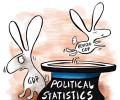
The GDP growth is estimated to come at the "deceptively high" level of 20 per cent for the April-June 2021 quarter but is far below the same in the pre-COVID times, rating agency Icra said on Wednesday. Icra said the low base of the last year, when the GDP had contracted by close to 24 per cent, "conceals" the impact of the second wave of COVID-19 infections. Economic activity is boosted by robust government capital expenditure, merchandise exports and demand from the farm sector, it said, estimating the GDP to grow by 20 per cent and the gross value added (GVA) will register a growth of 17 per cent for the June quarter.

The cumulative loss of salaried jobs since the pandemic is even larger at 12.6 million, reveals Mahesh Vyas.

'The government is trying to kickstart the investment cycle in India and while the corporate investments are yet to gather momentum, there are early signs of the same.'

From Asgard's naughtiest imp to Arsene Lupin's biggest worshipper in Paris, Sukanya Verma notes OTT is full of curious options this week.

Falling incomes and longer winter to translate into lower demand for at least some months.

While sales momentum from rural areas may last another three to six months, sales growth in urban areas could stage a comeback by next year's June quarter as people learn to live with the coronavirus and economic activity gradually improves in the cities.

Overall, India had 451 million internet users at the end of March this year, second only to China in terms of monthly active internet users, the Internet and Mobile Association of India (IAMAI) said in its report titled 'India Internet 2019'.

The girl from the north east who now walks for the best names in international fashion today was content wearing hand-me-downs from cousins those days.

'People are getting back to work.' 'The worst seems to be over.' 'It is very likely that the recovery is mostly among the informal, self-employed, workers who cannot afford to be away from work for too long,' notes Mahesh Vyas.

'There was hardly any recruitment after the second wave.' 'Now, there is a huge demand for manpower.'

'Investors need to diversify at least 30% to 50% of their liquid wealth across different markets, asset classes, and instruments across the world.' 'Do this with proper guidance and advice.' 'Global investing is complicated, but if done right, is extremely rewarding.'
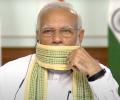
Modi said the coronavirus pandemic made people learn new things.

The 1.47-minute video also has a few glimpses of the prime minister's daily walk from his home to his office within the Lok Kalyan Marg residence.

'Increased allocations for MNREGA could have provided the much needed push to rural demand and consumption at a time when recovery continues to remain uneven.'

Consumer anxiety is at the highest levels since the outbreak of coronavirus pandemic in India with the less affluent most skeptical about economic outlook while a majority of consumers think their income in the next six months will be lower than the pre-COVID levels, says a latest study. As per the COVID-19 consumer sentiment research by global management consulting firm Boston Consulting group (BCG) conducted between May 23 and May 28, 2021, covering around 4,000 respondents across metros, tier I, II, III, IV and rural India, 51 per cent of consumers expected their spends over the next six months to be lower. In the last round of survey conducted from July 20 to August 2, 2020, the figure stood at 40 per cent.

Bengaluru, Delhi, Mumbai, and Hyderabad account for 33% of the total active paid subscriptions.

'An entrepreneur should always remain under pressure or he will die,' Vineet Rai tells Anjuli Bhargava.

'Kriti Sanon is an educated, well-read, articulate actress.'

The Indian FMCG industry has recorded a 9.4 per cent growth in the January-March quarter of 2021, helped by a consumption-led growth and value growth by increased prices of products, especially of staples, said data analytics firm Nielsen. The rural market continued to perform with strong growth of 14.6 per cent during the period and the metro markets have registered a positive growth after two quarters. Fast Moving Consumer Goods (FMCG) industry sales growth from the traditional trade channels jumped to double digits, while growth in e-commerce normalised down to single digits in the January-March quarter.

Although demonetisation and improper implementation of GST along with falling prices are being blamed for much of the distress in rural India for some time, experts believe those may not be the only reason.

'We must not forget that the virus will continue to adapt itself to live with us.' 'The vaccine is the only one way we can prevent mortality.'

With a revival in demand and consumption, FMCG companies are looking forward to 2022 with positivity and hopes of sustaining a healthy growth trend across both rural and urban markets while gearing up to cater to the ever-increasing digitally active consumers and tackle the challenge of higher commodity prices. Health and wellness and convenience are going to remain key trends and FMCG companies are strengthening their core brands, driving premiumisation across their portfolios with targeted innovations as consumers are gravitating towards trusted brands looking for quality, purity and hygiene, in continuation of the trend that started since the pandemic last year. FMCG makers are accelerating digitalisation and are investing in building capability in e-commerce and Direct-to-Consumer channels, identifying it as a key vector of their growth as the threat of a possible third wave is still not away.

We have our own problems for sure and they are not trivial, but for now, our economy is in not too bad a shape, our politics is as personality-driven and authoritarian as that of most countries in the world. We must make the best of what we have and not be excessively unhappy looking at the grass on the other side of the septic tank which may not be greener after all!, observes Shreekant Sambrani.
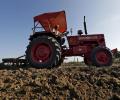
This rise was spurred by record kharif sowing - after a good rabi season - that ensured high disposable incomes in rural India.
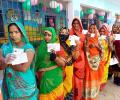
'Economic issues do not matter during elections; it is the emotional connect that helps swing votes.'
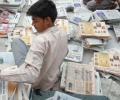
Newspaper readership was 50 per cent in the 16-19 year age group, the highest in any age segment, followed by 42 per cent each in the 12-15 years and 20-29 year age group.

A rare bonhomie among three private telecom companies in raising tariffs coming on the back of a bailout package by the government may have helped the telecom sector avert a crisis but the challenges haven't ceased to exist as the industry faces a cash-guzzling task of rolling out 5G networks in the coming months. The sector that provides direct and indirect employment to millions is projected to see Rs 1.3 lakh crore to Rs 2.3 lakh crore of investments in the coming years in creating robust infrastructure and building telecom and network products that have been incentivised by the government through PLI and other initiatives. After years of cut-throat competition and the apex court ruling on payment of past statutory dues left some players in the lurch, billionaire Sunil Mittal's Bharti Airtel and struggling Vodafone Idea almost in tandem raised tariffs, taking the plunge they had long been talking about.
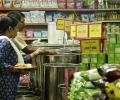
Rural inflation running higher than urban: HSBC
