
Dr Bhagwati P Agrawal is using new science, engineering and entrepreneurship to build self-sustainable social enterprises.

'If you can simplify the technology, you don't need a doctor or a highly qualified technician to work on the technology; even an Asha health worker or a similar front line health worker can use it with minimal training.'

'We will be hoisting the tiranga, but this kind of celebration is uncalled for when the farmers in this country are dying by suicides, their families are ravaged by poverty and farmers are not enjoying any freedom.'

In the past 12 months, since September 2020, the net cumulative increase in employment has been just 44,483. This is negligible -- just 0.04 million on a base of over 400 million jobs, reveals Mahesh Vyas.
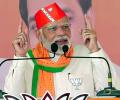
Congress spokesperson Abhishek Manu Singhvi cited a viral video on social media platforms, claiming that in it Modi's voice is heard in a call with BJP rebel Kripal Parmar.
In an expansive and relaxed mood, Finance Minister P Chidambaram explained the big idea behind Budget 2005-06 and his priorities for the coming year

A petition has been filed in the Supreme Court, seeking an independent probe by a special investigation team (SIT) into a recent hooch tragedy in Bihar, in which at least 30 people have lost their lives.

Once the novelty of the plot wears off, Jamtara 2 becomes just another small-town cops-and-gangs story, observes Deepa Gahlot.

Keeping the employment rate from slipping is challenging. To merely keep the employment rate unchanged, the economy has to generate additional jobs. It needs to run to stay where it is, points out Mahesh Vyas.

Gandhi said avenues of employment for the average young person in rural India are largely restricted to seeking government jobs but the government is employing less than before in every sector be it defence, police, railways or education.

Targeted at one million schoolchildren and college students, besides working professionals and researchers, the three-month course will be available in online mode, free of cost, to people in India and abroad.

A majority of the CEOs are expecting the economy to show growth in the next financial year on the back of rising consumer spending and a sharp turnaround in rural India.

Aseem Chhabra highlights 10 films that moved him, films that may show up in theatres near you.
According to the 66th round of National Sample Survey carried out between July 2009 and June 2010, all India average monthly per capita consumer expenditure in rural areas was Rs 1,054 and urban areas Rs 1,984.

Stories of rural India, campus capers, realistic family dramas and urban romance that are no longer picked up by film-makers, find their way to the Web, and the viewing experience is richer for the variety available.

Retail sales of automobiles in India grew 8.31 per cent in August this year on the back of increase in registrations of vehicles across all major segments, automobile dealers' body FADA said on Thursday. As per data released by the Federation of Automobile Dealers Associations (FADA), total vehicle retail sales in the country stood at 15,21,490 units last month as compared to 14,04,704 units in August 2021. Passenger vehicles (PV) retail sales stood at 2,74,448 units as compared to 2,57,672 units in the year-ago month, a growth of 6.51 per cent.

Sharad Pawar reckons that the NCP has value as a united, going concern, not as a gaggle of leaders in search of followers, notes Shreekant Sambrani.

The country's largest retailer Reliance Industries on Monday announced that it will enter the fast-moving consumer goods (FMCG) business this year as part of its expansion plan. Addressing the 45th AGM of Reliance Industries on Monday, Reliance Retail Ventures Ltd (RRVL) Director Isha Ambani said: "This year, we will launch our FMCG goods business". The objective of this business will be to develop and deliver products and solve every Indian's daily needs, with high-quality products at affordable pricing, she said while addressing Reliance Industries' annual general meeting.

'Walking is the loudest statement.' 'When someone says, I control everything and no one can oppose me, there are thousands of people on the streets saying no, we oppose you -- this is a very bold statement.'

With India rolling out 5G services, can telcos get the sizeable 350-400 million 2G customers to upgrade to 4G, or even better -- but very improbably -- straight to 5G?

'It's been an absolute joy for my team and me to create this special collection along with the artisans of Bhuj.'

Udaan - India's largest business-to-business (B2B) e-commerce company - has laid off about 180 employees, or 4-5 per cent of its workforce of 4,000, in a move to drive cost efficiency, revealed sources. They said the layoffs have happened across various department functions. The layoffs have happened at a time when the Bengaluru-based firm is trying to turn into a publicly listed entity in 18-24 months.

Political parties and individuals cannot be prevented from making poll promises aimed at fulfilling the constitutional mandate and the term 'freebie' should not be confused with genuine welfare measures, the Supreme Court said on Wednesday.

83% of the CEOS plan to hire more in the new year.

The festival season has already begun in the west and south of India with Ganesh Chaturthi and Onam, respectively, and consumer companies are witnessing a pick-up in sales compared to pre-Covid levels. Retailers, fast-moving consumer goods (FMCG) and consumer durables companies expect their sales to grow in double digits this festival season compared to pre-pandemic times, as there are no curbs on movement now. Adani Wilmar expects sales volume to be higher by 15-20 per cent as rural India has largely witnessed good monsoon rains, and employment has picked up in urban areas.
Economists on Tuesday are not convinced about the latest monthly unemployment data released by the Centre for Monitoring India Economy (CMIE), particularly about the statistics of the rural areas. They asserted that it is difficult to get the real picture of unemployment from the methodology used by the CMIE to get the data. The overall unemployment rate in India has increased to 7.83 per cent in April 2022 as compared to 7.60 per cent in the previous month, CMIE said in its report.

The fall in urban sentiments in June is worrisome, observes Mahesh Vyas.
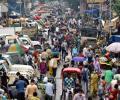
'We have lived through 10% plus inflation in India and we are aware of the economic pitfall.' 'With the RBI now having formally adopted an inflation target range, they cannot turn a blind eye to the impending risks.'
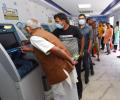
The correlation between withdrawal of deposits and the Covid death rate is stark, reveals Tamal Bandyopadhyay.

'Usually, urban wage rates are 50 per cent higher than rural wage rates. But, this could be narrowing very rapidly now,' points out Mahesh Vyas, CEO, Centre for Monitoring Indian Economy.

"I am not talking about any political party or individual. I see that the people who fit my definition of pariwarvad are angry with me. These dynasts are uniting against me across the country. They are angry why the youth in the country are taking Modi seriously," he said.

Auto sales, particularly of two-wheelers, may not bounce back immediately and may take another two months to come back on track even as car bookings have started seeing an initial uptick. Various states started Unlock 2.0 on Monday, following a fall in the number of Covid-19 cases. Auto sales were hit in May following the impact of Covid-led lockdowns.

Experts emphasise on the need to curb the spread of the novel coronavirus using strategic and pragmatic approaches in villages as well as Tier 2 and Tier 3 cities and towns, which are reporting increased COVID-19 infections and deaths during the ongoing second wave of COVID-19 pandemic.

Tokyo Olympics gold medallist Neeraj Chopra has been selected as one of the six nominees for the 2022 Laureus World Breakthrough of the Year Award.

Indian companies are expecting generous tax incentives from the Union Budget that will help them invest more in building capacities in the coming years. While the productivity-linked incentives (PLIs) are a good start to spur local manufacturing, the government should also take steps to boost consumer demand, which is not showing encouraging signs, say chief executive officers (CEOs) of India Inc. Statistics released by the Reserve Bank of India (RBI) shows that Indian banks had sanctioned loans worth Rs 75,558 crore in 220 new projects - a record low - in the pandemic-hit financial year ending March 2021. This is not showing any signs of a significant pick up in the last nine months of the ongoing financial year.

The Telecom Regulatory Authority of India (Trai) has directed the Cellular Operators Association of India (COAI) to make a presentation detailing the pros and cons of the controversial Indian 5G standard, also known as 5Gi, which the government has been pushing for. The move comes after serious differences emerged among telcos with regard to the technology's efficacy and implementation.
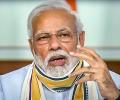
This is more than 25 per cent higher as compared to the same period of the previous year when the prime minister had 78 domestic engagements.

This doctor couple put their faith in India. And in return India has put faith in them.

The week ended October 17 was remarkable as it saw a fall in the unemployment rate. We have not seen such a level in any monthly estimate of the employment rate since March 2020, Mahesh Vyas points out.

The study showed that 50 per cent of households have reduced the number of meals ever since the lockdown was imposed
