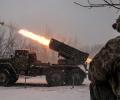
A peace keeping role for India is a distinct possibility. Indian military has both the numbers and experience to carry out this job, observes Colonel Anil A Athale (Retd).

Dr Kissinger, then US president Richard M Nixon's national security adviser, feigned illness on a visit to Pakistan in July 1971 and made a secret trip to Peking, as Beijing was then called, to begin the process of a rapprochement between America and China. It was a debt that Chinese leaders have never forgotten.
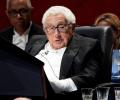
Dr Kissinger died on Wednesday at his home in Connecticut.

'The consensus was that the debate was between looking backward and looking forward.' 'Trump, with his great enamourment of his own 'achievements,' was obviously looking backward, while Harris, nearly 20 years his junior, was focussing on the future, with hope,' notes Shreekant Sambrani.

Any miscalculation and miscommunication are fraught with the risk of a major catastrophe, warns Rup Narayan Das.

Newsweek has compared the upcoming visit of US President George W Bush to India to that of Richard M Nixon to China in the early 1970s.
Within a few hours of Nitish Kumar leaving the NDA, entirely reasonable people were speculating as to how the CBI or ED could be used against him or his party, notes Mihir S Sharma.

On December 10, Kissinger began to encourage the Chinese to take action against India: 'If the People's Republic were to consider the situation on the Indian subcontinent a threat to security, and if it took measures to protect its security, the US would oppose efforts of others to interfere with the People's Republic.' On the 50th anniversary of India's greatest military victory, Claude Arpi recalls how the US suggested that China intervene militarily on Pakistan's side.

United States President Donald Trump and US First Lady Melania Trump will be visiting India -- Ahmedabad and Delhi -- on February 24 and 25 on the invitation of Prime Minister Narendra Modi. Let's assess earlier American presidential visits to India.
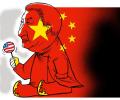
'Seen in the context of world turmoil in face of the pandemic and the Chinese 'miracle' of being the only country in the world to control it, this is not merely a 'Sputnik' moment, but a 'Sputnik Plus' moment,' argues Colonel Anil A Athale (retd).

The trust some people in India had that the Biden-Harris administration would be friendly to India has been eroded already, observes Ambassador T P Sreenivasan.

In its sheer audacity, the initiative with Russia has the potential to transform world politics in the same way as the 1972 Nixon visit to China and 'Shanghai Declaration' changed world dynamics, says Anil Athale.

"He's a man of tremendous talent and tremendous experience," said Trump of his new appointment.
'Modi, with his sharply honed political savvy and undoubted grasp of international affairs, is a past master at taking the measure of world leaders.' 'He would be the last person to think of the unpredictable and not too well-regarded Trump as the mediator,' says B S Raghavan.

'She preserved national unity against great odds.'

'What Trump and Kim have demonstrated is that leaders need not remain prisoners of the status quo and they can, by showing the necessary will and courage, break out of the hang-ups and constrictions of the past and carve out a new pathway for themselves,' says B S Raghavan.

'While dairy farmers are suffering from low prices, consumers are paying a high price for milk.'

'China any day would prefer to team up with India and dump Pakistan once the resolution of the border dispute becomes an accomplished fact.'

'Is Xi's China stable?'
'No one can say whether the regime will fall all at once or if its leaders are devising a new solid and competitive -- anything but democratic -- model.' A fascinating excerpt from Francois Bougon's Inside The Mind of Xi Jinping.

'The coming two months could unfold unpredictable results or unpredictable consequences or both at the same time,' says Rajaram Panda.

Minister for External Affairs Salman Khurshid speaks about the importance of the fourth edition of the India-US Strategic Dialogue, which he co-chaired with United States Secretary of State John Kerry in New Delhi

Lieutenant General J F R Jacob, Chief of Staff, Eastern Army Command during the 1971 war, revealed how, armed with only a draft surrender document and an aide, he made the Pakistani army led by Lieutenant General A A K Niazi surrender.
Lieutenant General J F R Jacob, Chief of Staff, Eastern Army Command during the 1971 war, revealed how, armed with only a draft surrender document and an aide, he made the Pakistani army led by Lieutenant General A A K Niazi surrender.
Lieutenant General J F R Jacob, Chief of Staff, Eastern Army Command during the 1971 war, revealed how, armed with only a draft surrender document and an aide, he made the Pakistani army led by Lieutenant General A A K Niazi surrender.
Lieutenant General J F R Jacob, Chief of Staff, Eastern Army Command during the 1971 war, revealed how, armed with only a draft surrender document and an aide, he made the Pakistani army led by Lieutenant General A A K Niazi surrender.
Lieutenant General J F R Jacob, Chief of Staff, Eastern Army Command during the 1971 war, reveals how, armed with only a draft surrender document and an aide, he made the Pakistani army led by Lieutenant General A A K Niazi surrender.
 © 2026 Rediff.com - Investor Information - Advertise with us - Disclaimer - Privacy Policy - Sitemap - Feedback - About us - Terms of use - Grievances