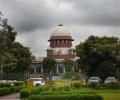
The Supreme Court has reserved its verdict on a petition challenging the Special Intensive Revision (SIR) of electoral rolls in Bihar, following arguments from various lawyers and the Election Commission of India.
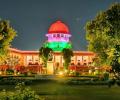
The Supreme Court has agreed to list for final hearing the pleas challenging the validity of certain provisions of the Places of Worship (Special Provisions) Act, 1991.

Banerjee is personally present in court room one along with her lawyers. A gate pass was issued in the chief minister's name on Tuesday.
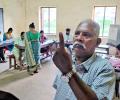
The Supreme Court has requested the Election Commission to consider extending the deadline for submitting enumeration forms for the Special Intensive Revision (SIR) of electoral rolls in Kerala, due to the ongoing local body elections.

The Supreme Court has directed the Election Commission to display the names of those on the 'logical discrepancies' list at various public offices in West Bengal, addressing concerns about irregularities in the voter rolls.
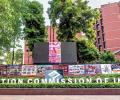
The Election Commission (EC) defended its power to revise electoral rolls and ensure no foreigners are registered as voters before the Supreme Court. The EC argued it has a constitutional duty to maintain the purity of electoral rolls and exclude those not eligible to vote.

Chief Justice of India considers shifting Supreme Court hearings to virtual mode due to severe air pollution in Delhi after experiencing its effects firsthand.
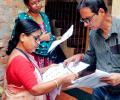
The Supreme Court expressed concern over threats to election officials in West Bengal and other states, urging the Election Commission to take action. The court also addressed the lack of cooperation from state governments in electoral roll revisions.

The Supreme Court has directed states to consider deploying additional staff to ease the workload on booth level officers (BLOs) engaged in the special revision of electoral rolls, following concerns about extreme work pressure and related issues.
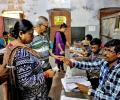
The Supreme Court has requested the Election Commission to respond to petitions challenging the Special Intensive Revision of electoral rolls in Tamil Nadu and West Bengal. The court has also asked the Madras and Calcutta High Courts to keep proceedings on similar petitions in abeyance.
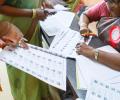
The Election Commission of India clarified that claims, objections, and corrections to the draft electoral roll in Bihar's special intensive revision exercise can be filed beyond September 1, but will be considered after the roll is finalized. The Supreme Court directed assistance for voters and parties in filing claims.

The Supreme Court has directed the Election Commission to provide details regarding the 3.66 lakh voters excluded from Bihar's final electoral roll after a Special Intensive Revision (SIR) exercise. The court's direction came after concerns were raised by petitioners about the lack of notice or reasons given to the excluded voters.

The Supreme Court has directed the Bihar State Legal Service Authority to assist voters excluded from the final electoral rolls in filing appeals with the Election Commission.
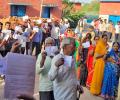
The Supreme Court has directed the Election Commission to include Aadhaar as a valid document for voter identification in Bihar's special intensive revision of electoral rolls, clarifying it is not proof of citizenship.
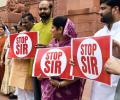
The Supreme Court has warned that it will set aside the special intensive revision (SIR) of electoral rolls in Bihar if any illegality is found. The court is reviewing the validity of the Bihar SIR and its potential impact on a similar exercise across India.
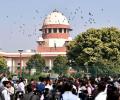
The Supreme Court has begun hearing petitions challenging the Election Commission's decision to conduct a special intensive revision exercise in Bihar ahead of elections, raising concerns about voter exclusion.
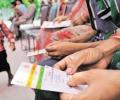
Expressing surprise over political parties not coming forward in filing objections related to 65 lakh excluded voters, the top court directed the chief electoral officer of Bihar to implead them in the court proceedings.

"There is bound to be revision," the top court said, "otherwise, how will the poll panel delete the names of those who are dead, migrated or shifted to other constituencies?"

The Supreme Court has stated it will intervene if there is mass exclusion in the special intensive revision of electoral rolls in Bihar, emphasizing the Election Commission's role as a constitutional authority.
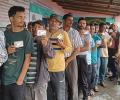
The Supreme Court has directed the Election Commission of India (ECI) to publish details of deleted names from the voters list in Bihar, along with reasons for non-inclusion, to enhance transparency in the special intensive revision (SIR) of the electoral roll.

Underscoring the 'presumption of genuineness' of Aadhaar and voter ID, the Supreme Court on Monday refused to stay the publication of draft electoral rolls in poll-bound Bihar and said it would once and for all decide pleas against Election Commission's special intensive revision (SIR) of electoral rolls.
A bench of Justices Sudhanshu Dhulia and Joymalya Bagchi, however, questioned the timing of the exercise, besides offering its prima facie view that Aadhaar card, voter ID card and ration cards could be considered during the SIR in Bihar.
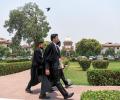
The Supreme Court of India has reserved its interim orders on three key issues related to the Waqf (Amendment) Act, 2025, including the power to denotify waqf properties, the composition of waqf boards, and the provision regarding government land. The court heard arguments from both the petitioners, who challenged the validity of the amended law, and the Centre, which defended the Act as a secular concept. The petitioners sought interim orders to prevent the implementation of certain provisions while the court considers the legal challenges.

The Supreme Court of India has ruled that Tamil Nadu Governor R.N. Ravi can no longer serve as chancellor of state-run universities, a decision welcomed by the ruling DMK party. The court's judgment stems from a long-standing dispute between the state government and the governor over the assent of 10 bills passed by the Tamil Nadu Assembly. The DMK alleges that the governor had obstructed the smooth functioning of universities by delaying appointments and other critical matters. The judgment paves the way for the Tamil Nadu government to appoint new chancellors for its universities, effectively removing the governor's influence in higher education.

The Centre on Thursday assured the Supreme Court that it will neither denotify Waqf properties, including "Waqf by user", nor make any appointments to the central Waqf council and boards till May 5.
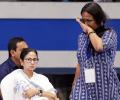
West Bengal Chief Minister Mamata Banerjee on Monday pledged to protect the rights of 'eligible candidates' who lost their jobs after a recent Supreme Court verdict, evoking mixed responses from the affected teachers, thousands of whom turned up to hear the leader speak but remained dangling between hope and despair after she finished.
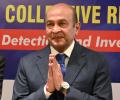
The Supreme Court addressed concerns about misinformation spreading related to an incident involving Delhi High Court judge Justice Yashwant Varma. The court clarified that the proposal to transfer Justice Varma to Allahabad High Court was independent of an internal investigation into the discovery of a large sum of cash at his residence following a fire. The Delhi High Court Chief Justice is conducting the investigation and will submit a report to the Chief Justice of India today.
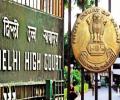
Legal experts have lauded Chief Justice of India Sanjiv Khanna's decision to make public crucial documents related to a controversy surrounding the alleged discovery of cash from Delhi High Court judge Yashwant Varma's residence. They also welcomed the formation of an in-house committee to further investigate the matter. While some expressed concerns about the incident's impact on the judiciary's image, others emphasized the need for transparency and a fair inquiry. The Supreme Court released the inquiry report by Delhi High Court Chief Justice D K Upadhyaya, which included photos and videos of the alleged cash discovery. Justice Varma has denied the allegations, calling them a "conspiracy to frame and malign him."
The views came in the wake of Vice President Jagdeep Dhankhar wondering on Friday that how could the CJI, even by "statutory prescription", get involved in executive appointments such as that of Central Bureau of Investigation director, and said it was time to "revisit" such norms.

A bench comprising Justices J B Pardiwala and R Mahadevan said, "He (the governor) seems to have adopted his own procedure. He says, 'I withhold assent, but I will not ask you to reconsider the bill'. It does not make sense to keep withholding assent and not send it to the legislature, thereby frustrating the provision of Article 200."
The Supreme Court of India has a new 'Lady Justice' -- a six-foot-tall sculpture in the judges' library holding scales in one hand and the Constitution in the other sans the sword.

Chief Justice D Y Chandrachud, who is demitting office on November 10, Wednesday deferred by four weeks hearing on pleas challenging the immunity granted to husbands in cases of marital rape.
The Supreme Court on Wednesday rejected the Centre's plea for prospective effect of its July 25 verdict, which upheld the power of states to levy tax on mineral rights and mineral-bearing land, and allowed them to seek refund of royalty from April 1, 2005 onwards.
The BSP has not entered into any alliances and has also been keen to shed the tag of being a 'B-team' of the BJP.

The Supreme Court on Tuesday reserved its verdict on a batch of pleas challenging the abrogation of Article 370 of the Constitution which bestowed special status on the erstwhile state of Jammu and Kashmir.

In a major relief to 25,753 teachers and non-teaching staff of West Bengal, the Supreme Court on Tuesday stayed the order of the Calcutta high court order invalidating their appointment made by the state's School Service Commission (SSC) in the state-run and state-aided schools.

According to the cause list for December 11, Monday, uploaded on the apex court website, a five-judge constitution bench headed by Chief Justice D Y Chandrachud would deliver the verdict.

Solicitor General Tushar Mehta, the Centre's key counsel in defending the abrogation of Article 370 of the Constitution, said on Monday the Supreme Court verdict upholding the government's August 5, 2019, decision will go down in history as the one that corrected a "Himalayan constitutional blunder" of gigantic proportions.
The bench, which also comprised justices AS Oka, JB Pardiwala, Pankaj Mithal and Manoj Misra, pronounced two separate but concurring judgements in the matter.

An institution of national importance must reflect the "national structure", the Centre told the Supreme Court on Tuesday while pointing out that around 70 to 80 per cent students studying at Aligarh Muslim University (AMU) are Muslims even without reservation.
 © 2026 Rediff.com - Investor Information - Advertise with us - Disclaimer - Privacy Policy - Sitemap - Feedback - About us - Terms of use - Grievances