
'As of this moment, we have 1,173 ventilators, 2,695 ICUs and about 10,408 plus isolation beds.' 'But this number keeps changing with every passing hour as we incorporate more private as well as government hospitals in our fight against the pandemic.'

'The prime minister did not think that COVID-19 was a serious challenge as late as March 20.'

'Time and again, through their actions, often more covert than overt, the BJP has shown that it is a power-hungry party and its hunger isn't getting satiated sitting in the Opposition.'

'We cannot be naughty and expect the government to do good!' 'We have to behave ourselves and then we can expect the government to support us.' 'If we are able to protect ourselves well, then we should not be having deaths.' 'Unfortunately, people have gotten into this super scary event participation (mode) -- birthday parties, large gatherings.' 'Among the people who have attended those, 80 to 90 per cent of them have come down with COVID-19.'
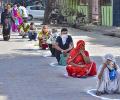
'We hope that people are aware that even after the lockdown, we will have to follow a lot of things that we were following during the lockdown.' 'Don't get out for non-essential things.' 'Don't gather together for parties, religious events or at religious places.' 'Ensure social distancing at work and otherwise.' 'You know, in India, it is not uncommon for people with a cough and a cold to go to work.' 'We really want people to understand that if you have a cough, cold, fever, just stay at home.' 'Don't get back to work or don't get back to school.'

State Health Minister K K Shailaja told reporters that the government has declared the epidemic as a 'state calamity' to take all necessary steps to ensure that the outbreak is effectively controlled. A medical bulletin issued by the government said the health status of all the three students, who tested positive for the virus, was 'satisfactory'.

'If it doesn't happen, we may be in for a difficult time.' 'Our biggest problem is our population and the fact we are a very social people.' 'However, I would say two months is more than enough time for things to settle down.'
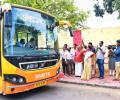
'Even though we have around 156 patients, we don't have anyone who requires ventilatory support or the ICU facility.'

'Considering Mumbai's population density, one can expect to see more positive cases in areas like Dharavi in the days to come.' 'That is the challenge before the public health infrastructure and preparation of the city in dealing with such crises.'

Of the 20 deaths reported in the last 24 hours, eight were from Maharashtra, three each from Gujarat and Madhya Pradesh, two from Jammu and Kashmir and one each from Punjab, Uttar Pradesh, Karnataka and Tamil Nadu.

Far from the metros and big cities, the coronavirus crisis in the country's districts, towns and villages is being led by district magistrates.
The responsibility of keeping the pandemic under control lies with the DM or collector.
Subrat Kumar Sen, the young district magistrate of Saran, north Bihar, tells Rediff.com's Archana Masih how he and his staff are combating a crisis that no one has confronted before.

'Given the first-time healthcare emergency of this nature and scale, we don't have enough experienced hands to deal with the situation.' 'The models, policies and protocols keep changing everyday depending upon the evolving situation.' 'We are all in trial-and-error mode where we do some right things as well as wrong things.' 'We cannot have an ideal environment to fight this pandemic.'

'My biggest challenge is to keep motivating my staff to do their best without compromising on their safety even as we all strive to do our best for the patients under our care.'

'If you look at the deaths that are occurring across the state or country, I think out of these 25 not even one required ICU care. That's what we are proud of.'
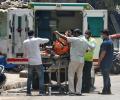
'It is a bigger challenge for Mumbai because we have a dense population and people are staying in very, very small rooms.' 'So even if there is one case, then it can spread to you know, four or five people are staying together.'

With Ebola claiming at least 932 lives and infecting more than 1,700 people since breaking out in west Africa earlier this year, the World Health Organisation has declared it to be a "public health emergency of international concern." The disease has no vaccine and no specific treatment.

'The genetic thing is not in your control. The virulence is not known.' 'The only thing is if you can avoid it.' 'Once you get COVID-19, none of it is in your control.'
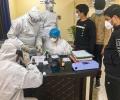
'The josh is very high as we fight this global pandemic.'

Maharashtra has reported 31 positive cases, Kerala 19, Uttar Pradesh 11, Delhi and Karnataka six each, Ladakh three, Jammu and Kashmir, Rajasthan and Telangana two each; and Tamil Nadu, Andhra Pradesh and Punjab one case each. The total number of confirmed cases also includes 17 foreigners -- 16 Italian tourists and a Canadian, it said.
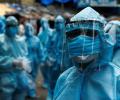
'When the virus, in a way, tires itself out, because it is not finding any more people to attack or keep itself viable, that is when the peak actually has been reached and you are on the downward limb (of the curve).'

'My biggest fear is if I get infected will I get admission in a good hospital and how much money will the hospital charge for my treatment.'
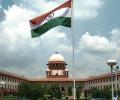
'There is a special benefit in the matter being taken up by the Supreme Court rather than the high courts.' 'The orders of the high courts are limited, but the Supreme Court order is binding upon everybody.'

'This is a long haul, god knows where it will end.' 'So it is best to conserve all the funds right now for fighting the COVID-19 pandemic.'

'People are getting admitted to hospital two to three days before their death in a very serious respiratory compromise state and they are passing away within 48 hours.' 'Those who are coming early in the disease, the minute they are suspicious that they have COVID-19, the recovery rate has been much, much, higher.' 'The moral of the story is: We must destigmatise COVID-19.' 'People should be told: 'Look, if you have anything like this, please come immediately'.'

'Without it, it is going to be much, much, much, much worse.' 'In the meantime, we really need to work on a sort of war footing, given that it is a natural disaster, provide relief, provide essentials, till we get biological herd immunity, we need to get economic immunity, and also social immunity.'

A doctor who treated Ebola patients in Guinea and returned to the United States last week has tested positive for the Ebola virus, becoming New York city's first diagnosed case.

India has so far succeeded in staving off the deadly virus that has claimed over 4,500 lives abroad.

Dr Kalyani Gomathinayagam, a young Indian doctor who volunteered to spend four weeks in west Africa helping those suffering and dying of Ebola, speaks to Vaihayasi Pande Daniel/Rediff.com why she took on an assignment many would shy away from.
 © 2026 Rediff.com - Advertise with us - Disclaimer - Privacy Policy - Sitemap - Feedback - About us - Terms of use - Grievances