
The Punjab government has refused to pay a bill of Rs 6.35 crore to the Center for deployment of paramilitary forces during and after the terror attack at Pathankot air force base.

Talk of a blackout by other news channels in solidarity remained inconclusive because of the heavy news agenda on that day.

Even as the anti-terror operations continue at the Pathankot Air Force base, the National Investigation Agency has started piecing together the puzzle over how the terrorists managed to sneak into the country and launch the brazen attack.
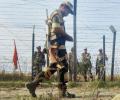
The ceasefire violation comes after nearly seven months as last such incident took place on September 18, 2015 in the Balakote sector of Poonch district.

State capitals and major cities across the country have seen security being beefed up at vulnerable places and key installations.

The NIA on Tuesday summoned the caretaker of a shrine in Punjab which a superintendent of police rank officer had claimed to have visited before being kidnapped by terrorists who attacked the Pathankot Air Force base hours later.

Pathankot residents expressed anger over frequent cross-border strikes and sought enhanced border security and strengthening of the police set-up.
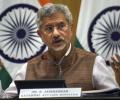
The external affairs minister, a JNU alumnus, condemned the attack on the university campus. He said it's completely against the culture and tradition of the university.

Former Director General of Sikkim Police Avinash Mohananey interrogated Azhar many a times during his two-decade tenure in the Intelligence Bureau.
For two decades after his release in exchange for passengers of a hijacked Indian Airlines plane in 1999, Azhar has since been the darling of Pakistan's external snooping agency Inter-Services Intelligence.

The anti-terror probe agency's chief Sharad Kumar said help of Pakistan will be sought in solving the Pathankot terror attack case.
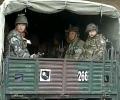
'My fear is that if Gurdaspur happened, and now Pathankot happened, then what if they go more inside Punjab... what if Jalandhar were to happen... then what happens...'

'There are retaliatory incursions, ambushes, captures and killings by Indian forces along the 700 km border; alleged spies are caught on both sides, then mutually traded as pawns; envoys are summoned in both capitals to be routinely given dressing downs.' 'And there is always a handy courier pigeon, like Sajjan Jindal, sent over to test the troubled waters,' says Sunil Sethi.

Intermittent blasts and exchange of fire to neutralise two more terrorists continued on Sunday night at Air Force Station in Pathankot, Punjab where four terrorists were killed, seven security men lost their lives and 17 persons were injured in the over 40-hour-long operation.

India plans to provide the probe team from Pakistan access to all witnesses in the Pathankot terror attack case but not security personnel from the National Security Guard or the Border Security Force.

'It sounds hollow when the military -- the last bastion meant to secure India within the State of India -- is itself not found secure on the third day of the Pathankot strike, in spite of so-called definitive intelligence inputs and preparations,' says Lieutenant General Anil Chait (retd), former chief of the Integrated Defence Staff.
'The message to India is (with attacks like Pathankot) basically what the Pakistani army is trying to test is how serious are you when it concerns the peace process with that country.'
'If you destroy the assets in Pathankot, you degrade the combat potential of India; you degrade the war potential of India.'
 © 2026 Rediff.com - Investor Information - Advertise with us - Disclaimer - Privacy Policy - Sitemap - Feedback - About us - Terms of use - Grievances