
'This was Indian land the PLA advanced on and occupied.' 'The Chinese then 'negotiated' a pullback of their troops a small distance on Indian territory even as Indian jawans draw back further into India from the forward position.' 'An apparently satisfied Indian government says this is a great move for peace! How great is that for China!'
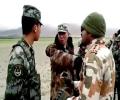
India has significantly enhanced military infrastructure, surveillance and combat capabilities along the nearly 3,500 km-long Line of Actual Control (LAC) with China since the deadly clashes in Galwan valley in 2020, sources in the defence establishment said Wednesday on the eve of the third anniversary of the hostilities.

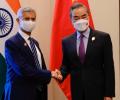
Jaishankar said the last few years have been a "period of serious challenge", both for the relationship and for the prospects of Asia, noting that continuation of the current impasse will not benefit either India or China.

India and China made progress in five-six friction points along the Line of Actual Control in eastern Ladakh through talks in the last three years and efforts are underway to resolve the remaining issues, External Affairs Minister S Jaishankar said on Monday.
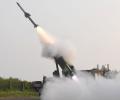
'China is in the middle of a substantial expansion of its nuclear weapon arsenal, which satellite images indicate includes the construction of over 300 new missile silos,' SIPRI's statement noted.

Raking up the border issue, Congress leader Rahul Gandhi on Friday said every individual in Ladakh knows that China has "taken away our land" and claimed that Prime Minister Narendra Modi's assertion that not an inch of land was taken away was "absolutely false".

Over 68,000 Army soldiers, around 90 tanks and other weapon systems were airlifted by the Indian Air Force to eastern Ladakh from across the country for rapid deployment along the Line of Actual Control (LAC) after the deadly clashes in the Galwan Valley, top sources in defence and security establishment said.
The Indian Army has been pitching for a faster disengagement process in areas like Hot Springs, Gogra and Depsang to bring down tension in the mountainous region.

On Monday China said it has "effectively managed and controlled" frictions in certain border areas.

The naming of the places in memory of the soldiers comes days after Chinese military commander Qi Fabao, who was injured in the Galwan Valley clash with Indian troops in June, 2020, attended the ruling Communist Party of China's (CPC) Congress as a delegate.
India and China are likely to hold the 16th round of high-level military talks on July 17 to resolve the issues in remaining friction points along the Line of Actual Control (LAC) in eastern Ladakh, people familiar with the development said on Wednesday.
The 11th round of the Corps Commander-level talks began at around 10.30 am at the Chushul border point on the Indian side of the Line of Actual Control (LAC) in eastern Ladakh, they said.

Gen Pande also said that Indian troops are adequately deployed along the Line of Actual Control to deal with any situation and that guidance has been given to them to "remain firm and resolute" in their tasks.
India and China failed to make any breakthrough, but agreed to maintain dialogue to arrive at a mutually acceptable resolution at the earliest.

The Indian Army has deployed a significant number of easily transportable M-777 ultra-light howitzers in mountainous regions along the Line of Actual Control (LAC) in Arunachal Pradesh, military officials said on Thursday.

In its annual threat assessment presented before the Senate Armed Services Committee during a Congressional hearing on Tuesday, the US intelligence community said the expanded military posture by both India and China along the disputed border elevates the risk of armed confrontation between the two nuclear powers that might involve direct threats to US persons and interests and calls for America's intervention.

The destabilising and corrosive behaviour of the Chinese Community Party in the Indo-Pacific region is simply not helpful and some of the defence infrastructure that is being set up by China near its border with India is alarming, US Army's Pacific Commanding General Charles A Flynn said on Wednesday.
India and China on Tuesday agreed to hold the next round of the Senior Commanders meeting at an early date to achieve complete disengagement from all friction points in eastern Ladakh to create conditions for the restoration of normalcy in bilateral ties.

'The Chinese are retaining geostrategic pressure on India by keeping troops there and building infrastructure continually.'

The country's 75th Independence Day was celebrated across country on Sunday with usual fervour.

After a gap of over three months, India and China on Wednesday are holding another round of high-level military talks to resolve the 20-month-long military standoff in the remaining friction points in eastern Ladakh, sources in the security establishment said.
Indian Army Chief General M M Naravane had said on Wednesday that India was hopeful of resolving issues related to disengagement at Patrolling Point 15 (Hot Springs) in eastern Ladakh in the 14th round of talks.

It has been argued that India should have held back on disengagement from the Kailash Range, using that as a trump card to force Chinese concessions in areas such as Depsang, where they hold the advantage.

This is Gen Pande's first visit to the sector after taking over as the chief of the Indian Army on April 30.
Both countries have reached a mutual agreement for disengagement of troops from the most contentious area of North and South Pangong Lake.

The Indian Army has occupied several key heights in the strategically located Rezang-La and Reqin-La areas on the southern bank of the lake since the end of August.
There was no official word on the outcome of the talks.

India and China held a special round of military talks on Tuesday at the Chushul-Moldo border meeting point in Eastern Ladakh to discuss air space violations and provocations by the Chinese side in that area in the last 45 days.

Army Chief Gen Manoj Pande conducts a comprehensive review of the overall security situation in eastern Ladakh.

Where were Bollywood stars travelling last weekend?
We hope that the two sides will work in concerted efforts to achieve the goal, Chinese Foreign Ministry spokesperson Hua Chunying said

The Indian Army's Shatrujeet brigade is conducting an airborne exercise along the northern borders in eastern Ladakh to validate its rapid response capabilities, sources said on Monday.
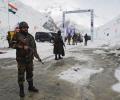
External affairs ministry spokesperson Arindam Bagchi said it is essential that "appropriate agreements between India and China of 1993 and 1996 are scrupulously followed".

The fresh round of Corps Commander-level talks took place at the Chushul-Moldo border point on the Chinese side of the Line of Actual Control in eastern Ladakh, they said.

On the first day of his two-day visit to Ladakh, Gen Naravane held a series of meetings with top commanders about the evolving situation in the region as well as on India's overall combat readiness to deal with any eventualities, military sources said.
The ministry also made certain clarifications in the statement, and said, "the assertion that Indian territory is up to Finger 4 is categorically false. The territory of India is as depicted by the map of India and includes more than 43,000 sq km currently under illegal occupation of China since 1962."
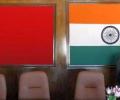
The sources said the focus of the talks was to take forward the disengagement process in friction points like Hot Springs, Gogra and Depsang in eastern Ladakh.
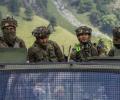
India and China on Saturday held another round of military talks with a focus on taking forward the disengagement process in Hot Springs, Gogra and Depsang in eastern Ladakh and bring down the tensions in the region, official sources said.
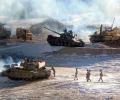
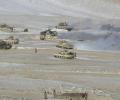
The army shared pictures of tanks and convoys of light armored vehicles moving with soldiers and equipment towards the rear areas as part of the disengagement process. Large number of Chinese tanks can be seen moving away from the south bank of the Pangong Tso.

'If you behave like a nail, the adversary will behave like a hammer.'
 © 2026 Rediff.com - Investor Information - Advertise with us - Disclaimer - Privacy Policy - Sitemap - Feedback - About us - Terms of use - Grievances