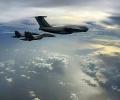
India has wrapped up its operation at a strategic air base in Tajikistan's Ayni following the lapse of a bilateral agreement, people familiar with the matter said this week.
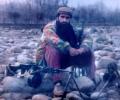
'A man with a gun commanded respect. I thought if I also got a gun, I could save my family. With this thought, I went to Pakistan and got training there'
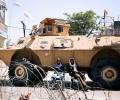
The activation of diplomatic channels is likely to yield better results than a simmering hostility, recommends Ajai Shukla.
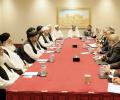
The Afghan tradition of gaining control of areas does not necessarily involve combat. Most engagements are settled through negotiations and pay-offs before battle is joined. This style of fighting is peculiar to Afghanistan, explains Ajai Shukla, who witnessed such a transaction between the Taliban and the Northern Alliance in November 2001.
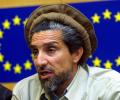
Ahmed Shah Massoud's assassination, 9/11 and the defeat and ejection of the Taliban suggested a break in Afghanistan's history, but the events of August 2021 and the Taliban's return shows how deeper continuities remained in place, points out T C A Raghavan, former Indian high commissioner to Pakistan.

The Taliban is highly pragmatic and would regard it wasteful to resume military offensive to capture Panjshir. The Taliban's preference, historically, has been to keep the military option as the last resort, explains Ambassador M K Bhadrakumar

'The Afghans used to say that if there is any person whose name should be taken after Allah, it is Hindustani.'
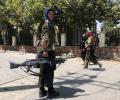
A closure of the Indian mission in Kabul will be a Himalayan blunder at this historic juncture when the wheels of diplomacy and politics are set to accelerate in Afghanistan, argues Ambassador M K Bhadrakumar

Reports coming from the ground confirm that an intense battle between Taliban and opposition forces to control the Panjshir Valley north of Kabul, the last Afghan province holding out against the group.

The road ahead will be long and winding and much resistance can be expected from the high-flying 'hawks' in our skies. But that should not deter the policymakers from planning a road map with the 'big picture' in mind, observes Ambassador M K Bhadrakumar.

The billions India invested in dams, schools, etc in Afghanistan will be gone. The Hindu and Sikh population of Afghanistan has already shrunk from some 200,000 to about 500, points out Rajeev Srinivasan.

Once Mazar-i-Sharif falls, some isolate pockets of resistance may remain, which the Taliban would tackle through political work or coercion, asserts Ambassador M K Bhadrakumar.

India is apprehensive about the Taliban's return as it would mean loss of access to Baluch rebels and help to the restive tribals of Waziristan. This would be a setback to the Indian strategy of returning the compliments of death by a thousand cuts to Pakistan, notes Colonel Anil A Athale (retd).

The US intends first to cripple the Afghan government financially through sanctions, freezing of assets, denial of access to international banking, etc, and then proceed to do pretty much what it wants to do with scant regard for Afghanistan's sovereignty, predicts Ambassador M K Bhadrakumar.
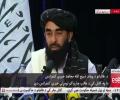
'The really striking thing is that the Taliban has suo moto presented to us certain firm benchmarks against which it expects us to hold to account the Taliban rulers's actions in the period ahead' notes Ambassador M K Bhadrakumar.
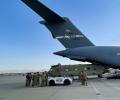
Remember the US withdrawal agreement was signed in February 2020. In the intervening period, a proper evacuation plan ought to have been in place. It was not. Consequently, tens of thousands of Afghans who had worked as interpreters, drivers, suppliers of goods and services, etc, face brutal retribution from the Taliban, Virendra Kapoor points out.
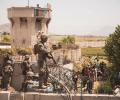
The US military efforts in Afghanistan were akin to filling a bucket that had gaping holes, asserts Colonel Anil A Athale (retd).
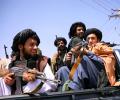
India is worried about Pakistan getting the Taliban to ignite trouble in Kashmir, observes Ramesh Menon.

'Whatever comes in the minds of the Pakistani generals and Pakistan military, they just go for it.' 'They do not care about the consequences for their country or the consequences to the people of Pakistan.'
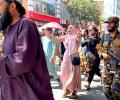
ISI chief Faiz Hameed coerced the Taliban to announce an interim government guaranteed to preserve Pakistan's control over the levers of power in Kabul, observes Ambassador M K Bhadrakumar.


'It is important to note that American officials were trying their best to use the Taliban for their oil games till December 1997 when Mullah Ghous was invited to America. State Department officials did not show any interest in capturing or killing Osama bin Laden even at that time.'

''83 is a once in a lifetime story.' 'I often say that sometimes, I feel that you don't choose stories, stories choose you.' 'Why for the last 37 years was the story not made?' 'It's staring at our faces, the greatest sporting triumph for India ever.'

Unlike football, which offends the sensibilities of some very conservative Muslims because it is normally played in shorts, cricket is played in long sleeves and trousers, in line with traditional dress codes. It also bears some resemblance to traditional Afghan children's games involving throwing and using sticks to hit smaller sticks or balls.

Karzai has steadfastly opposed direct talks between the US and the Taliban, wanting Afghan ownership of the "reconciliation process", as the reintegration of the Taliban into the mainstream is referred to.
Wisner said during a discussion organised by Asia Society here yesterday on the Indian elections.
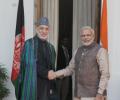
Security will be a consideration, as would protocol, but given Modi's penchant for the unconventional, it should not come as a surprise if he indeed decides to attend the ceremony in Kabul, says Ramesh Ramachandran.
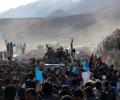
If Afghanistan is going to make any gains through democratic reforms, the newly elected president must start with addressing corruption at all levels of government and developing a comprehensive government financing plan independent of American support.
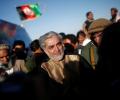
P B Chandra reports from Kabul on the Afghan presidential election, that has entered a run-off stage for the first time. The battle now is between the two frontrunners Abdullah Abdullah and Ashraf Ghani Ahmadzai, with Abdullah holding the edge.
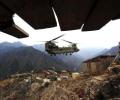
India should not have a large bilateral military training program in Afghanistan in the future because that would predictably exacerbate tensions, says Director of research, Brookings Institution Michael O'Hanlon.

'It was a mission undertaken in darkness in every sense -- literally, because Afghanistan had no electricity at that time; and, metaphorically because Delhi historically dealt only with the Pashtuns of Afghanistan and the foreign ministry's vast archives had nothing to offer on the culture and politics of the northern tribes in the Hindu Kush.'

'US counter-terrorism policy was encouraging and emboldening the Indians to deal with the problem of Pakistani-supported terrorism once and for all.' 'The US had been trying to browbeat Pakistan into doing what it wants, with very limited success.'
 © 2026 Rediff.com - Investor Information - Advertise with us - Disclaimer - Privacy Policy - Sitemap - Feedback - About us - Terms of use - Grievances