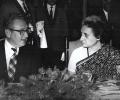
'She was brave. She didn't care a hoot. And India was not the strongest of nations as it is now.'
'She was brave. She didn't care a hoot. And India was not the strongest of nations as it is now.'
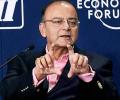
A new committee chaired by former Chief Economic Advisor Shankar Acharya will examine the feasibility of having a 'new financial year' to coincide with the calendar year.

Nationalisation has served its purpose. It's time to move ahead, keeping majority ownership of the government in a few banks to serve the people, argues Tamal Bandyopadhyay.
'An era of fiscal pessimism is setting in, which, if not countered intellectually, is going to have the same effect as export pessimism has had,' notes T C A Srinivasa Raghavan.

In a sharp attack on the Narendra Modi government, BJP leader Arun Shourie on Monday contended that it believes that managing economy means "managing the headlines" and that people had started recalling the days of former Prime Minister Manmohan Singh.
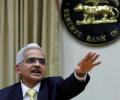
Not only were Urjit and Rajan outsiders, they also hired laterally, bypassing the existing talent, especially in the field of economics

If Jammu and Kashmir comes under Governor's rule, it will be for the eighth time in four decades.

'While the GST is structured to be an all-encompassing tax and to create a vastly expanded digital network of recorded transactions, no one knows how traders long used to avoiding taxes will apply their ingenuity,' says T N Ninan.

When the Indian economy tanked in 1991, it did so because it ran out of foreign exchange. Today, it is tanking because it has run out of rupees even as the foreign exchange granary is overflowing, says T C A Srinivasa-Raghavan.

The NDA government was initially reticent about fleshing out its economic strategy for the future. But now that it has taken enough bold initiatives on the economic front it must have the confidence to tell us more about its approach going forward, says Abheek Barua.
'Nehru once told JRD, "I hate the mention of the very word profit".' '"Jawaharlal, I am talking about the need of the public sector making a profit!" JRD replied.' 'Nehru reiterated, "Never talk to me about the word profit, it is a dirty word".' A fascinating excerpt from Shashank Shah's The Tata Group: From Torchbearers To Trailblazers.

The most serious recommendations to change the financial year came in the years preceded by deficient rainfall. The Jha committee was formed after droughts in 1979-80 and 1982-83, reports Rishika Pardikar/IndiaSpend.
Economists who get too close to prime ministers eventually come to grief after their boss is defeated

Shastri took the first big step to transform India's agriculture, the benefits of which his successors reaped in plenty, says A K Bhattacharya.

In its essence, GST is a national level system of value added taxation of goods and services, says Shankar Acharya.

'This is basically aimed at vilifying Nehruvian ideals.' 'Why?' 'Because, Nehruvian leadership is seen by Hindutva forces as the one which did not let them have their Hindu Raj.' 'The Hindutva proponents have always assumed that had Sardar become the first prime minister, India could never have become a secular State,' says Mohammad Sajjad.
Reform ideas do not occur overnight and evolve over the years.
From Swachh Bharat to spearheading the Make in India campaign, the PMO seems to be at the centre of all policies, writes Nivedita Mookerji.

Glimpses of the final days of the 1965 War, as seen from the diary then defence minister Y B Chavan maintained during the war.

A man of perseverance and great survivor, Mufti Mohammed Sayeed had an astute political sense honed by decades of experience in Kashmir politics that has stood him in good stead in crafting a delicate alliance with Bharatiya Janata Party to return as chief minister for the second time.

20 years ago this day, May 11, 1998, India conducted its second nuclear test at Pokharan in Rajasthan. In a fascinating interview on Rediff.com, K Subrahmanyam revealed how Indian PMs reacted to nuclear ambitions.

'He depended too much on assurances given by sadhus and sants. He may not be culpable, but he was wholly responsible for December 6, 1992.' 'While Manmohan Singh came to reforms out of conviction, Rao came to reforms out of compulsion. If the compulsion had not been there, I don't know how he would have responded.'
Who are the men the prime minister relies on to execute his impressive agenda?
 © 2026 Rediff.com - Investor Information - Advertise with us - Disclaimer - Privacy Policy - Sitemap - Feedback - About us - Terms of use - Grievances