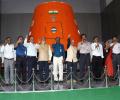
The space agency is gearing up for the human spaceflight programme by 2021-end that is likely to include a woman astronaut.
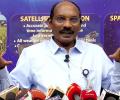
Sivan said the Indian National Space Promotion and Authorisation Centre (In-Space) has been created under the Department of Space as a separate vertical for taking independent decisions with respect to permitting and regulating space activities of the private sector.

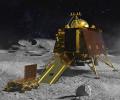
ISRO chief's comments came after NASA said that it had found the remains of the Vikram lander by its Lunar Reconnaissance Orbiter and credited the discovery to Chennai-based amateur astronomer and engineer Shanmuga Subramanium.
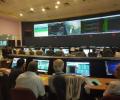
'The unflappable temperament and nerves of steel under extreme pressure -- essential ingredients in space research -- were on full display in the rows occupied by the scientists still engrossed in their monitor screens,' says Minnie Vaid, author of Those Magnificent Women And Their Flying Machines, ISRO's Mission to Mars.

'Gaganyaan' is set for December 2021 launch and is likely to include a woman astronaut.

K Sivan has to hasten the effort to bring in private players into satellite and rocket building and replicate India's software success in aerospace.
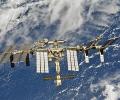
Once ISRO masters the technology to send humans into space, the next step will be experimenting with technologies allowing humans to live in space.
He also said it may be adopted for use in every stage of a rocket. He was speaking at the 16th convocation of SRM Institute of Science and Technology, near Chennai.
As NASA's Perseverance rover landed on Mars to look for signs of past life, ISRO chief K Sivan said India's next mission to the Red Planet is likely to be an orbiter.

The Chandrayaan-2 spacecraft weighing around 3,290 kg would orbit around the moon and perform the objectives of remote sensing the moon.
The Gaganyaan mission aims to send a three-member crew to space for a period of five to seven days by 2022 when India completes 75 years of Independence.

'We are planning to send an unmanned mission prior to the man mission, in next two years.'

When asked if it would be possible to achieve the Gaganyaan mission with the given time frame, Sivan said, "Yes, we are not doing this for the first time, and we are also not starting the mission from the scratch. We are already on the job," adding that several important procedures, like the crew module, crew escape systems, environment control and life support systems, had already been completed.

Indian Space Research Organisation's plan to soft land Chandrayaan-2's Vikram module on the Lunar surface did not go as per script in the early hours of Saturday, with the lander losing communication with ground stations during its final descent.

"It is going to be the most complex mission ever undertaken by ISRO. It is going to take place between July 9 and 16, this year," Sivan said, addressing scientists from the Mission Control Centre.
ISRO chairman K Sivan said the proposed soft-landing was going to be a 'terrifying' moment.

The Indian space agency is all set to embark on its most complex mission.

The polar satellite launch vehicle-C42 launch vehicle carrying the two satellites blasted off from the first launchpad at the Satish Dhawan Space Centre at 10.08 pm.

The year has come to an end and we are looking forward to 2020. While we think back of the events that shaped the year, we couldn't help but think of these awards for these personalities.

The landing on the moon near the South Pole, an uncharted territory so far, would be on September 6 or 7, Sivan told reporters, as the Indian space agency is all set to embark on its most complex mission.

Her comments came amid the ongoing war of words between India and Pakistan ever since India withdrew Jammu and Kashmir's special status and bifurcated it into two union territories on August 5.

"I remember Chandrayaan-2's launch was earlier scheduled on July 15. I was there in Sriharikota. I saw the massive carrier, 'Bahubali', from close proximity.
Despite the odd time, hordes of enthusiasts had reached the island, some of them travelling long distances on two wheelers, to witness the historic moment.
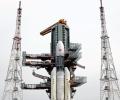
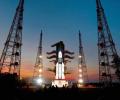
The Indian Space Research Organisation said that the countdown started at 6.51 am on Sunday.

India is all set to script history by launching a record number of 22 satellites, including a number of micro and nano ones from foreign countries, in a single mission in May this year.

Cartosat-3 satellite is a third-generation agile advanced satellite having high-resolution imaging capability.

India will be the fourth country after the United States, Russia and China to send humans to space.
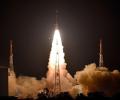
"I am really grateful to the entire ISRO family for having worked this hard and making IRNSS-1I a success," said the space centre's chief K Sivan.

ISRO Chairman K Sivan described the GSAT-11 as the "richest space asset" for India.
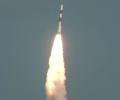
The launch marks a significant milestone for the space agency as it is the 50th flight of PSLV and the 75th vehicle mission from Sriharikota. The 628 kg satellite is meant for applications in various fields like agriculture, forestry and disaster management support. It would also serve military purposes.

The 3,423 kg GSAT-29 carries Ka and Ku band high throughput transponders intended to meet the communication requirements of users, including in the North East and in Jammu and Kashmir.

The ISRO lost communication with the satellite when it attempted to ignite the engine in a third and final move to its desired location.

Since Pakistan has 'opted out' of the project, it is now being called South Asian satellite.

Connecting with people is the first step to creating greater awareness for the brand and that in turn, believes ISRO chief K Sivan, will translate into the institution becoming a place that people want to work in.

An ISRO official said: "Unless and until everything is intact (lander), it's very difficult (to re-establish contact). Chances are less. Only if it had soft-landing, and if all systems functioned, then only communication can be restored. Things are bleak as of now."
"Already, orbiter is in space and it should do an excellent job of mapping," Nair said.

The Vikram Moon Lander, named after the father of India's space mission Vikram Sarabhai on his birth centenary year, is scheduled to touch the lunar surface near its south pole on September 7 about 1.55 am.

All spacecraft parameters are normal, the Bengaluru headquartered space agency said after the maneuver on the spacecraft.
There will be two more orbit manoeuvres to make the spacecraft enter into its final orbit passing over the lunar poles at a distance of about 100 km from the Moon's surface.

If the April launch of the Chandrayaan-2, the country's second mission to the Moon, is not possible, then the ISRO will aim for a launch by October.
 © 2026 Rediff.com - Investor Information - Advertise with us - Disclaimer - Privacy Policy - Sitemap - Feedback - About us - Terms of use - Grievances