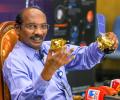
ISRO chairman K Sivan said all activities related to the third lunar mission -- Chandrayaan-3 -- were going on smoothly but its launch may shift to next year.

In the first dedicated mission of its commercial arm New Space India Limited (NSIL), the Indian Space Research Organisation on Sunday successfully launched Brazil's earth observation satellite Amazonia-1 and 18 other co-passengers, including five built by students, onboard a Polar rocket from the spaceport in Sriharikota.

This is the first mission by the Indian Speace Research Organisation this year.

This is the first full-scale review of VIP protectees by the Union home ministry after the Modi 2.0 government took charge.
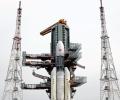
India's second mission to the moon will be launched on Monday at 2.43 pm after its initial launch on July 15 was called off owing to a "technical glitch."

"Chandrayaan-2 is not the end of story. Our plans on Aditya L1 solar mission, human spaceflight programme are on track. A large number of advance satellite launches are planned in the coming months. SSLV will make its maiden flight sometimes in December or January. Testing of 200 ton semi-cryo engine is expected to begin shortly. Work is on to provide NAVIC signals on mobile phones, which will open the path to develop large number of applications for societal needs," he added.
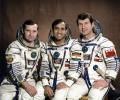
ISRO has to select astronauts, training them to withstand the space environment, and then bring them back to earth and rehabilitate them.

Vikram (with rover 'Pragyan' housed inside) is expected to touch down on the lunar surface on September 7, between 1.30 am and 2.30 am.

The year ended with the launch of the PSLV's 50th mission.
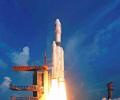
The rocket can put satellites weighing upto four tonnes in space, double the weight that the current GSLV-Mark-II can lift.

The weight of the space station is likely to be 20 tonnes.

The ISRO had earlier said Chandrayaan-2 will be launched in a window from January-February 16, 2019.Sources said it is expected by the middle of next month but no date has been finalised.

The 3,357-kg satellite, which was deployed from the lower passenger position of Ariane-5 launch vehicle (VA 251) into the geostationary transfer orbit, is configured on ISRO's enhanced I-3K Bus structure to provide communication services from Geostationary orbit in C and Ku bands.

The RISAT-2B would replace the RISAT-2, which has been actively used by India to monitor activities in camps across the border in Pakistan to thwart infiltration bids by terrorists.

'All possible efforts are being made to establish communication with (the) lander,' the ISRO further said in a tweet.
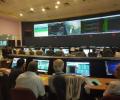
Veteran space scientist G Madhavan Nair said on Tuesday that Indian Space Research Organisation's unsuccessful bid to soft land on the moon is nothing to be alarmed about, and it would only enable the space agency master complex missions going forward.
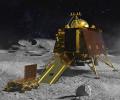
While participation of start-ups in the space sector has largely been minimal so far, their involvement will be key towards building India's very own aerospace companies such as Maxar, Elon Musk's SpaceX and Rocket Labs, according to experts.

Hours before Chandrayaan-2's 'Vikram' module's proposed soft landing on the Lunar surface, Indian Space Research Organisation chairman K Sivan said on Friday things are progressing as per plan for the much-awaited event.

Two de-orbit manoeuvres of Vikram Lander, to bring it further down, have been planned to prepare for its landing in the south polar region of the moon.

The Chandrayaan-2 spacecraft is expected to reach the moon's orbit on August 20 and land on lunar surface on September 7.

ISRO Chairman K Sivan said there might by a postponement if the weather was not conducive.

Indian Space Research Organisation will announce a revised launch date later.

India's premier Space Research Organisation is targetting up to 10 launches a year by 2016 , a top ISRO official said on Monday.

The year is coming to an end and overall, it's been one hell of a year! We have had our share of ups and downs and we look forward to a better 2020. While we count down the days to the new year, let's also reflect on those who gave us strength to stand up in what we believe, the courageous who didn't bow down and the ones with gumption who inspired us to be better. We, Rediff.com, have selected 26 personalities, who we think are worthy of the title -- HERO OF THE YEAR -- and we want you, dear readers, to choose your hero!

Sivan asserted that though Chandrayaan-2 did not go as per script, it will have no bearing with on the 'Gaganyaan' mission.

'If people are not cooperating and do not follow policies laid down by the government or follow scientific infection control management, then all will be lost.'

'Space is dangerous and there will be many failed attempts as we try to use mankind's ingenuity to take the next evolutionary step.'

Microsat-R, an imaging satellite, is meant for military purposes, but the ISRO did not give any details about it.

"Efforts are underway to establish the link with the satellite," it added.

'By pushing PSLV production to industry, the extra ISRO personnel available will be utilised to do projects like the human space mission.'

Out of its 47 operational satellites, India currently has six to eight satellites which are used entirely for military purposes.

The primary goal of HysIS, whose mission life is five years, is to study the earth's surface in visible near infrared and shortwave infrared regions of the electromagnetic spectrum.

The GSAT-31 is a 'high power' communication satellite going to serve and replace some of the satellites that are going to expire soon.
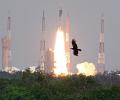
The nine-second de-orbiting or retro-orbiting manoeuvre was executed at 3.42 am using the onboard propulsion system.
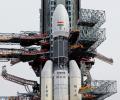
'It is time we Indians learnt to believe in ourselves, and stopped questioning our own capabilities every time a space launch is not a glorious success,' says M D Riti.
Asked if the lander was 'damaged' during the 'hard landing", Sivan said: "That we do not know".
Nirmala Sitharaman, Amit Shah, Arvind Kejriwal and Rahul Gandhi also expressed solidarity with ISRO.

The space agency said Chandrayaan-2 planned for mid-April.
India scripted history by successfully launching EMISAT, a military satellite, and 28 foreign nano satellites on-board its polar rocket from Sriharikota on Monday, in a complex mission which marked many a first for Indian Space Research Organisation.

The Rs 978 crore mission, which has been rescheduled for Monday after scientists corrected the glitch in the rocket, will be launched at 2.43 p.m from the second launchpad at Satish Dhawan Space Centre, over 100 km from Chennai.
 © 2026 Rediff.com - Investor Information - Advertise with us - Disclaimer - Privacy Policy - Sitemap - Feedback - About us - Terms of use - Grievances