
A Constitutional Amendment Bill paving way for the creation of a Judicial Appointments Commission to replace the present collegium system to appoint judges to higher courts was passed in the Rajya Sabha on Thursday amid high drama with the Bharatiya Janata Party walking out.

Eminent jurist Ram Jethmalani on Sunday asserted that Indian Parliament "is not sovereign" for its decisions can be challenged in court, as he hit out at Finance Minister Arun Jaitley for criticising the Supreme Court verdict to scrap NJAC Act on appointment of higher judiciary.

The Supreme Court will hear on Monday a batch of petitions challenging the 121st constitutional amendment by which collegium system for appointment of judges in higher judiciary was scrapped and a new mechanism under National Judicial Appointment Commission was proposed to be put in place.

The current session of Parliament may be extended to enable the passage of bills, Parliamentary Affairs Minister Venkaiah Naidu told Bharatiya Janata Party MPs in New Delhi on Tuesday.

Justice Kurian Joseph, who will turn 65 on November 30, was part of the five- judge bench which by a majority of 3:2 had ruled the practice of divorce through triple talaq among Muslims as "void", "illegal" and "unconstitutional".

A landmark bill to replace the collegium system of judges choosing judges was on Thursday passed in the Lok Sabha after government dropped a controversial provision that required unanimity in recommendation if the President seeks reconsideration.

Justices A M Khanwilkar, D Y Chandrachud, Ashok Bhushan and L Nageshwar Rao were on Friday sworn in as Supreme Court judges, taking the apex court's strength to 29, including Chief Justice T S Thakur.
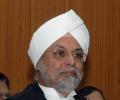
Justice Khehar, 64, will be the first Chief Justice from the Sikh community and he will succeed CJI Thakur who will be demitting office on January 3, 2017.

Former AAP leaders Yogendra Yadav and Prashant Bhushan said the Bill was completely different from the one envisaged originally.

Along with the triple talaq matter, the Supreme Court will also hear cases related to Aadhaar and WhatsApp during the nearly 50-day summer vacation.

The establishment of a National Judicial Commission to give the Executive a say in appointment of judges and setting up a special investigation team on blackmoney stashed abroad are the priority areas for the Modi government, newly-appointed Law Minister Ravi Shankar Prasad said.

Justice Chelameswar led three senior judges to an unprecedented press conference, mounting a virtual revolt against CJI Dipak Misra.

Vacancies in high courts continue to mount with the collegium which made a comeback three months ago yet to recommend fresh names for the posts, including that of chief justices to eight of them.
The apex court, which quashed the NJAC Act in an unanimous verdict, also declared as unconstitutional the 99th amendment to the Constitution to bring in the Act to replace the collegium system.

Parliamentary Affairs Minister M Venkaiah Naidu on Monday said there was "some amount" of intolerance in the society which has to be identified and dealt with firmly, instead of generalising it.

The government's decision of not approving Joseph's name has evoked sharp reactions.

The finance minister said he said, "The judgement has upheld the primacy of one basic structure -- independence of judiciary -- but diminished five other basic structures of the Constitution, namely, Parliamentary democracy, an elected government, the Council of Ministers, an elected prime minister and the elected leader of the opposition."

Chief Justice of India R M Lodha asserted that independence of the judiciary is "non-negotiable" and it has the inherent strength to foil any attempt to interfere with that.

Several top jurists on Monday pushed for scrapping the existing collegium system where judges appoint judges but government's plans to bring a bill to make the process of appointments more transparent may take some more time.

The statement, made in the backdrop of the historic apex court verdict quashing the National Judicial Appointment Commission Act, assumes significance as the President said that the judiciary is "autonomous" and a vital feature of democracy.
The government had declined to appoint Justice Joseph's to the top court and asked it to reconsider his name.
The Supreme Court on Monday witnessed sharp exchanges when it took exception to Attorney General Mukul Rohatgi using the phrase "judges appointing judges" to attack the collegium system and observing that B R Ambedkar would have turned in his grave at the way the power was taken away from the executive.

Chief Justice of India Ranjan Gogoi on Monday said it was in "our best interest" to heed the advice of the Constitution as not doing so would result in a "sharp descent into chaos".
The SC on Wednesday restrained all high courts from entertaining any petition challenging validity of NJAC act meant to replace the two-decade-old collegium system.

He also made it clear that judiciary cannot depend on executive in choosing judges.
If the judiciary loses this fight, it will suffer irreparable damage and all of us citizens will be the losers.

Keen to scrap the collegium system, government on Monday introduced a Constitution Amendment Bill in Lok Sabha to establish a six-member body for appointment of judges to the Supreme Court and the high courts.
The recent meeting of chief justices and chief ministers skirted vital issues, which could have helped in improving the efficiency in the functioning of courts

PM says rendering free legal aid to the poor should be a criterion in selection of judges.
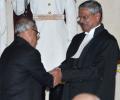
'The appointment of judges must not be under the control of the government,' says Prashant Bhushan.

'If ever there was a decisive moment in the history of the Supreme Court where it has been under attack by the Executive, and the judges have boldly stood up for independence of the Judiciary, that time was now.' 'These four judges did a brilliant thing, they set an example.' 'They showed that they were fulfilling their duty to the Constitution and to God.' 'Don't allow fear to dictate your actions was their message.'

'And Indians are loving it,' says Shekhar Gupta.

Landmark judgments follow new CJI's assumption of office.
The United Progressive Alliance government's efforts to rein in the judiciary may come unstuck as its ambitious bill scrapping the collegium system of appointing judges to the Supreme Court and high courts as the Bharatiya Janata Party is unlikely to allow the passage in the ongoing Parliament session.

'To suggest that activists -- and that too 'five star activists' -- are driving the courts, is to betray an ignorance of the functioning of the legal system of the most gross kind,' says Senior Advocate and former Additional Solicitor General Indira Jaising.

'The government has to take effective steps to strengthen democracy, rule of law, maintain communal harmony and safeguard the security of the country and its people.' 'The government has to carry all sections of the people with it irrespective of their race, caste, community, region or language,' and try to unite them by promoting fraternity among them,' says legendary Constitution expert P P Rao.
Following objection from petitioners who claimed conflict of interest.

'Manmohan Singh was blamed for administrative paralysis, but if you speak to any senior bureaucrat today, they are very bitter and say that files do not move. I am told that more than a thousand files are awaiting clearance.'

In a new twist, Chief Justice of India H L Dattu has refused to participate in a three-member panel for selecting two eminent persons in the six-member National Judicial Appointments Commission on whose validity a constitution bench began hearings on Monday.
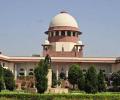
The nullifying of the NJAC Act has put the spotlight on the Judiciary. Concepts like transparency, being open to change, leading from front, management of perceptions that were reserved for the Executive earlier are now relevant for the Judiciary as well, says Sanjeev Nayyar.
 © 2026 Rediff.com - Investor Information - Advertise with us - Disclaimer - Privacy Policy - Sitemap - Feedback - About us - Terms of use - Grievances