
The US State Department, in its Congressional mandated annual Country Reports on Terrorism for the year 2018, on Friday said even though the Pakistani government voiced support for political reconciliation between the Afghan government and the Taliban, it did not restrict the terror group and the Haqqani Network from operating in Pakistan-based safe havens and threatening the US and Afghan forces in Afghanistan.
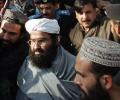
US Secretary of State Antony Blinken, in the 2020 Country Reports on Terrorism issued on Thursday, said that regionally, terrorist groups continued to operate from Pakistan.
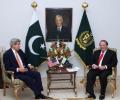
US Secretary of State John Kerry during his visit to Pakistan addressed the issue of terrorism and also called on both - India and Pakistan to find a diplomatic solution to the violence at the border issue.

Mullah Akhtar Mansoor, a top Afghan Taliban leader who backed the peace process and a former aviation minister in the pre-2001 Taliban regime, has been appointed as the new chief of the insurgent group, as Taliban confirmed the death of its longtime supremo Mullah Omar.

Mullah Akhtar, a close aide of Mullah Omar who served as his deputy for the past three years, was chosen as the new leader.

The team's remarkable rise has been cricket's biggest fairytale story in recent times but Afghanistan risk isolation following the country's takeover by the Taliban in August.

The Pakistan government has, however, put the JuD on the list of groups being closely watched by the officials.

Former Inter-Services Intelligence chief Ahmed Shuja Pasha has admitted that the deadly Haqqani network was created by it and America's Central Intelligence Agency and claimed that the insurgent group's chief Jalaluddin Haqqani had "in fact been invited to the White House by President (Ronald) Reagan".

Aziz said that Pakistan-US relations had come to a standstill in 2011 because of incidents of WikiLeaks, Raymond Davis, Abbottabad operation, Datta Khel and Salala.

The two leaders reaffirmed that the United States and India 'will take concerted action against all terrorist groups, including groups proscribed by the UNSCR 1267 Sanctions Committee'.

In a major crackdown to eliminate the terrorists' sanctuaries, Afghanistan has carried out three air strikes within a week in Kunar province, bordering Pakistan, inflicting heavy casualties on Lashkar-e-Tayiba terror group.
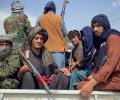
Even though the Taliban has managed to capture Afghanistan and form a government, an internal rift between the faction has started emerging, according to media reports.
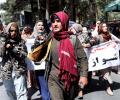
Mullah Muhammad Hassan Akhund is appointed as Prime Minister with two deputies Mullah Abdul Ghani Baradar and Molavi Abdul Salam Hanafi.

The suspension of US aid to Pakistan, which was announced by President Donald Trump in January 2018, remained in effect throughout 2019, the State Department said.

"They support terror operations in India with terrorist organisations. They support the Haqqani network and the Taliban in conducting operations against the United States and NATO and Afghanistan. They've got blood all over their hands with the casualties," General (Retd) Jack Keane said.

The US administration will take the final call in a meeting in coming weeks.

The US will not be delivering military equipment or transfer security-related funds to Pakistan unless it is required by law.

The US wants action against the existing safe havens of the Taliban and the Haqqani network and demolish its ability to carry out strikes across the border in Afghanistan.

United States officials have identified Pakistan as a base of operations or target for numerous armed and non state militant groups, some of which have existed since the 1980s, the independent Congressional Research Service said in the report.

The US and others have long complained that Pakistan provides safe haven to the Afghan Taliban and their allies, the Haqqani network.

A Congressional Committee in its budgetary proposals for the year 2013 has prohibited economic and security assistance to Pakistan till it co-operates with the United States in the fight against terrorism and takes action against groups such as Haqqani Network, Taliban, Al Qaeda and Lashkar-e-Tayiba.
"I don't think that we have seen any evidence of efforts by India to directly undermine Pakistani national security. This is something that the Pakistanis fear but I don't think that we should let US policy be driven by Pakistani fear," Lisa Curtis of the Heritage Foundation said in response to questions from lawmakers who raised Pakistani concerns in this regard.
Pakistan's powerful spy agency Inter Services Intelligence regards the United States as its "worst enemy" and Islamabad's claim that it is cooperating with Washington is a sham to extract billions of dollars in aid, jailed Pakistani doctor Shakeel Afridi who helped the CIA trace Osama bin Laden has said.
The United States on Friday designated Pakistan-based dreaded Haqqani network as a terrorist group, a move that could degrade the organisation's ability to execute violent attacks and pressurise Islamabad to act militarily against the outfit.

With Intelligence reports suggesting Pakistan-based terrorists planning strikes in India, Home Minister Rajnath Singh attacked the neighbouring country for "not mending its ways" despite being given a befitting reply many times.
Possibility of yet another Mumbai-style attack in India cannot be ruled out and such a threat will arise if the Taliban or Haqqani network succeed in seizing large parts of Southern Afghanistan, a veteran Indian diplomat has said.

Former Afghanistan President Ashraf Ghani, who fled to the United Arab Emirates before the Taliban seized power last month, on Wednesday apologised to the people for leaving the country abruptly, saying he believed it was the 'only way to keep the guns silent and save Kabul and her six million people'.
At least 16 militants, including some foreign fighters, were killed when the United States drones targeted the compound of a militant commander believed to have links with the Haqqani network and the Al Qaeda in northwest Pakistan on Thursday.
Unless Pakistan's military leaders awaken to the dangers that lie ahead from the Islamist extremist threat, it may eventually overwhelm the Pakistani state, warns Lisa Curtis
Two top United States lawmakers have called for "aggressive steps" by America to disrupt operations of the Pakistan-based Haqqani network, saying that Al Qaeda group was responsible for recent surge in attacks in Afghanistan.

However, the US praises India for its significant counter-terrorism actions.
Badruddin Haqqani, the key operational commander of the Al Qaeda linked Haqqani network, and top Pakistani Taliban commander Mullah Dadullah are believed to have been killed in US drone and air strikes in the tribal region of Pakistan and Afghanistan.
The Tehreek-e-Taliban Pakistan has welcomed the Pakistan government's offer for peace talks with all insurgent groups. Prime Minister Yousaf Raza Gilani had said recently that his administration was ready to hold negotiations with all militant groups, including the Haqqani network.
Karzai will hold comprehensive talks with Prime Minister Manmohan Singh after which the two countries are expected to ink a strategic pact to streamline the various assistance programmes of India and institutionalise bilateral security dialogue.
The Pentagon on Tuesday said it had shared with Pakistan in recent years the indications of Islamabad's "complicity" with extremist groups, renewing top United States commander Admiral Mike Mullen's allegations that Inter-Services Intelligence was conniving with the Haqqani network in Afghanistan.
Apparently Hina Rabbani Khar, Pakistan's youngest and first female foreign minister, has had it with Chairman of the Joint Chiefs of Staff Admiral Mike Mullen's incessant indictments of Pakistan's intelligence agency, the Inter Services Intelligence.
Admiral Mike Mullen, chairman of the United States joint chiefs of staff, just days before his retirement, has made yet another scathing indictment of Pakistan's Inter-Services Intelligence's perfidy. The spy agency maintains proxies like the Haqqani network for its own strategic depth in Afghanistan, he said.
The Tehreek-e-Taliban Pakistan militants have found sanctuary in Afghanistan's eastern provinces, which are under the Haqqani network's control, reports B Raman
Is the United States actually serious to proceed against the Haqqanis this time or is it yet another ploy on the part of the Obama administration to pressurise one of the most influential power players in Afghanistan to join hands with the international community to hold future negotiations with the Taliban? Amir Mir tries to find out.
Is the United States actually serious to proceed against the Haqqanis this time or is it yet another ploy on the part of the Obama administration to pressurise one of the most influential power players in Afghanistan to join hands with the international community to hold future negotiations with the Taliban? Amir Mir tries to find out.
 © 2026 Rediff.com - Advertise with us - Disclaimer - Privacy Policy - Sitemap - Feedback - About us - Terms of use - Grievances