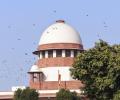
The Indian government defended the Waqf (Amendment) Act, 2025 in the Supreme Court, arguing that waqf, while an Islamic concept, is not an essential part of Islam. Solicitor General Tushar Mehta stated that waqf is essentially charity, which is recognized across religions, and cannot be considered a fundamental tenet of any faith. He also argued that the amended law addresses secular aspects of waqf and activities unrelated to Islam, and that "waqf by user" does not grant ownership of public land. Mehta highlighted the extensive consultations involved in the bill's creation, including feedback from various stakeholders. The hearing will continue on Thursday.

The bench, which examined the online post by the professor, who heads the political science department in the Sonipat-based Ashoka University, questioned his choice of words, saying they were used deliberately to humiliate, insult, or put others in discomfort. "The choice of words are deliberately made to insult, humiliate or cause discomfort to others. The professor, who is a learned person cannot lack a dictionary... he could have conveyed the very same feelings in a simple language without hurting others. He should have shown respect for the sentiments of others. He could have used a simple and neutral kind of language, respecting others," Justice Kant said.

If a woman can fly Rafale fighter jet in the Indian Air Force, then why are fewer women officers in gender neutral posts of judge advocate general (legal) branch of the Army, the Supreme Court wondered recently and questioned the Centre's rationale on a 50-50 selection criterion.

Several petitions were filed in the apex court challenging the Act, contending that it was discriminatory towards the Muslim community and violated their fundamental rights.
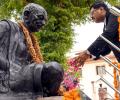
Justice Bhushan Ramkrishna Gavai, India's 52nd chief justice and its first Buddhist one, has played a key role in shaping the judicial landscape, penning about 300 verdicts, including landmark rulings on constitutional issues, liberty, and perhaps most important against the executive's 'bulldozer justice'.

The Bangladeshi national arrested for allegedly stabbing actor Saif Ali Khan after breaking into his Bandra house this January has moved a court in Mumbai for bail claiming he has been implicated in the case.

The National Council of Educational Research and Training (NCERT) has removed all references to the Mughals and Delhi Sultanate from its class 7 textbooks. The new textbooks, released this week, have been designed in line with the new National Education Policy (NEP) and the National Curriculum Framework for School Education (NCFSE) 2023, which emphasize incorporating Indian traditions, philosophies, knowledge systems, and local context into school education. The textbooks now include new chapters on ancient Indian dynasties, sacred geography, and government initiatives like Make in India and Beti Bachao, Beti Padhao. The revamp has been met with criticism from opposition parties who equate it with "saffronisation."

A three-judge Supreme Court bench will hear petitions challenging the constitutional validity of the Waqf (Amendment) Act, 2025, on April 16. The petitions, including those by politicians and the All India Muslim Personal Law Board (AIMPLB) and Jamiat Ulama-i-Hind, were filed in the top court challenging the validity of the newly-enacted law. The Centre has filed a caveat in the apex court, seeking a hearing before any order is passed.

The Punjab and Haryana High Court has directed the Punjab government not to take any coercive action against Congress leader Partap Singh Bajwa till April 22 in connection with an FIR lodged against him over his "50 bombs have reached Punjab" remarks. Bajwa, the leader of opposition in the Punjab Assembly, has been booked on charges, including misleading information that endangers the country's sovereignty and unity, after being quizzed over his "50 bombs have reached Punjab" claim. The court also issued a notice to the state of Punjab on Bajwa's plea seeking quashing of the FIR registered against him over his statement.
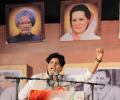
The Supreme Court of India has strongly criticized the police for suppressing freedom of speech by filing FIRs against artists for their performances, stating that mere recitation of a poem, stand-up comedy, or any form of art cannot be alleged to incite hatred or animosity between communities. The court quashed an FIR against Congress MP Imran Pratapgarhi, who was booked for a song performed at a mass marriage function, emphasizing that such actions stifle legitimate expressions of view in a free society.

The Bombay high court on Wednesday said the Maharashtra government has not taken vindictive action against any person for re-sharing or re-uploading stand-up comic Kunal Kamra's video in which he indirectly passed a 'traitor' jibe at Deputy Chief Minister Eknath Shinde.

The Delhi high court granted bail to alleged middleman Christian Michel James in the Rs 3,600-crore AgustaWestland money laundering case on Tuesday. Justice Swarana Kanta Sharma, while granting the reprieve to James, said it was an "exceptional situation" where the accused was in custody for over 6.2 years but the trial had not yet commenced due to incomplete investigation. James, who was extradited from Dubai in December 2018, can now walk out of prison subject to compliance with the conditions.
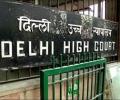
The right to seek 'default' bail is a fundamental right and an indefeasible part of right to personal liberty under the Constitution which cannot be suspended even during a pandemic situation, the Delhi high court said.

"No fundamental right has been violated. Section 144 was already in place and anyone who breaks the law can be taken into preventive custody," Noted constituional expert Fali Nariman told rediff.com.

Some of his directives had the Supreme Court judges disclose their assets whereas the row over the discovery of cash from a sitting judge's official residence paved way for inquiry.
The Supreme Court of India has sought the Indian government's response to a petition filed by a Muslim woman seeking to be governed by the Indian succession law instead of Shariat. The woman, Safiya P.M., argues that she does not believe in Shariat and wants to be governed by secular law, including the Indian Succession Act of 1925. The court has asked the government to file a counter affidavit within four weeks.

The Bombay High Court has allowed the police investigation against comedian Kunal Kamra over his remarks against Maharashtra Deputy Chief Minister Eknath Shinde to continue, but has barred his arrest. The court said the investigation can continue, but Kamra will not be arrested during the pendency of the petition. The court also said that if the police wanted to record Kamra's statement, they shall do so in Chennai, where he currently resides, after giving him prior notice.
The Supreme Court has admitted that it had violated fundamental rights of citizens during the 1975 Emergency. The observation was made by the court which in an unprecedented move commuted to life imprisonment the death sentence, earlier upheld by it, of a man who murdered four members of a family.

The Delhi high court on Wednesday sought to know from news channel Aaj Tak why it wanted to telecast the recording of narco analysis conducted on Aaftab Amin Poonawala, the man accused of strangling his live-in partner Shraddha Walkar and dismembering her body.
The Indian government has defended the Waqf (Amendment) Act, 2025 in the Supreme Court, arguing that there cannot be a blanket stay on the law as there is a presumption of its constitutionality. The Centre countered the pleas challenging the law's validity, asserting that the amendments were undertaken after a comprehensive study by a parliamentary panel. The government also highlighted the "reported misuse" of earlier provisions and the increase in waqf land, claiming that over 20 lakh hectares were added after 2013.

The Centre had termed privacy as a 'vague and amorphous' right which cannot be granted primacy to deprive poor people of their rights to life, food and shelter.

Privacy is liberty itself. And in ruling on it, the Supreme Court must not only seize the concerns of today but also gaze into the future, says Apar Gupta.

Congress MP Mohammad Jawed and AIMIM president Asaduddin Owaisi have challenged the validity of the Waqf (Amendment) Bill, 2025 in the Supreme Court, arguing that it violates constitutional provisions. The petitions claim the bill imposes arbitrary restrictions on Waqf properties and their management, undermining the religious autonomy of the Muslim community. They also allege that the bill discriminates against Muslims by imposing restrictions not present in the governance of other religious endowments. The bill was passed in the Rajya Sabha and Lok Sabha, with the petitioners arguing that it introduces limitations on the creation of Waqfs based on the duration of one's religious practice, mandates inclusion of non-Muslim members in Waqf administrative bodies, and shifts key administrative functions to government officials, thereby diluting the autonomy of Waqf management.
'Residence-based reservation in PG medical courses is violative of Article 14 of the Constitution.'

'The time has come to have a relook at the Constitution as every document has a shelf life.'

The Supreme Court has directed a Maharashtra authority to respond to a man's plea for initiating contempt action against it after his properties were demolished for allegedly raising anti-India slogans during a cricket match. The petitioner, who hails from Sindhudurg district in the state, claims his house and shop were demolished on February 24 following an FIR against him, his wife, and his 14-year-old son for allegedly raising anti-India slogans during the India-Pakistan Champions Trophy match. The plea argues that the demolition violated the Supreme Court's November 13, 2024 verdict on demolition of properties, which barred demolition without a prior showcause notice and 15 days' time for the aggrieved party to respond. The petitioner seeks directions for initiating contempt proceedings against the chief officer and administrator of the Malvan Municipal Council.

The Supreme Court of India has granted interim police protection to Discovery Communications India officials who have been receiving threats from followers of self-styled godman Asaram Bapu. The threats were triggered by the release of a documentary series titled "Cult of Fear: Asaram Bapu". The court has directed the Centre and several state governments to ensure the safety of the petitioners, including their offices.

The Supreme Court of India reserved its judgment on Tuesday in a case concerning the termination of two female judicial officers by the Madhya Pradesh High Court. The court had previously stated that judges should avoid social media and expressing opinions on judgments, emphasizing a "hermit life" and "work like a horse" approach. The case involves six women civil judges who were terminated for alleged unsatisfactory performance. Four were subsequently reinstated, but two, Aditi Kumar Sharma and Sarita Chaudhary, remained terminated. The court is considering the cases of these two judges, who joined the Madhya Pradesh judicial service in 2018 and 2017, respectively. The court is also considering arguments regarding potential violations of fundamental rights related to the termination process, including claims of unfair work assessment during maternity and child care leave.
The Supreme Court of India will likely hear a batch of petitions challenging the constitutional validity of the Waqf (Amendment) Act, 2025 on April 15. The Act, which came into force on April 8, has been met with widespread criticism from various stakeholders, including politicians, the All India Muslim Personal Law Board (AIMPLB), and Jamiat Ulama-i-Hind. They argue that the law is discriminatory and violates the fundamental rights guaranteed under Articles 25 and 26 of the Constitution. The petitions allege that the amendments give the government more control over the administration of Waqf, effectively sidelining the Muslim minority from managing their own religious endowments.

Terming as 'unfortunate' the January 29 stampede at Maha Kumbh where at least 30 people were killed, the Supreme Court on Monday refused to hear a public interest litigation (PIL) for guidelines over safety of devotees and asked the petitioner to move the Allahabad high court instead.

The top court rejected the Centre's vehement contention that there was no general or fundamental right to privacy under the Constitution.
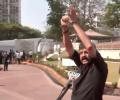
Nationalist Congress Party-Sharadchandra Pawar MLA Jitendra Awhad arrived in handcuffs at the Vidhan Bhavan complex in Mumbai on the first day of the Maharashtra legislature's budget session on Monday to highlight 'growing attack' on freedom of expression and protest the deportation of illegal immigrants from the United States.

Attorney General K K Venugopal resumed his arguments before a nine-judge bench headed by Chief Justice J S Khehar, stressing that it was not a fundamental right.

The court upheld the guidelines and imposed Rs 1 lakh cost each on the petitioners to be deposited with the CCPA towards consumer welfare.

The Bombay high court on Friday said all prisoners had a fundamental right to access their own medical records.
The legislation is aimed at streamlining various services related to immigration and foreigners, including their entry, exit and stay in India.

In 1954, a bench of eight Supreme Court judges declared that the Constitution-makers did not recognise the Fundamental Right to Privacy. It is hoped that a larger bench as and when constituted will uphold the Right to Privacy as a Fundamental Right overruling the 1954 decision, says the distinguished lawyer, P P Rao.

Congress president Mallikarjun Kharge accused the BJP-RSS of carrying out a "well-planned conspiracy" against national heroes and said that Sardar Vallabhbhai Patel's ideology was contrary to the RSS' ideas. He defended the relationship between Sardar Patel and Jawaharlal Nehru, saying they were "two sides of the same coin". He also criticized the BJP-RSS for their alleged attempts to appropriate the legacy of Mahatma Gandhi and Sardar Patel.

The Supreme Court of India has criticized the Madhya Pradesh High Court's decision to sack a woman judge due to performance concerns, without considering the impact of a miscarriage on her ability to work. The court questioned the lack of similar criteria for male judges and highlighted the mental and physical trauma associated with a miscarriage. The case involves six women civil judges who were terminated by the state government over alleged unsatisfactory performance. While the high court reinstated four judges, the fate of the other two, including the judge who suffered a miscarriage, remains uncertain. The Supreme Court has issued notices to the high court registry and the judicial officers involved, seeking clarification on the termination criteria and emphasizing the importance of considering factors beyond quantitative performance assessments.

AG Venugopal asserted that right to privacy could not be bundled as a single right in a developing country like India where a few persons, claiming right to privacy, override the fundamental rights of 60-70 million people, who did not have access to basic amenities like food and shelter.
 © 2026 Rediff.com - Investor Information - Advertise with us - Disclaimer - Privacy Policy - Sitemap - Feedback - About us - Terms of use - Grievances