
The Supreme Court of India has assured the creation of a robust mechanism to address the alarming number of suicides occurring in Indian Institutes of Technology (IITs) and Indian Institutes of Management (IIMs). The court was informed that 18 suicides had taken place in these institutions over the past 14 months. The court has also directed the University Grants Commission (UGC) to finalize draft regulations aimed at combating caste-based discrimination in educational institutions.

Former Union Law Minister Ashwani Kumar has argued for replacing the existing collegium system for judicial appointments, asserting that public sentiment leans toward an alternative mechanism, potentially resembling the National Judicial Appointments Commission (NJAC). He believes that the government has the authority to propose a revised constitutional amendment for judicial appointments that would withstand judicial scrutiny. Kumar also urged the Supreme Court to establish a robust internal process to address concerns within the judiciary, including allegations against judges.
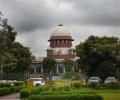
The top court remarked that there is no place for flamboyance in judiciary.
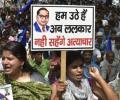
A group of around 130 Dalit families in West Bengal's Purba Bardhaman district have been facing discrimination for centuries, being denied access to a local temple. The families, belonging to the traditional community of cobblers and weavers, have been ostracized and face economic hardship due to this caste-based practice. Despite recent attempts by the administration to resolve the issue, the situation remains tense and the families are left with few options.
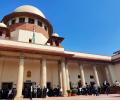
The apex court termed the prevalence of "social evil" of child marriage as "sobering" and passed a slew of directions to the Centre, states, district administrations, panchayats and the judiciary to eradicate the malaise.

Kangana Ranaut's decline as an actor feels complete, observes Utkarsh Mishra.

The Delhi High Court has ruled that the right to privacy includes the "right to be forgotten," and ordered the masking of an acquitted man's name from online records. The court reasoned that no public interest is served by keeping information alive on the internet after criminal proceedings are quashed. It also directed portals and search engines to comply with the order.
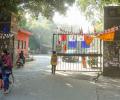
Students at Jawaharlal Nehru University (JNU) defied an advisory from the university administration and screened a banned BBC documentary on Prime Minister Narendra Modi. The screening, organized by the Left-backed All India Students' Federation (AISF), was initially planned to be displayed on a projector but was moved to a laptop after security personnel allegedly damaged the projector. The university had warned of disciplinary measures for violating the advisory, which stated that the documentary could "disrupt communal harmony" on campus. The AISF and the JNU Students' Union (JNUSU) condemned the advisory, calling it an attack on students' fundamental rights and alleging that the administration was attempting to stifle dissent and curb freedom of expression.
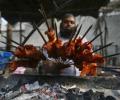
The high court directed the Food Safety and Standards Authority of India (FSSAI) to issue a fresh communication to all the authorities concerned stating the obligation to make clear disclosure as to whether the food article is vegetarian or non-vegetarian.

Here's what you must know about the new rule, its implications, and whether it affects taxpayers' rights and privacy.

The Supreme Court of India has granted interim bail to Tahir Hussain, a former councillor accused in the 2020 Delhi riots. Justice Ahsanuddin Amanullah, while granting bail, said the allegations against Hussain were grave but as of now they were just allegations. The bench, however, delivered a split verdict, with Justice Pankaj Mithal opposing the bail. The court also questioned the Delhi Police for the delay in the trial over the murder of Intelligence Bureau staffer Ankit Sharma during the riots.

The Supreme Court of India has ruled that a daughter has an indefeasible right to secure educational expenses from her parents, who can be compelled to provide necessary funds within their means. This ruling came in a matrimonial dispute where a daughter studying in Ireland refused to accept Rs 43 lakh given by her father towards her studies, which was part of the total alimony being paid to her mother. The court stated that the daughter has a fundamental right to pursue her education and that the parents can be compelled to provide necessary funds within their financial resources. The court also granted a decree of divorce by mutual consent to the estranged couple, directing them to abide by the terms of a settlement agreement they had reached.
The Supreme Court of India has expressed concern over the protracted trials in heinous offences related to Maoist activities, stating that indefinite incarceration violates the right to liberty under Article 21 of the Constitution. Two separate benches of the court granted relief to two accused, citing the delayed trials. One bench expedited the trial of a man accused of transporting ammunition for a banned organization, while the other granted bail to a man accused of transporting materials for Naxal activities. The court emphasized the importance of speedy trials and suggested the establishment of special courts to handle Maoist-related cases, aiming to expedite proceedings. The court also criticized the practice of examining an excessive number of witnesses, which can lead to indefinite delays in the conclusion of trials.

In a significant order, the Supreme Court has restrained the Enforcement Directorate from accessing and copying content from electronic devices seized during searches against Santiago Martin, also known as the 'lottery king', his relatives, and employees.
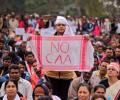
The affidavit, filed by B C Joshi, Director in the Ministry of Home Affairs, said the CAA does not confer any arbitrary and unguided powers on the executive as the citizenship to the persecuted minorities of Pakistan, Afghanistan and Bangladesh would be granted in a manner as specified under the law governing grant of citizenship.
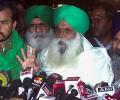
Dallewal has been on a fast-unto-death at the Khanauri border since November 26 to press the Centre to accept demands including a legal guarantee to the MSP on crops.
Four in five people across 26 countries of the world, including India, believe that access to the Internet is a fundamental right, according to a recent poll

"Right to Privacy is not a fundamental right under our Constitution. It flows from one right to another right. Constitution makers did not intend to make right to privacy a fundamental right," said the AG.
A division bench of Justices Bharati Dangre and Manjusha Deshpande termed the man's arrest illegal, as the police had not informed him in writing of the grounds for it.
A bench of Justices Abhay S Oka and Augustine George Masih therefore directed the Delhi police commissioner to immediately inform all the stakeholders concerned about the ban order and ensure no sale and manufacture of crackers.

Disclosing an individual's income-tax returns is tantamount to violating the person's fundamental right to privacy as recognised by the Constitution.

The judge further underlined that the minorities of the country had not only joined the mainstream but also were an important facet of it.

"It is not a fundamental right of a citizen to eat beef," it said.

Finance Minister Nirmala Sitharaman on Tuesday expressed anguish over not being allowed to learn Hindi in Tamil Nadu as a student and was even mocked on the streets for attempting to learn the language.

The Supreme Court of India has announced its intention to establish an effective mechanism to address caste-based discrimination in educational institutions throughout the country. The court directed the University Grants Commission (UGC) to draft regulations to prevent such discrimination and to provide data on institutions that have implemented equal opportunity cells as mandated by the 2012 UGC equity regulations. The court's decision stems from a public interest litigation filed in 2019 highlighting the prevalence of caste-based discrimination in higher education institutions and its tragic consequences, including the suicides of students like Rohith Vemula and Payal Tadvi.

The Supreme Court of India has directed all high courts, state governments, and union territories to ensure the availability of separate toilet facilities for men, women, persons with disabilities (PwDs), and transgender persons in all court premises and tribunals across the country. The court stressed the importance of public health and the right to privacy, stating that adequate public toilets protect women and transgender persons. The court also expressed concern about the condition of public toilets near toll plazas on national highways and emphasized the need for proper sanitation facilities in court premises for judges, advocates, litigants, and staff members. This decision highlights the importance of access to basic amenities in ensuring a fair and dignified justice system.
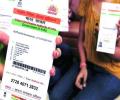
The order came on a batch of petitions challenging the constitutional validity of the Aadhaar scheme.

Under the Maharashtra Hindu Place of Worship (Entry Authorisation) Act, if any temple or person prohibits any person from entering a temple then he or she faces a six-month imprisonment.
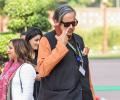
The Kerala unit of the Congress instantly gets a headache when Shashi Tharoor lets loose one of his observations showering flowers on enemy territory. With every such action triggering controversy within a nervous Congress party, some feel it is high time Tharoor showed a degree of solidarity with the ideals of his party, notes Shyam G Menon.
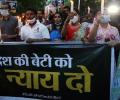
The Supreme Court on Thursday said the fight against caste-based discrimination was not a battle that can be won overnight and it requires sustained effort, dedication, and the willingness to confront and challenge societal norms that perpetuate inequality.

The Madhya Pradesh high court on Monday issued notices to actor Kangana Ranaut, the Centre, censor board and others on a public interest litigation (PIL) challenging the screening of her upcoming Hindi film Emergency on the ground it contains scenes that violate fundamental rights of Sikhs.
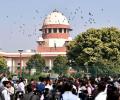
'A rigid or overly broad interpretation could lead to a chilling effect on investments and growth in sectors traditionally driven by private initiative.' 'Entrepreneurs may fear that their assets could be arbitrarily appropriated by the State under the guise of serving the 'common good' without sufficient legal safeguards.' 'The judgment thus supports a more nuanced view, one that balances individual property rights with public welfare objectives.'

Madhya Pradesh Home Minister Babulal Gaur fuelled another controversy with his remarks that drinking liquor is a "fundamental right" and that it is a status symbol too.

The Supreme Court will hear on Friday a plea challenging a Bombay high court verdict upholding a Mumbai college's decision to ban hijabs, burqas and naqabs inside the campus.
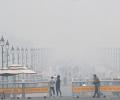
The SC questioned the Delhi government over delay in implementation of stricter anti-pollution measures under GRAP-4, and said it will not allow scaling down of the preventive measures without its prior permission.

Chief Justice of India Sanjiv Khanna on Tuesday said no oral submissions for urgent listing and hearing of cases will be permitted and urged lawyers to either send emails or written letters for it.

Former Chief Justice of India D Y Chandrachud has expressed concern about the influence of social media on the judiciary, stating that special interest groups are using it to sway court decisions and judges need to be vigilant. He highlighted the dangers of forming opinions based on short social media clips, emphasizing the nuanced nature of judicial decision-making. Chandrachud also defended the collegium system for judicial appointments and clarified that while there is no legal bar on judges entering politics after retirement, their decisions might be scrutinized differently due to their past roles.

Justice Sanjiv Khanna, who has been part of several landmark Supreme Court judgements such as scrapping the electoral bonds scheme and upholding abrogation of Article 370, will be sworn in as the 51st Chief Justice of India on Monday.

Jagjit Singh Dallewal, a 70-year-old Punjab farmer leader, is on his 21st day of a hunger strike demanding the Indian government address farmers' concerns, including a legal guarantee of MSP on crops. His health has deteriorated, and doctors have recommended immediate hospitalization. However, Dallewal, a cancer patient, has refused medical treatment.
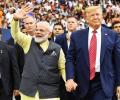
After being sworn in as the 47th president of the United States, Trump started his inaugural address with a sentence that echoed Modi's coinage some years ago, notes Modi biographer Nilanjan Mukhopadhyay.
 © 2026 Rediff.com - Investor Information - Advertise with us - Disclaimer - Privacy Policy - Sitemap - Feedback - About us - Terms of use - Grievances