
The legal regime does not permit home delivery of medicines, tough owing to situation of COVID-19 pandemic and an emergency-like situation, the government allowed the home delivery of medicines but it was meant for only neighbourhood pharmacies, AIOCD said.

In 2015, e-commerce contributed significantly to the growth in television advertising revenues.

The big breakthrough in e-commerce came in October when the big three of Flipkart, Amazon and Snapdeal went into an overdrive to win customers and offered pre-Diwali sales with eye-popping discounts.

Gits now has super food mixes like brown rice and flax seeds idli mix, oats idli mix and such other products. It has also launched an organic and vegan version of ready meals abroad. It also has an e-store, besides selling through Flipkart, Amazon and Big Basket.

Amazon India Country Head Amit Agarwal refers to all talk of mergers as 'noise'. 'All this is a distraction, when the focus should be on the customer,' he says.

The market price action seems to point in this direction. Let's hope we finally break out. It is about time! asserts Akash Prakash.

Unlike the race to buy airwaves by telecom companies, airports by infrastructure companies and city gas networks by energy companies, the race to develop super apps by consumer-facing companies in India has not brushed up against any regulatory issues. Officials at the ministry of electronics and information technology and at other regulators are happy they do not have to meddle in who among the Tata group, Reliance Industries Ltd, Flipkart or Paytm will manage to build an app that sweeps in customers. Unlike separate apps a customer uses on her mobile to order groceries, buy food or airline tickets or just make payments, a super app can perform all these functions.

The Delhi High Court on Tuesday permitted Chinese mobile phone maker Xiaomi to sell and import Qualcomm chipset based handsets till January 8, as a temporary measure.
E-commerce companies are seeing an increase in demand for products such as fresh fruits and vegetables, milk, flour, rice, and lentils, and personal hygiene items like sanitisers and soaps and household cleaning products. Other products include instant noodles, baby food and Ayurvedic items. "There is even a huge spike in pet food," said a person.

An emergency arbitration hearing between Amazon and retail conglomerate Future Group took place last week and a verdict is expected in the next few days, according to sources.

Finance Minister Nirmala Sitharaman on Tuesday unveiled a Rs 39.45 lakh crore Budget with a view to fire up the key engines of the economy to sustain a world-beating recovery from the pandemic. This was Sitharaman's fourth Budget. While the taxpayers were left in the lurch, once again, was she able to cheer Corporate India?

'It's pretty likely that Kissinger, Rice et al came bearing gifts (read Trojan Horses) from McDonnell Douglas, Boeing, Grumman, Northrop, and all the other Military Industrial Complex stalwarts,' argues Rajeev Srinivasan.

Industry sources said all the iPhone 7 handsets shipped in had been sold out.

From mass layoffs to acquisitions, here's how the Indian start-up industry kept us on our toes.

Suveen Sinha finds out what the tribe of modern, internet entrepreneurs who no longer run their first start-ups are up to.

For the traditionalists, wars on Twitter and Facebook smack of immaturity.

Kapoor charges between Rs 3 and Rs 3.5 crore for a day's work for a brand. His current roster of brands include Asian Paints, Pepsi, Panasonic, Renault, Flipkart, Macroman, Saavn, and Hero MotoCorp.

Zomato has the potential to be an equally important milestone for Indian equity markets, notes Akash Prakash.
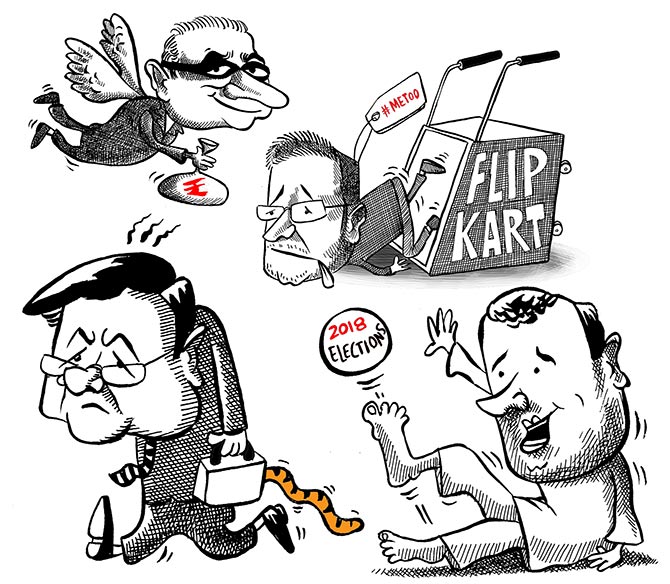
Urjit Patel, Binny Bansal, Nirav Modi and Rahul Gandhi personify the big trends that defined 2018. Well, almost...

Chinese mobile brands are deeply entrenched in the Indian market. A move to bar them may send a bold diplomatic message. But its cost for the local industry is anybody's guess. In the event that Chinese brands face curbs, two handset makers - Samsung and Apple - squarely stand to gain.

Tata Sons Chairman Emeritus Ratan Tata said e-commerce is one of the areas where is he looking to personally invest because of its "good potential" as a large proportion of the country's consuming public do not have the required access to goods.

Urvi Malvania looks at what is in store for the IPL's 2019 edition.

The new online store, which will be launched on September 23, will provide customers with the same premium experience found in Apple Store locations around the world, delivered by online team members who are ready to offer their expertise, Apple said in a statement.
Comes with the latest Android OS and has a slot for memory card.

Investing in start-ups can be highly rewarding, but direct investing is not meant for everyone. For the majority of wealthy investors, taking the private-equity route could still be the better option.

The government, in February, had released the draft national e-commerce policy proposing setting up a legal and technological framework for restrictions on cross-border data flow and also laid out conditions for businesses regarding collection or processing of sensitive data locally and storing it abroad.

Khosla said 85 per cent of Indian e-commerce firms were over-valued.

Investors spent much of 2016 cleaning house. And a VC tells Ranju Sarkar, "There's still some bad news left in the portfolios (of VC firms). What happens to Ola and Flipkart will drive sentiment in future."

In the start-up world, hitting the $1-billion mark, which accords the "Unicorn" tag, is a milestone. Enterprises typically reach the milestone only by series C or series D, or three to four funding rounds later. Zeta achieved it at the first one. On May 25, the six-year-old banking tech firm raised $250 million from Japanese conglomerate SoftBank, at a post-money valuation of $1.45 billion. "This is the first time we have raised institutional money," Zeta co-founder Bhavin Turakhia beamed on the conference call. This trajectory is uncommon in start-ups.

A good price. Slim bezels. The Aptoide app store. But is it enough, asks Aparna Banerjea.

What made these 10 businesses rise above the rest? Read on to find out...

Most Indian start-ups and e-commerce are largely funded by foreign investors
All they used was their creativity, sill and intelligence.
While Flipkart and Amazon go on a fund-raising spree, the real battle will begin once big industrial houses such as the Tatas, Reliance and the Aditya Birla group join the race.

With consumers staying indoors and e-commerce firms extending their reach to a larger number of pin codes, these giants have snatched a larger share from the offline traders this season.

The deal, which will kick in after the holiday season, in January, will give Apple more visibility among online buyers in India. The partnership could help Apple take on Chinese smartphone maker OnePlus, which has become one of the leading player in the premium smartphone market thanks to Amazon.
India's e-commerce sector is a prize, but one that may end up being spread thinly.

As India's online population crosses 450 million, e-commerce ventures are trying to grab a pie of online sales estimated to hit $48 billion by 2020.
Next month, US e-commerce giant Amazon is set to complete a year in India.
While the investment amount could not be immediately ascertained, a report pegged it at about $2 billion.
