
In its report, 'Asset Recovery Guidance and Best Practices', the global money laundering and terrorist financing watchdog, shared multiple examples from cases investigated by the ED, citing them as models of effective asset recovery practice and inter-agency coordination.

The Reserve Bank on Tuesday proposed greater flexibility to authorised persons to undertake foreign exchange transactions for hedging their exposures, balance sheet management and market-making, as well as to ease reporting obligations, after a review of the current regulations.

The FATF statement comes in the backdrop of Indian authorities highlighting Pakistan's persistent support for terrorism and its funnelling of multilateral funds for arms procurement.

Under the new rules, users must take a "live selfie" using software that verifies their presence, typically through eye-blinking or head movement. The measure helps prevent the use of static photos or deepfakes.

India will argue for Pakistan's return to the Financial Action Task Force (FATF) grey list due to its alleged failure to combat money laundering and terror financing. The move comes after recent tensions between the two countries following a terror attack in Pahalgam, India. India believes Pakistan has not adequately addressed the issue of terrorism emanating from its territory and has diverted funds from multilateral agencies towards arms purchases.

Re-entry into the list could have far-reaching consequences for Pakistan, including diminished foreign investment, increased borrowing costs, and tighter scrutiny from global financial institutions.

Under the defence partnership, India and the UAE are eyeing defence industrial collaboration and cooperation in advanced technologies, cyberspace training, special operations, interoperability of their militaries and counter terrorism.

The agency has questioned the trial court's findings and sought appellate review, arguing that the refusal to proceed has caused serious prejudice to the investigation and prosecution.

The Enforcement Directorate 'simply inverted the template' of Prevention of Money Laundering Act (PMLA) by registering a first information report (FIR) in 2021, a Delhi court on Tuesday said while refusing to take cognisance of the ED's money laundering charge against Congress leaders Sonia Gandhi and Rahul Gandhi in the National Herald case.
A Delhi court has declined to take cognisance of the Enforcement Directorate's (ED) complaint against Congress leaders Sonia Gandhi, Rahul Gandhi, and others in the National Herald case, citing the absence of a First Information Report (FIR).

Dream11, Baazi Games, Zupee and WinZO among others are invited for the discussion with the anti-money laundering watchdog.

India has decided to submit a dossier at the upcoming Financial Action Task Force (FATF) meeting, calling for Pakistan to be placed back on the grey list of the global money laundering and terrorist financing watchdog.

External Affairs Minister S Jaishankar clarified that there was no third-party intervention in the ceasefire with Pakistan during Operation Sindoor. He asserted that halting the operation was not linked to trade and refuted claims of mediation by US President Donald Trump.

It said a "sudden rise" in terrorist-financing investigations was seen in 2023 and this was attributed to events arising out of incidents in Manipur that led to such probes in more than 50 cases.

Pakistan's former foreign minister Bilawal Bhutto-Zardari on Monday said his country will go to war if India denies Islamabad its fair share of water under the Indus Waters Treaty (IWT).

'Operation Sindoor is still ongoing. The Prime Minister himself said that blood and water cannot flow together, that talks and terrorism cannot go together. So how can we have a cricket match with a country that indulges in terrorism?'

The government stated that Operation Sindoor was launched in response to a 'barbaric' attack by 'Pakistan-sponsored terrorists,' focusing on dismantling terror infrastructure and neutralizing terrorists likely to be sent across to India.

The Reserve Bank of India (RBI) has updated Know Your Customer (KYC) norms for politically exposed persons (PEPs) who transact with regulated entities (REs), seeking to comply with the recommendations of intergovernmental organisation Financial Action Task Force (FATF). PEPs are individuals entrusted with prominent public functions by a foreign country, including the heads of states/governments, senior politicians, senior government or judicial or military officers, senior executives of state-owned corporations and important political party officials, said the RBI. This change is expected to provide more clarity to undertake Customer Due Diligence (CDD), said the RBI in a communication to REs.

In an unexpected move, the government has terminated services of K V Subramanian as the executive director at the International Monetary Fund (IMF) six months ahead of his three-year tenure. The move comes days before the IMF executive board is to consider financial aid for debt-ridden Pakistan.

In a major initiative, Pakistan has announced the establishment of its first government-backed Strategic Bitcoin reserve as it invited investment in the country's crypto markets.

AIMIM chief Asaduddin Owaisi slammed Pakistani politician Bilawal Bhutto-Zardari for his "blood would flow in rivers" remark and called former cricketer Shahid Afridi a "joker" for his comment on the Pahalgam terror attack. Owaisi also supported India's decision to suspend the Indus Waters Treaty and called for Pakistan to be placed on the FATF grey list. He also advocated for cyber attacks against Pakistan.

The Indian government has announced new rules for non-governmental organizations (NGOs) receiving foreign contributions under the Foreign Contribution (Regulation) Act (FCRA). These rules include requiring NGOs to obtain a "Not a Newspaper" certificate from the Registrar of Newspapers for India if they engage in publication-related activities, as well as submitting financial statements and audit reports for the past three years. Additionally, NGOs must submit a commitment letter from the donor, a project report detailing proposed expenses, and a declaration that administrative expenses will not exceed 20% of the foreign contribution.

The world should remain clear that Pakistan must continue to take 'credible, verifiable and irreversible' action against terrorism, India said after anti-money laundering watchdog Financial Action Task Force (FATF) removed the neighbouring country from its 'grey list'.

Reserve Bank of India (RBI) Governor Sanjay Malhotra on Wednesday said regulations should not create unintended barriers to financial inclusion while emphasising that the impact of regulations on individuals and businesses should be considered.

Pakistan was put in the inglorious list in 2018 for its failure to check risk of money laundering, leading to corruption and terror financing.

India is pushing for greater disclosures by credit card companies, fintech firms, and payment aggregators (PAs) at the Financial Action Task Force (FATF), so that the sender and recipient in a cross-border financial transaction can be easily identified and the information shared with law enforcement agencies. Separately, the inter-governmental group, which sets standards to curb money laundering, will release the fourth round of its mutual evaluation report on India on September 19. FATF in June had adopted the mutual evaluation report on India and placed the country in the "regular follow-up" category - the highest rating given by the global watchdog and a distinction shared by only four other G20 countries.

Significantly, for the first time, the FATF put Myanmar in the "high risk jurisdictions subject to a call for action", often referred to as the watchdog's black list.

Pakistan will remain on the 'grey list' of the Financial Action Task Force (FATF) until it further demonstrates that action is being taken against Jamaat-ud-Dawah chief Hafiz Saeed and Jaish-e-Mohammed founder Masood Azhar who are listed as global terrorists by the United Nations, the global anti-money laundering and terror financing watchdog said on Thursday.

The nine targets struck under 'Operation Sindoor', four in Pakistan and five in Pakistan-occupied-Kashmir, were chosen by the IAF after receiving intelligence inputs about terror camps operating under the guise of health centres to evade detection at these sites, officials said on Wednesday.

'If there is a military standoff eyeball to eyeball on the western border, the Chinese could create problems by making movements in the north, in our northeast, which could involve us tying down some forces there so that could stretch our military actions.'

'Surgical strikes or air strikes, or both, are likely on the table.'

'Pakistan's only concern has been while they were on the FATF watch list was to distance their State institutions and organs from any direct connection with the actual execution of militancy inside Kashmir.'

The Paris-based global watchdog for curbing terror financing and money laundering will hold its virtual plenary session from October 21 to 23. It will review Pakistan's progress on the 27-point action plan.

The Centre on Monday defended in the Supreme Court the third extension of service granted to Enforcement Directorate chief Sanjay Kumar Mishra, asserting it was due to a peer review being conducted by the Financial Action Task Force (FATF) this year and said he will retire this November.

Pakistan said no 'new decision' was taken about it at the virtual plenary of the global terror financing watchdog.

The global agency said there are "serious deficiencies" on the part of the country in checking terror-financing and it lacks an effective system to deal with it.

The Financial Action Task Force (FATF) on Friday retained Pakistan on its 'grey list' for failing to check money laundering, leading to terror financing, and asked Islamabad to investigate and prosecute senior leaders and commanders of United Nations-designated terror groups, including Hafiz Saeed and Masood Azhar.

If Pakistan continues with the 'Grey List' or put in 'Dark Grey' list, it would be very difficult for the country to get financial aid from the IMF, the World Bank and the European Union, making its financial condition more precarious.

The FATF warned Pakistan that if it doesn't complete a full action plan by June, it could lead to consequences on its businesses
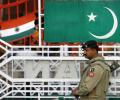
Pakistan has been scrambling in recent months to avoid being added to a list of countries deemed non-compliant with anti-money laundering and terrorist financing regulations.
 © 2026 Rediff.com - Investor Information - Advertise with us - Disclaimer - Privacy Policy - Sitemap - Feedback - About us - Terms of use - Grievances