
No limit exists on the number of electoral bonds that a person (including corporate entities) can purchase.
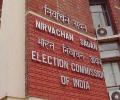
The Election Commission (EC) had, in 2019, flagged its concerns in the Supreme Court on the changes made in several laws relating to political funding to facilitate the electoral bonds scheme, saying it will have 'serious repercussions' on transparency.

Key individual parties have cornered a larger share, with some favouring regional and others national players.
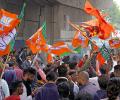
Senior advocate Prashant Bhushan, who appeared for the petitioners in the court, said at least 30 shell companies purchased electoral bonds worth over Rs 143 crore.

;The entire INDIA bloc, led by Rahul Gandhi, was against the bonds and they wanted the old system of cut money to rule over politics once again;

'The government does not want to be transparent or accountable. Therefore, they do not want to appoint information commissioners.'

The State Bank of India (SBI) on Tuesday evening submitted details of electoral bonds to the Election Commission of India in compliance with the Supreme Court order.

Justice Sanjiv Khanna 'belongs to that school of legal luminaries who give the highest primacy to facts.'

Not ordering disclosure of details of electoral bonds prior to April 12, 2019, was a "conscious choice" by the Constitution bench, the Supreme Court said on Monday while refusing to entertain the submissions of ASSOCHAM and CII against the disclosure of bond details on the ground of their plea not being listed.
The State Bank of India has not shared details of the electoral bonds encashed by political parties till Wednesday, the deadline set by the Supreme Court.

"But the BJP wants it to be done after Lok Sabha elections. The tenure of this Lok Sabha will end on 16th June and SBI wants to share the data by 30th June," Kharge said.
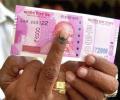
Between 2016-17 and 2021-22, the last year for which the data is available, seven national parties and 24 regional parties received a total donation of Rs 9,188.35 crore through electoral bonds.

The Congress on Wednesday questioned the Election Commission's move to get a post on electoral bonds scheme deleted from social media platform X and said that the issue raised in the post makes the government 'extremely uncomfortable'.

A bench comprising Chief Justice of India DY Chandrachud and Justice PS Narasimha said the petitions raise three separate issues and hence, the need to hear them separately.

A voter's right to know is 'far too important' in democracy than the privacy of a donor, Supreme Court judge Justice Sanjiv Khanna said on Thursday as the apex court scrapped the 2018 electoral bond scheme for funding political parties.

Government unlikely to bring in an ordinance to address the developments arising out of the Supreme Court order.

He could have blazed a trail that few Indian judges had. It was a missed opportunity of a lifetime, notes Ramesh Menon.

The State Bank of India told the Supreme Court on Thursday it has provided all details of the electoral bonds in its possession to the Election Commission.

While that created a stir so did the decision on his penultimate day at work with the Supreme Court rechristening its summer vacation "partial court working days", an issue that has led to criticism that the apex court judges enjoyed long breaks.

All political parties put together received more than Rs 12,000 crore till last fiscal since the introduction of the now-annulled electoral bond scheme in 2018, of which the ruling BJP got nearly 55 per cent or Rs 6,565 crore, according to the data available with Election Commission and Association for Democratic Reforms (ADR).

When a strong executive decides it wants something, even something that is dangerous and unconstitutional, there is little resistance from within to stop it, notes Aakar Patel.

He said a petition has been filed before the Supreme Court, seeking an independent probe by a special investigation team into the alleged nexus between political parties and companies for corruption through electoral bonds.

A five-judge constitution bench headed by Chief Justice D Y Chandrachud held that the 2018 scheme was 'violative' of the constitutional right to freedom of speech and expression and right to information.

The apex court bench, also comprising justices Sanjiv Khanna, BR Gavai, JB Pardiwala, and Manoj Misra, will assemble at 10.30 am to hear the two petitions.
The bench, headed by Chief Justice D Y Chandrachud, will also hear a separate plea which has sought initiation of contempt action against the SBI alleging it "wilfully and deliberately" disobeyed the apex court's direction to submit details of the contributions made to political parties through electoral bonds to the Election Commission by March 6.
The Supreme Court of India on Wednesday said the problem with electoral bonds scheme is that it provides for "selective anonymity" and "selective confidentiality" as the details are available with the State Bank of India (SBI) and can also be accessed by the law enforcement agencies.

A five-judge constitution bench headed by Chief Justice D Y Chandrachud said there is "no manner of doubt" that the SBI is required to disclose complete details of the bonds.

This has affected all political activity of the party, Maken said at a press conference.

Holding that the electoral bonds scheme was not fool-proof, the Supreme Court said on Thursday that information about funds received by a political party is essential for voters to exercise their freedom to vote effectively.

State Bank of India on Monday moved the Supreme Court seeking an extension of time till June 30 to disclose details of each electoral bond encashed by political parties.

'Not even a single rupee from the electoral bonds should be allowed to be used in the election.' 'If it is used in the election, it will taint India's electoral process itself.'

In its verdict last month, the top court directed the SBI to furnish the details to the Election Commission (EC) by March 6.
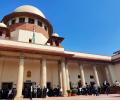
A bench of Justices B R Gavai and Vikram Nath said the matter requires to be heard.
The ECI data covers 20,421 bonds worth Rs 12,769 crore. The ADR data, however, collated information on 27,811 bonds worth Rs 16,492 crore. The gap is nearly Rs 4,000 crore and involves over 7,000 bonds.

Democracy does not begin and end with elections and the integrity of election process is pivotal for sustaining the democratic form of government, the Supreme Court said on Thursday while striking down as unconstitutional the electoral bonds scheme for political funding.
'However, to establish a quid pro quo, one can potentially see several things, like whether they got any benefits from the party that they gave money to. That is something that people (of India) will gauge. But to finally establish that there was money paid as consideration, it would require an investigation, a proper investigation, to be able to come up with such conclusions.'
The Centre told the Supreme Court on Wednesday that almost every country, including India, was grappling with the problem of use of black money in elections and the electoral bonds scheme was a "conscious attempt" to eradicate the menace of "unclean money" in the poll process.

'Democracy cannot be taken for granted. It has to be fiercely guarded.'
Electoral bonds have been pitched as an alternative to cash donations made to political parties as part of efforts to bring transparency in political funding.

Kharge also raised the issue of several companies purchasing electoral bonds soon after they faced raids by central agencies such as Enforcement Directorate and Income Tax Department.
 © 2026 Rediff.com - Investor Information - Advertise with us - Disclaimer - Privacy Policy - Sitemap - Feedback - About us - Terms of use - Grievances