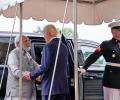
Foreign policy is always a work in progress and ups and downs are built into foreign policy process. What is permanent is national interest. Hopefully, this year, which will also witness general elections in the country, will also clear clouds in the foreign policy horizon, observes Rup Narayan Das.
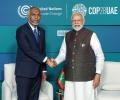
'India should respect Maldivian nationalism and their desire to be not over-dependent on India.' 'India should not behave like a big brother towards Maldives as many times, we tend to behave like that.'

Addressing the G-20 University Connect initiative, the first event of India's presidency of the grouping, Jaishankar said it would also be India's endeavour to emerge as the voice of the Global South -- comprising Asia, Africa and Latin America -- that has to face the brunt of polarisation and conflict in the developed world.

EAM Jaishankar's mission is aimed at strengthening India's strategic autonomy in a complex international environment, observes Ambassador M K Bhadrakumar.
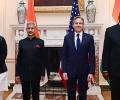
Responding to a question, Jaishankar said while the issue of human rights was not discussed during the current meeting, it has come up in the past.

'This incident offers ammunition to those inside the US government and elsewhere who question the wisdom of trusting India, so it will have a lasting consequence no matter how it is managed.'

'You know the kind of force involved in all of this. They are not good for the country where all of this will happen.'

As president, global corporate affairs, Jaishankar will report to Tata Sons Chairman N Chandrasekaran, the company said in a statement.
'China seems more intent on creating a new world order rather than shaping the existing one.' 'India is of course, at this moment in time, aligned with the West-led order because of China's full-spectrum aggressive behaviour towards India.'

Mr Modi might have questions to ask himself on the most formidable strategic challenge before India that he inherited from the United Progressive Alliance: The triangulation between China and Pakistan. The failure to break out of it, or even loosen it a bit, is something to reflect on, notes Shekhar Gupta.

External affairs minister S Jaishankar on Tuesday discussed issues relating to Afghanistan and the Indo-Pacific during his bilateral meetings with global counterparts on the sidelines of the annual high-level UN General Assembly session.
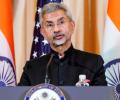
'What Jaishankar says is simplistic.' 'The past does not matter that much.' 'If we think that it does it is because we are not good enough at running the nation competently today and are searching for excuses why,' argues Aakar Patel.
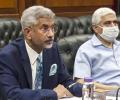
'Terrorism continues to be the overwhelming threat to security and stability in the SCO region and therefore Dr Jaishankar strongly pitched for 'collective action',' observes Dr Rajaram Panda.
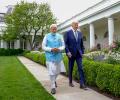
'India will want a lot of help from the US, but it's not going to want US troops.'

At a time when China is trying to make its foray into South Asia, India should use its shared history to strengthen its ties in the region, says Dr Rup Narayan Das.

'This speech is going to be more of a punishment. I spoke too much this afternoon' A tireless Prime Minister Narendra Modi left over 700 notable luminaries in peals of laughter with his quick wit and sense of humour during a dinner and reception hosted by Indian Ambassador Subrahmanyam Jaishankar at the Taj-owned, The Pierre Hotel. In the presence of the who's who of desi Americans and US lawmakers, Modi once again thanked the Indian-Americans for their contributions and discussed his plans of developing India and the ties he hopes to nurture with America. Aziz Haniffa/Rediff.com presents a sneak-peak into the festive, grand dinner.
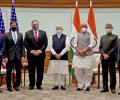
China on Tuesday urged US Secretary of State Mike Pompeo to stop sowing discord between Beijing and countries in the region, undermining regional peace and stability, amidst his visit to India for a high-level dialogue aimed at further ramping up their overall defence and security ties, and boost strategic cooperation in the Indo-Pacific.

'During Congress rule, the government used to get both the fishermen and the boats released whenever the Sri Lankan navy apprehended them.' 'Under BJP rule, only the fishermen are being released.'

'The Indian government evacuated its citizens from the clutches of the Taliban and Covid-hit Wuhan, so I am not worried.'

'While the US-Pakistan relationship has been stabilised, it's still mired in uncertainty.'

Heading G20 will give India a foreign affairs year like it has never had in history. You can trust Narendra Modi to exploit this to India's benefit. And, of course, to his own in his election year, explains Shekhar Gupta.
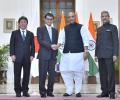
The India-Japan 2+2 dialogue added strategic heft to the special relationship in the wake of growing Chinese assertiveness on regional affairs, points out Dr Rajaram Panda.

'The MEA, hopefully, made it clear that the Indian PM can't be seen in Xi Jinping's company when China has, for all intents and purposes, annexed over 1,000 sq kms of Indian territory in eastern Ladakh, and essentially that the Wuhan spirit and the Mamallapuram spirit have turned into vinegar.'

Whether it is Sri Lanka, Maldives, or Nepal, quietly but steadily, India has been reclaiming some of the ground it had lost to China, observes Aditi Phadnis.

'If the Chinese were keen to mend fences with India, they would merely have to withdraw their troops in Eastern Ladakh.' 'They have not done so and they have not said that they will do so.'

Among the other names tipped to make it to the Cabinet are Jyotiraditya Scindia, Sarbananda Sonowal, Baijayant Panda.

India has realised that one can only deal with China from a position of strength and that is not palatable to Beijing, observes Dr Rup Narayan Das.
"The 21st century peacekeeping must be anchored in a strong ecosystem of technology and innovation that can facilitate UN peacekeeping operations in implementing their mandates in complex environments," India's external affairs minister S Jaishankar said
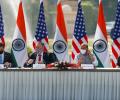
Henry Kissinger once said, 'It may be dangerous to be America's enemy, but to be America's friend is fatal.' India will have to wait and see, observes Rajeev Srinivasan.
'I am not minimising either the seriousness or the complex nature of the current situation.' 'Naturally, we have to do what it takes to secure our borders.' 'We are talking to the Chinese, both through military channels and diplomatic ones.'
'In fact, they work in tandem.' 'When it comes to finding a solution, this must be predicated on honouring all agreements and understandings.' 'And not attempting to alter the status quo unilaterally.'
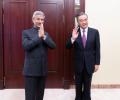
External affairs minister S Jaishankar has told his Chinese counterpart Wang Yi that the two sides should work for an early resolution of the remaining issues along the LAC in eastern Ladakh to restore peace and tranquility in the border areas as this has been an essential basis for progress in Sino-India ties.
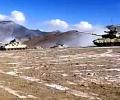
Once the tanks roll back, a zero-based assessment of future equations with China is necessary. Given the conflict situations that China is imposing on India time and again, the red, amber and green lines of interactions with China need to be laid down and communicated in no uncertain terms, asserts Srikanth Kondapalli, the leading China expert.
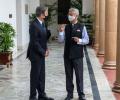
We do not know, because there has been no discussion, no transparency and most likely no real thinking on this matter at our end, observes Aakar Patel.
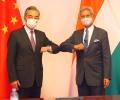
'We've never really been in the situation of having a difficult time with the Chinese and an increasingly difficult time with the Russians along with a relationship with the Americans which is important.'

'India has to prepare for future warfare where kinetic use of force at the border will be limited. War will take place in the realms beyond the border.'
Prime Minister Modi has entrusted Amit Shah with the task of coordinating all the agencies with their power to monitor movement and phone calls, says R Rajagopalan.
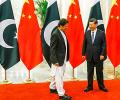
If and when India and Pakistan bilateral talks take place any issues concerning Jammu and Kashmir will not be on the table. Any future talks with Pakistan will be only about PoK, tactically or otherwise.

China remains the elephant in the room and has to be tamed, which the United States alone is unable to do and therefore calls allies to come on board.
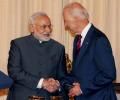
US-India defence cooperation must not adversely affect the India-Russia interface, which has its own strategic meaning and content, asserts Vice Admiral Premvir Das (retd).
A wise politician would disarm his critics, try to take them along, co-opt them, or, at least, take the criticism in his stride. Developing a thick skin ought to be an essential part of any politician's toolkit, notes Virendra Kapoor.
 © 2026 Rediff.com - Investor Information - Advertise with us - Disclaimer - Privacy Policy - Sitemap - Feedback - About us - Terms of use - Grievances